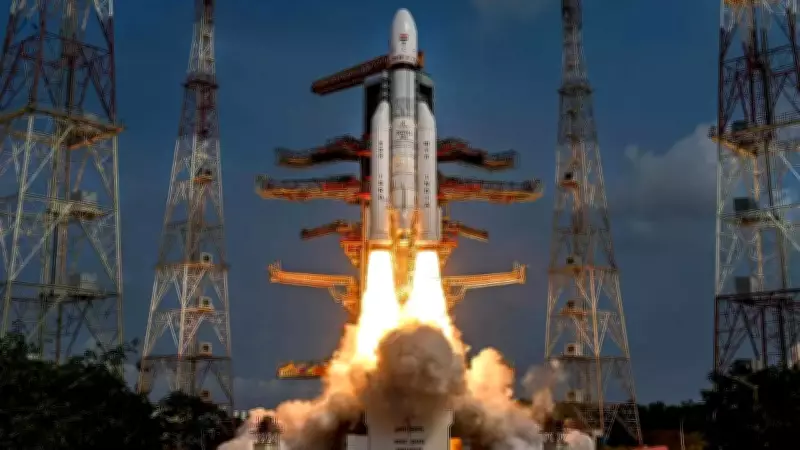
BENGALURU: In a renewed push to hand over ISRO's LVM-3 launch vehicle to private industry, the Indian National Space Promotion and Authorisation Centre (IN-SPACe) has invited expressions of interest (EoI) for the transfer of technology (ToT) of the country's heaviest operational rocket. This move comes more than two years after Space PSU NewSpace India Limited (NSIL) had sought private partners to scale up production of the launch vehicle through a public-private partnership model. That initiative, however, did not culminate in the selection of an industry partner, as NSIL withdrew the request for proposal.
Shift in Approach
The latest EoI marks a shift in approach, with IN-SPACe seeking to transfer the technology required for end-to-end realisation and commercial exploitation of LVM-3 by Indian industry. The initiative aligns with the Centre's broader space sector reforms announced in 2020, which envisaged a larger role for private players in launch services and spacecraft manufacturing.
Previous Efforts and Progress
This move follows IN-SPACe's EoI for the Polar Satellite Launch Vehicle (PSLV) late last month. That EoI came nearly four years after NSIL awarded the first private-sector contract worth Rs 860 crore to manufacture five PSLVs, not even one of which has flown so far. While the process for PSLV ToT is ongoing, IN-SPACe had, last year, completed the technology transfer for ISRO's Small Satellite Launch Vehicle (SSLV). If the industry takes up IN-SPACe's offer for PSLV and LVM-3, then three of the four operational rockets of ISRO — barring GSLV-Mk2 — will reach private hands for manufacturing.

About LVM-3
LVM-3, earlier known as GSLV-Mk3, is India's heavy-lift launcher capable of placing satellites into geostationary transfer orbit and deploying large satellite constellations into low Earth orbit. The rocket gained international commercial visibility in 2022 and 2023 when it successfully launched 72 satellites for the UK-based OneWeb constellation across two missions.
Opportunity for Industry
This opportunity is aimed at capable Indian industries or consortia who have handled multi-disciplinary turn-key projects and are keen on assimilating LVM-3's proven technology and offering commercial launch services to compete in the global heavy-lift satellite launch market. To ensure seamless technology absorption, infrastructural and hand-holding support will be provided by ISRO for a defined period of 42 months or until realisation and launch of two LVM-3 vehicles by the selected party, whichever is earlier, IN-SPACe said.
Production Targets
Earlier, NSIL had projected a need to increase annual production capability from the current two vehicles to between four and six rockets a year. The commercial arm had envisaged producing up to 60-65 LVM-3 vehicles over a 14-year period through industry participation.
Eligibility and Support
Under the new EoI, eligible Indian entities or consortiums with experience in managing large multidisciplinary projects can express interest in acquiring the technology and capability to manufacture and commercialise the launcher. As part of the technology transfer process, ISRO is expected to provide handholding and support for a defined period, enabling industry to absorb and operationalise the complex launch vehicle technologies.
Strategic Alignment
The initiative is also in line with ISRO's long-term strategy of transitioning operational activities to industry while focusing its internal resources on advanced research and next-generation technologies, including reusable launch systems, semi-cryogenic propulsion and human spaceflight missions.

About the Author: Chethan Kumar is a Senior Assistant Editor with the Times of India. Aside from specialising in Space and Science, he has reported extensively on varied topics, with special focus on defence, policy and data stories. He has covered multiple elections, too. As a young democracy grows out of adolescence, Chethan feels, there are reels of tales emerging which need to be captured. To do this, he alternates between the mundane goings-on of the Common Man and the wonder-filled worlds of scientists and scamsters, politicians and soldiers. In a career spanning nearly 18 years, he has reported from multiple datelines — Houston, Florida, Kochi, Hyderabad, Chennai, Sriharikota (AP), NH-1 (J&K Highway), New Delhi, Ahmedabad, Raichur, Bhatkal, Mysuru, Chamarajanagar, to name a few — but is based out of Bengaluru, India's science capital that also hosts the ISRO HQ.