IIT Bhilai Team Creates Revolutionary Bio-Hydrogel for Water Purification
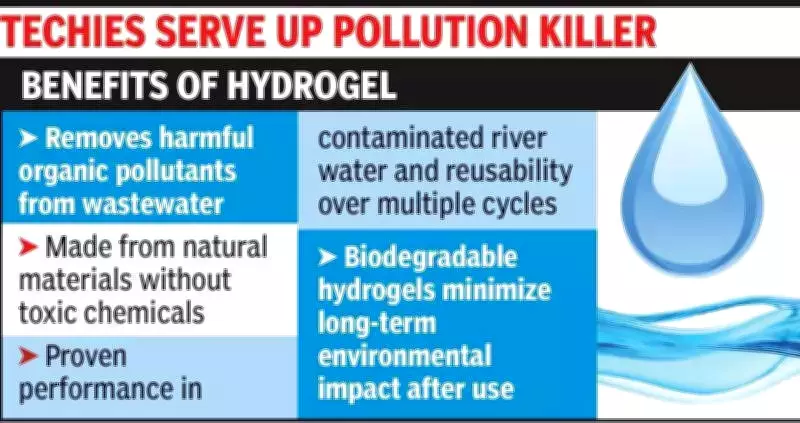
In a significant breakthrough for environmental science, researchers from the Indian Institute of Technology Bhilai in Chhattisgarh have developed an innovative bio-derived hydrogel capable of effectively removing toxic industrial dyes from contaminated water bodies. This pioneering material, crafted using amino acid-based copolymers, presents a sustainable alternative to conventional synthetic filtration systems that often contribute to persistent plastic pollution.
Sustainable Solution for National Water Missions
The environmentally friendly chemical holds immense potential to bolster key national initiatives including the Jal Jeevan Mission, Swachh Bharat Mission, and National Mission for Clean Ganga. The research team, comprising Koushik Mahata, Nishikanta Singh, Durgesh Kumar Sinha, Swarup Maity, and lead researcher Dr. Sanjib Banerjee, has engineered this hydrogel to form spontaneously at room temperature without requiring harmful chemicals or catalysts, making the purification process notably safer, simpler, and more sustainable.
Advanced Material with Sponge-Like Properties
The hydrogel features a unique sponge-like architecture that enables it to absorb toxic dyes and pollutants commonly found in industrial wastewater. Remarkably, the material has been rigorously tested not only in controlled laboratory settings but also in actual polluted water bodies, demonstrating robust cleaning capabilities. Dr. Banerjee emphasized that many existing water-cleaning materials rely on toxic chemicals that can harm ecosystems, whereas their innovation proves that natural-source materials can effectively purify contaminated water without environmental damage while remaining suitable for large-scale implementation.

Real-World Testing and Performance Metrics
The research team conducted extensive testing using water samples from the Shivnath River at Sirsa Khurd, a stretch known for receiving substantial industrial effluents and maintaining a naturally alkaline pH of 8.5. To simulate severe contamination, researchers introduced industrial dyes including Eosin B, Malachite Green, and Rhodamine B into the river water. The study revealed that hydrogel performance is pH-dependent, with the alkaline conditions of the Shivnath River enabling a remarkable 98% removal rate for Malachite Green within just five hours. The material also exhibited exceptional effectiveness against Rhodamine B due to strong electrostatic interactions between the hydrogel and dye molecules.
Eco-Friendly Production and Degradation
The manufacturing process has been deliberately designed with environmental safety as a priority. Unlike traditional methods, this hydrogel is produced at room temperature using water as a solvent, eliminating the need for toxic chemical crosslinkers, UV irradiation, or energy-intensive equipment. This approach significantly reduces manufacturing costs and minimizes the carbon footprint. The material maintains stability during cleaning operations without releasing harmful residues into treated water. Following its functional lifespan, the hydrogel undergoes controlled degradation, beginning breakdown after two days and achieving nearly 90% degradation within six days, thereby preventing secondary waste accumulation in aquatic ecosystems.
Scalability and Future Applications
The research findings have already been published in the prestigious international journal Advanced Functional Materials (Wiley-VCH), highlighting IIT Bhilai's growing contributions to advanced materials research for environmental sustainability. Dr. Banerjee confirmed positive research outcomes and indicated that the team would formally pursue patent protection if mass production decisions are made. "We are actively exploring scaling up production through collaborations with industries and Micro, Small and Medium Enterprises (MSMEs)," Banerjee stated, noting that several industrial players have already expressed interest in the technology.

Following successful pilot-scale production and on-site validation, this technology could provide decentralized water-treatment solutions for regions affected by industrial pollution. By merging eco-conscious design with powerful purification performance, this novel material offers a promising pathway for future wastewater management while advancing India's broader vision for clean water access, environmental protection, and sustainable development.