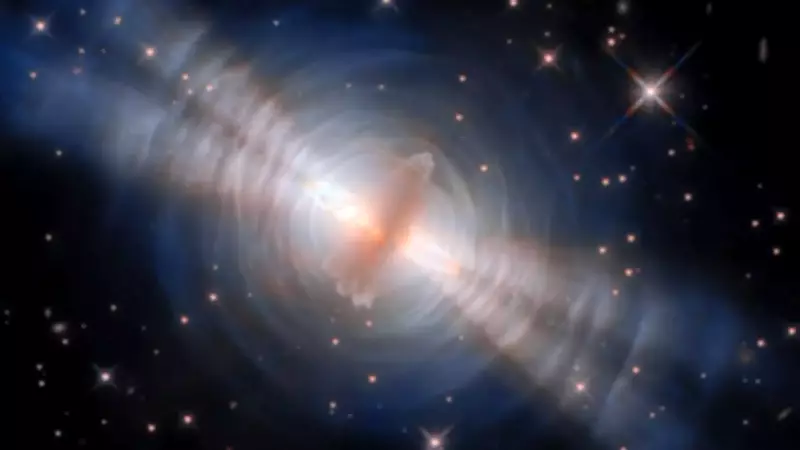
Hubble Space Telescope Reveals Dazzling Final Chapter of a Star's Life
In a breathtaking celestial display, NASA's Hubble Space Telescope has delivered what astronomers are hailing as the most detailed view to date of the Egg Nebula. Located approximately 1,000 light-years away in the constellation Cygnus, this glowing cloud of gas and dust represents the dramatic final stages of a sun-like star's existence.
A Cosmic Egg with a Brilliant Yolk at Its Core
The Egg Nebula earns its whimsical name from its distinctive appearance, which resembles a cosmic egg suspended in the vastness of space. At the very heart of this structure lies the fading star itself, often poetically described as the "yolk." Surrounding it is an expansive, hazy shell composed of gas and dust, evoking the image of egg white floating ethereally around the central core.
The physics behind this phenomenon is far from simple, yet the visual result is almost painterly in its beauty. The image showcases blue-tinted shells, twin beams of light radiating outward, and a bright central region that uncannily mimics a yolk. This provides a rare and precious opportunity for scientists to observe stellar evolution unfolding in what amounts to near real-time on cosmic scales.

Understanding the Pre-Planetary Nebula Phase
Unlike many other nebulae that emit their own glow through ionized gases, the Egg Nebula shines primarily via reflected starlight. The intense light from the dying star manages to penetrate through gaps in the thick, dusty shell that envelops it. This process creates the striking twin beams that cut through the darkness of space, appearing almost like celestial searchlights.
Experts classify this stage as a pre-planetary nebula, a brief and fragile transitional period in a star's lifecycle. It is important to clarify that planetary nebulae have no direct connection to planets themselves. The term originated from early astronomers who, peering through small telescopes, thought these objects resembled planets due to their round, fuzzy appearance.
In reality, a pre-planetary nebula forms when a star similar to our Sun begins to shed its outer layers. As the core contracts under gravitational forces, the outer gases drift outward into space. The Egg Nebula is reportedly the youngest and closest known example of this specific evolutionary stage, making it an invaluable laboratory for astronomical study.
Symmetry and Order in a Chaotic Universe
One of the most intriguing aspects revealed by the new Hubble image is the remarkable symmetry of the Egg Nebula. The arcs of material ripple outward in surprisingly neat and orderly layers, creating patterns that seem almost too perfect for a process born from stellar death. This level of organization appears unlikely to emerge from the chaotic violence of a supernova explosion, suggesting more gradual and structured mechanisms at work.
Over time, as this stellar evolution continues, the star's core will grow progressively hotter. Eventually, it will reach temperatures sufficient to ionize the surrounding gas cloud. When this ionization occurs, the nebula will begin to glow with its own intrinsic light, marking its transition into the next phase as a fully fledged planetary nebula.
This Hubble observation not only captivates with its aesthetic beauty but also serves as a critical scientific window. It allows astronomers a front-row seat to witness the intricate processes that govern the death of stars, shedding light on the cosmic cycles that shape our universe.