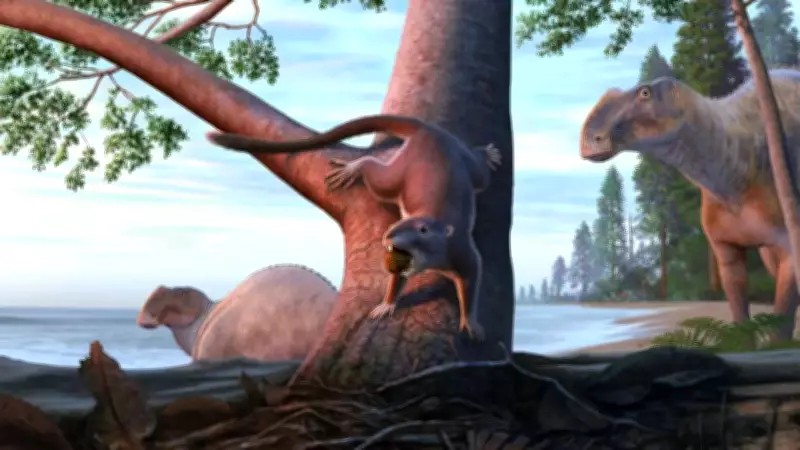
Seventy-five million years ago, during the twilight of the Cretaceous period, a small mammal called Cimolodon desosai roamed the Earth. While dinosaurs dominated the landscape, this tiny omnivore possessed biological traits that would prove crucial for surviving the catastrophic extinction event that occurred 66 million years ago, according to the University of Washington.
Fossil Discovery Offers Rare Insight
Recently unearthed fossils include relatively complete skeletal remains, featuring most of the skull and other parts of the skeleton. These findings provide an exceptional glimpse into how multituberculate mammals managed to endure when dinosaurs perished. By studying these fossils, paleontologists can observe how early mammals developed evolutionary resilience, ultimately paving the way for modern mammals.
The Tiny Mammal That Outlasted Dinosaurs
Cimolodon desosai survived due to its small size and dietary flexibility. Research published in the Journal of Vertebrate Paleontology indicates that this mammal was roughly the size of a modern hamster. This compact stature allowed it to exploit ecological niches inaccessible to larger dinosaurs. Additionally, its omnivorous diet acted as a buffer against the ecological instability that caused food chains to collapse during the mass extinction.

A Breakthrough in Skeletal Discovery
The discovery of Cimolodon desosai is significant because previous finds from the region were limited to tooth fragments. This specimen includes many more skeletal elements, such as the skull, jaws, femur, and ulna. The research team, led by the University of Washington, employed micro-CT scanning to produce high-resolution images, confirming that this species is distinct from all other Cimolodon species. The recovery of post-cranial elements also enhances understanding of the locomotion and habitat use of these ancient mammals.
The Evolutionary Legacy of Multituberculates
Multituberculates, a highly successful group of mammals that first appeared in the Jurassic Period and existed for over 100 million years, include Cimolodon desosai. According to senior author Gregory Wilson Mantilla, fossils of Cimolodon have been found across western North America, from Canada to Mexico. The species name honors Michael de Sosa VI, the field assistant who first discovered the fossil in 2009. This discovery is crucial for understanding the evolution of early mammals before and after the mass extinction.