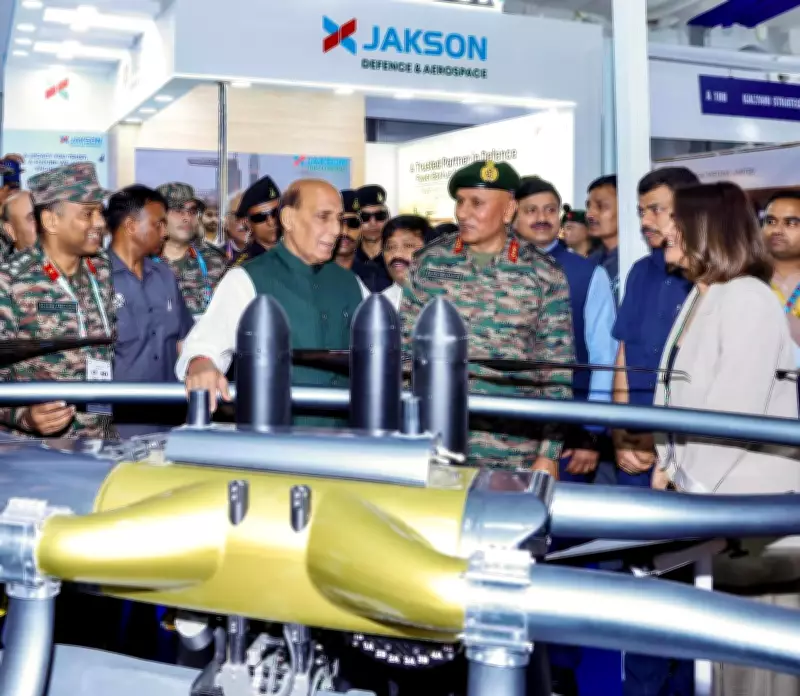
Prayagraj: Underscoring the changing nature of global conflicts, Defence Minister Rajnath Singh on Monday said it will be laboratories, not battlefields, that will determine how future wars will be fought. Speaking at the inaugural ceremony of the North Tech Symposium here, Singh referred to Israel's 'Operation Grim Beepers' pager blasts to warn that 'everything can be weaponised'.
Pager attacks as a turning point
'Could anyone have imagined that a seemingly ordinary pager would become a bomb? The pager attacks in Lebanon and Syria have forced the entire world to rethink warfare. No one can predict what could become a weapon these days... Everything can be weaponised. Now, in such a situation, when this dire form of change is before us, the preparedness of a country like India becomes even more important,' he said.
Evolution of warfare
Drawing examples from global conflicts, including the Russia-Ukraine war, Singh pointed out how warfare has rapidly evolved from conventional weapons to drones, sensors and unconventional tools. 'Human history has rarely witnessed such an explosive pace of technological change. To understand the impact of unprecedented speed and productivity, consider the example of the Russia-Ukraine conflict. Consider how drastically the nature of war changed within just 3-4 years of the conflict. In the early days, we saw it begin as a conventional conflict, in which equipment like tanks and missiles was relevant. But gradually, the nature of this war changed, and we saw how drones and sensors emerged as the centrepiece of this war,' the minister added.

Knowledge corridor proposed
Singh also proposed the creation of a 'knowledge corridor' to bring together industry, academia and the armed forces for collective advancement in emerging technologies. He stressed, 'Research and the element of surprise are essential to remain future-ready in today's technology-driven era.' He noted that the nation which adapts fastest to technological revolutions will hold a decisive edge in future warfare.
Proactive approach needed
Emphasising that India must remain proactive in building capabilities for future conflicts, Singh said, 'History shows that the side with the element of surprise holds the advantage.' The three-day symposium, jointly organised by the Northern and Central Commands of the Indian Army along with the Society of Indian Defence Manufacturers, brought together defence personnel, innovators, start-ups and industry leaders. The symposium, themed 'Raksha Triveni Sangam — Where Technology, Industry & Soldiering Converge', also features an extensive exhibition with participation from 284 companies showcasing advanced defence technologies.
Focus on emerging domains
Calling for accelerated progress, the minister urged stakeholders to focus on emerging domains such as directed energy weapons, hypersonic systems, underwater and space technologies, quantum computing, artificial intelligence and machine learning. He assured full government support to boost innovation and indigenous capability in these areas.
Operation Sindoor hailed
Ahead of Operation Sindoor's first anniversary, Singh called it a 'unique' example of the Indian military using advanced technology to deliver a decisive blow to terror groups and their 'patrons'. Addressing the symposium, he emphasised that while the armed forces 'showed patience', they were clinical in destroying terrorist infrastructure. He added that the operation served as a global reminder of the Indian military's capabilities. India launched Operation Sindoor on May 7 last year in response to the April 22 Pahalgam terror attack. The operation targeted terror infrastructure in territories controlled by Pakistan. 'The decisive response our soldiers gave to the terrorists and their patrons made the entire nation proud. It was a good thing that we showed patience and destroyed only the terrorists; otherwise, the whole world knows what our armed forces are capable of,' Singh said. He described the operation as a unique example of technology use, noting that advanced missile systems like Akash and BrahMos, along with a host of latest equipment, were used. 'This proved that our forces both understand changes and use them with confidence,' he said.

Defence production records
On the economic front, Singh highlighted that India's defence production has reached a record Rs 1.54 lakh crore in FY 2025-26, while exports touched an all-time high of Rs 38,424 crore. He noted that this growth is expected to accelerate further, driven significantly by private sector participation and global collaborations.
Symposium platform for collaboration
Lt Gen Anindya Sengupta, General Officer Commanding-in-Chief, Central Command, said the symposium offers a unique platform for the armed forces, industry, start-ups and academia to collaboratively develop indigenous technological solutions. He added that the initiative is driven by jointness, self-reliance and innovation to strengthen India's warfighting capabilities. Lt Gen Pratik Sharma, General Officer Commanding-in-Chief, Northern Command, emphasised that the objective is to transform ideas and innovation into deployable capabilities. He noted that modern warfare now demands critical technologies such as unmanned aerial systems, counter-drone solutions, AI-enabled tools and precision strike systems to ensure battlefield dominance.
DRDO transferred 2,200 technologies
Singh said the government has prioritised defence research, with DRDO transferring 2,200 technologies to industries so far. He told defence personnel, industry leaders, innovators and start-ups that sustained research focus and cultivating the element of surprise are key to staying future-ready amid the ongoing technological revolution. He said 25% of the defence R&D budget is earmarked for industry, academia and start-ups, and these entities have already used over Rs 4,500 crore so far. He emphasised the need to adopt a proactive approach and build capabilities that enable the country, should the need arise, to launch an unexpected strike against its adversary. Singh highlighted that a new transfer of technology policy has been implemented, wherein the 20% fee, levied earlier, has been completely waived off for development-cum-production partners, development partners, and production agencies. The minister stated that DRDO has initiated a policy granting Indian industries free access to its patents, a move that will bolster both their technological capabilities and global competitiveness. 'DRDO's testing facilities have also been opened up for the industries on a payment basis. Every year, hundreds of industries utilise these facilities for R&D support,' he said.