Einstein's Theory Unlocks the Enigma of Disappearing Two-Sun Worlds
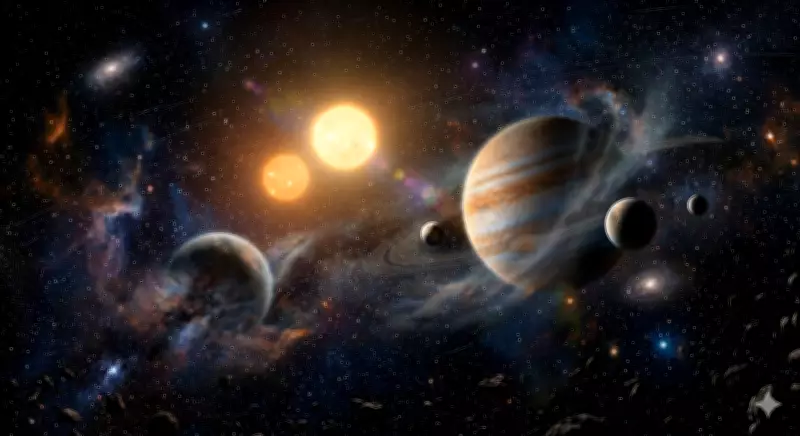
The concept of a planet orbiting two suns has long fascinated both scientists and the public, immortalized in science fiction. Known as circumbinary planets, these exotic worlds exist beyond our solar system, with discoveries like Kepler-16b confirming their reality. However, a baffling trend has emerged: many of these planets appear to vanish from astronomical observations, not through destruction or drift, but by becoming temporarily invisible to our instruments. Recent research suggests that Albert Einstein's theories of relativity hold the key to this mystery, fundamentally reshaping our understanding of these dynamic systems.
The Puzzle of Circumbinary Planets and Their Elusive Nature
Unlike typical planets that orbit a single star, circumbinary planets revolve around two stars simultaneously, creating an intensely active gravitational environment. NASA's Kepler Space Telescope has been instrumental in identifying such planets, yet scientists have noted a recurring phenomenon where these worlds disappear from view after a period. They are not literally vanishing; instead, as detailed in the study "Capture into Apsidal Resonance and the Decimation of Planets around Inspiraling Binaries," changes in their orbits render them invisible because they no longer transit across their parent stars. The research explains that "transits may cease for extended periods due to orbital precession," a process where the orbit slowly rotates over time.
Orbital Precession and Einstein's Revolutionary Insights
The core of this mystery lies in orbital precession, a gradual shift in an object's orbit. While classical mechanics can partially account for this, Einstein's theory of relativity provides a more comprehensive explanation by describing how massive bodies warp space-time. In binary star systems, gravity becomes exceptionally complex, as massive stars curve space-time, altering the motion of nearby planets. This curvature induces subtle yet significant changes in planetary trajectories, leading to oscillations in the orbital plane of circumbinary planets. Over time, these oscillations alter the inclination of a planet's orbit relative to Earth, making transits less frequent and eventually causing the planet to disappear from sight due to misalignment.

A Temporary Cosmic Disappearance, Not a Permanent Loss
It is crucial to emphasize that these planets are not permanently lost. Their orbits are inherently dynamic, and over years or decades, they will realign in a way that makes them visible again to telescopes and other observational tools. Scientists studying circumbinary systems have observed that transit visibility windows are limited but can recur periodically. This insight has practical implications for exoplanet research, suggesting that many more twin-sun planets may remain undetected due to these cyclical disappearances, highlighting the need for advanced monitoring techniques.
Rethinking Our Understanding of Planetary Systems
The ability of two-sun planets to vanish from view underscores the intricate and ever-evolving nature of the universe. What seems like a disappearance may simply be a matter of perspective—we might not be observing at the right time or angle. Thanks to advancements in Einstein's theories and modern technology, scientists are now unraveling these cosmic mysteries. As further studies progress, experts are developing methods to predict when these planets will reappear, ensuring they are not missed in future observations. This ongoing research enriches our knowledge of orbital mechanics and the diverse planetary systems that populate our galaxy.