Scientists Uncover Novel Method to Track Falling Satellites Using Earth's Seismic Signals
In a remarkable scientific breakthrough, researchers have discovered an unexpected method to monitor falling satellites by listening to vibrations within the Earth itself. A team led by scientists at Johns Hopkins University has found that when space debris re-enters the atmosphere at extreme hypersonic speeds, it generates powerful shockwaves that travel through the ground and can be detected by earthquake-monitoring instruments.
How Seismic Tracking Works for Space Debris
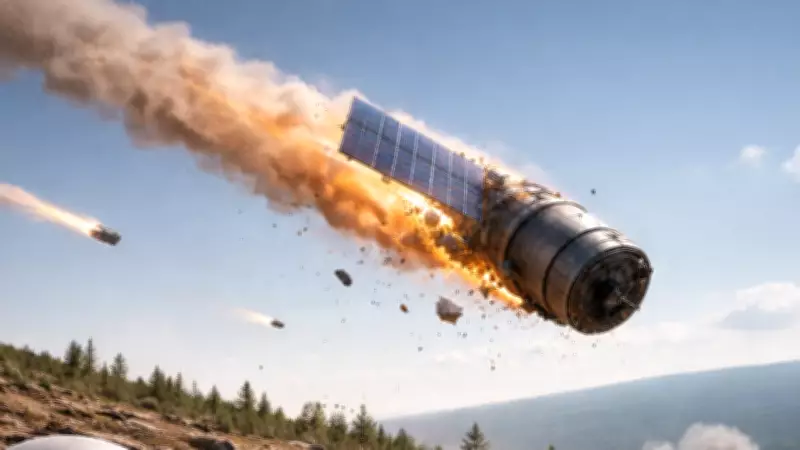
When satellites or large fragments of space junk descend through Earth's atmosphere, they travel at velocities many times faster than sound. This creates intense sonic booms similar to those produced by supersonic aircraft, but with significantly greater energy. These shockwaves interact with the ground below, producing distinct vibrations that propagate through the Earth's crust.
Seismometers, which are typically designed to record tectonic activity and earthquakes, have proven capable of detecting these space debris-induced vibrations even when no geological events are occurring. By analyzing the timing, strength, and sequence of signals recorded across multiple seismometers, researchers can reconstruct the object's flight path, speed, altitude, and potential landing zone in near real-time.

The Growing Urgency of Space Debris Tracking
Thousands of defunct satellites, spent rocket stages, and fragments of space junk currently orbit our planet. As these objects gradually lose altitude, they eventually re-enter the atmosphere, often with unpredictable trajectories. While most debris burns up during atmospheric entry, some components survive and reach the Earth's surface.
With satellite launches increasing dramatically each year, uncontrolled re-entries are now occurring far more frequently. Scientists warn that without improved tracking methods, it becomes difficult to confirm where debris breaks apart, whether hazardous materials survive the descent, or which regions might be at risk from falling space objects.
Real-World Validation: The Shenzhou-15 Test Case
The research team successfully demonstrated their seismic tracking method using debris from China's Shenzhou-15 orbital module, which re-entered Earth's atmosphere in April 2024. Data collected from more than 100 seismometers in southern California revealed the object traveling at hypersonic speeds along a path that differed significantly from forecasts made by US Space Command.
These findings confirmed that pre-re-entry predictions can be inaccurate by tens of kilometers, highlighting the importance of real-time verification methods for space debris tracking.
Safety and Environmental Implications
Accurate knowledge of where space debris actually travels and lands is critical for public safety and environmental protection. Some spacecraft components contain toxic chemicals, heavy metals, or, in rare instances, radioactive power sources. Faster and more precise tracking enables authorities to assess potential exposure risks, issue timely warnings when necessary, and recover debris quickly before it contaminates land or water resources.
Past incidents, such as the unresolved landing of radioactive debris from the Mars 96 mission, underscore the serious consequences of inadequate post-entry tracking capabilities.
Complementing Existing Tracking Systems
While radar and telescope networks remain essential for monitoring objects in orbit, these traditional methods struggle once debris begins to break apart during atmospheric re-entry. Seismic tracking does not replace these established systems but rather provides independent verification after re-entry commences.
Researchers emphasize that combining orbital data with ground-based seismic observations could dramatically improve response times, reducing uncertainty from days or months to mere minutes.
The Future of Earth's Listening Networks
As satellite activity continues to expand globally, scientists believe earthquake-monitoring networks could play an increasingly vital role in space safety. Instruments already deployed for geophysical research may quietly evolve into components of a global early-warning and verification system for falling space debris.

This innovative approach helps humanity better understand and manage the growing footprint we have created in Earth's orbit, turning our planet's natural listening capabilities into an unexpected tool for space situational awareness.