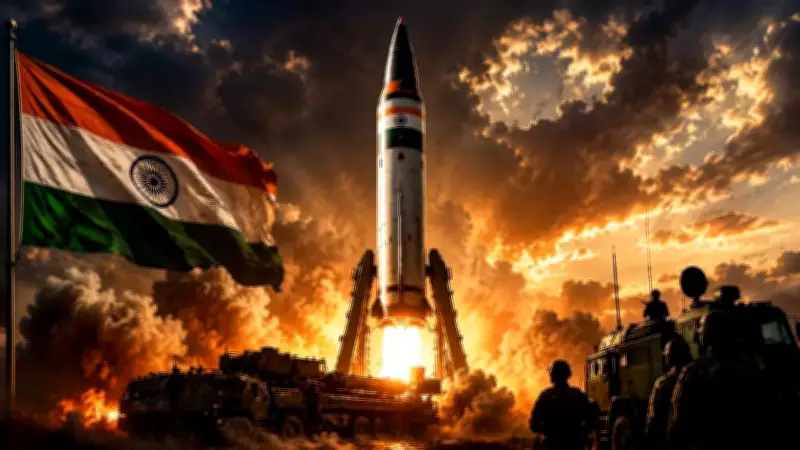
The Defence Research and Development Organisation (DRDO) has announced its readiness to proceed with the Agni-VI intercontinental ballistic missile (ICBM) programme, pending government approval. This next-generation missile, reportedly capable of traveling over 10,000 km with Multiple Independently Targetable Re-entry Vehicle (MIRV) capability, has sparked a strategic debate within India's defence ecosystem.
Why India needs an ICBM despite regional threats
India's primary security challenges have historically come from neighboring adversaries, Pakistan and China. Existing missiles like the Agni-V, with a range of around 5,000 km, can already strike key parts of China from deep within Indian territory. However, the Agni-VI is not merely about extending range but about ensuring survivability and assured retaliation after a first strike.
Strategic advantages of longer range
Longer-range missiles allow India to launch from safer interior locations, making it harder for adversaries to target launch assets. In a conflict, this enhances the credibility of India's nuclear deterrence. Moreover, the MIRV capability enables a single missile to carry multiple warheads aimed at different targets, complicating missile defence systems.

Keeping pace with evolving technology
China has been rapidly expanding its missile infrastructure, including silo-based systems, road-mobile launchers, and advanced missile defence. To maintain a credible deterrent, India must adapt. The Agni-VI would also carry strategic signalling value, placing India among a small group of nations with true ICBM capability.
Technical aspects of ICBMs
An ICBM travels over 5,000 km, following three stages: boost phase, midcourse phase (outside the atmosphere), and terminal phase (re-entry at hypersonic speeds). Hypersonic speeds, measured in Mach numbers, make interception extremely difficult. India recently tested a hypersonic anti-ship missile reaching Mach 10, reflecting a broader shift toward high-speed weapons.
What is MIRV?
MIRV allows one missile to carry multiple independently targetable warheads. Each warhead can strike a different target, overwhelming missile defences and increasing deterrence survivability. India demonstrated MIRV capability with the Mission Divyastra test, and the Agni-VI is expected to integrate this in an advanced form.
The Agni missile family evolution
- Agni-I: Pakistan-centric deterrence
- Agni-II and III: Extended reach into China
- Agni-IV: Improved mobility and survivability
- Agni-V: Canister launch and longer range
- Agni-VI: Expected to combine over 10,000 km range with advanced MIRV and mobile launch platforms
Future uncertainties and global trends
Strategic weapons are built for decades. The Agni-VI provides flexibility against future threats, such as expanded Chinese naval activity, advanced missile defences, and space-based surveillance. Recent Iran-US tensions highlight the importance of missile capability, saturation attacks, and strategic depth. India's no-first-use doctrine and focus on China and Pakistan make a survivable ICBM essential for credible minimum deterrence.
Political signalling
India's deliberate ambiguity around strategic programmes may be shifting. Visible messaging about ICBM and MIRV capabilities signals to adversaries that its strategic arsenal is evolving rapidly. The Agni-VI is not just about range but about ensuring deterrence credibility in a world of missile defences and hypersonic weapons.
About the Author: Rajeev Singh is a Digital Content Producer with The Times of India, covering politics, policies, defence, and conflicts.