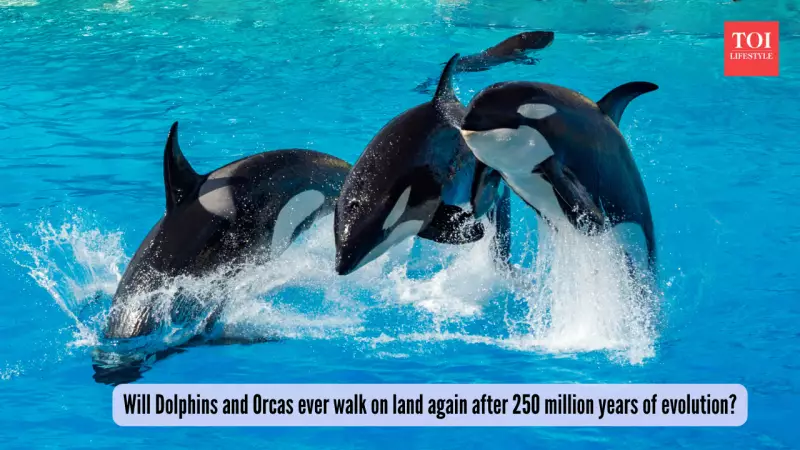
Dolphins and Orcas Are Forever Bound to the Ocean, Study Reveals
Dolphins and orcas move through ocean waters with breathtaking grace. Their sleek bodies slice through the waves as if designed for nothing else. Millions of years ago, their ancestors were land mammals that ventured into the sea. Over immense stretches of time, these creatures transformed completely. Paws became flippers. Lungs adapted for deep dives. Forests were exchanged for endless blue horizons.
Today, these cetaceans symbolize the majesty of marine life. They leap beside ships and fill the depths with their complex songs. Yet their playful exterior hides a deep evolutionary story. A new scientific study delivers a definitive verdict. After 250 million years of evolution, dolphins and orcas can never walk on land again.
The Evolutionary Point of No Return
Researchers from the University of Fribourg led this groundbreaking study. Bruna Farina headed the team that analyzed over 5,600 mammal species. They placed each on a spectrum from land to sea adaptation. The findings, published in Proceedings of the Royal Society B, are clear. Once a mammal becomes fully aquatic, it hits a biological threshold.

This aligns with a principle known as Dollo's Law. It states that complex traits, once lost, do not easily re-evolve. For dolphins and orcas, this means the door to terrestrial life is permanently locked. Evolution has taken them on a one-way journey into the ocean.
Anatomy Designed for an Aquatic World
The bodies of dolphins and orcas are masterpieces of marine engineering. Their evolution has specialized them utterly for life in water.
- Streamlined Form: They lost their hind limbs entirely. Their bodies became torpedo-shaped for speed and efficiency.
- Powerful Propulsion: Flippers act like underwater wings for steering. Powerful tail flukes generate tremendous thrust.
- Deep-Dive Adaptations: Their lungs and circulatory systems allow for prolonged dives. Blowholes enable quick, efficient breathing at the surface.
- Buoyancy and Birth: Their skeletons are lighter for buoyancy. They give birth and nurse their young entirely in the water.
These are not minor adjustments. They are fundamental, irreversible rewrites of mammalian biology. Their respiratory, skeletal, and reproductive systems are now dedicated to an aquatic existence.
The High Cost of Perfection
This specialization comes with a significant trade-off. Dolphins and orcas are apex predators. They rule their domains as supreme hunters. Yet their perfection for ocean life has made them vulnerable. They possess no backup plan.
Bruna Farina describes them as "trapped in watery paths." They thrive only where conditions are ideal and prey is abundant. Climate change is now testing that balance. Oceans are warming, acidifying, and losing prey species. Pollution creates additional hazards.
For a generalist species, a changing environment might prompt a shift in habitat or diet. For these specialized cetaceans, even small ecosystem disruptions can cause major trouble. Their evolutionary power was achieved at the cost of flexibility.
An Urgent Call for Ocean Conservation
The study carries a crucial message for conservation. Because these animals cannot adapt back to land, they have no buffer against environmental change. Protecting them requires protecting their entire world.
Scientists urge stronger, more focused conservation efforts. Key actions include:
- Safeguarding critical marine habitats from development and pollution.
- Aggressively curbing plastic and chemical pollution in the oceans.
- Monitoring populations closely to track the impacts of climate change.
- Managing fisheries to ensure their prey base remains healthy.
The fate of dolphins and orcas is now inextricably linked to the health of our seas. Their evolutionary journey, which began when their ancestors first entered the water, has reached its final destination. The ocean is not just their home. It is their unbreakable, and only, destiny.