In the limestone mountains near Santillana del Mar, at high elevations, the landscape opens into a diagonal strip of grassland interspersed with broken rock formations. On an ordinary day in 1868, a local hunter named Modesto Cubillas traversed this terrain, likely more focused on his hunt than on any historical significance lurking beneath the ground. While moving through the bushes, he noticed a small opening in the ground—an unimpressive crevice concealed by the side of a slope. Curious, Cubillas began exploring the dark void and discovered that it led to an underground maze of chambers.
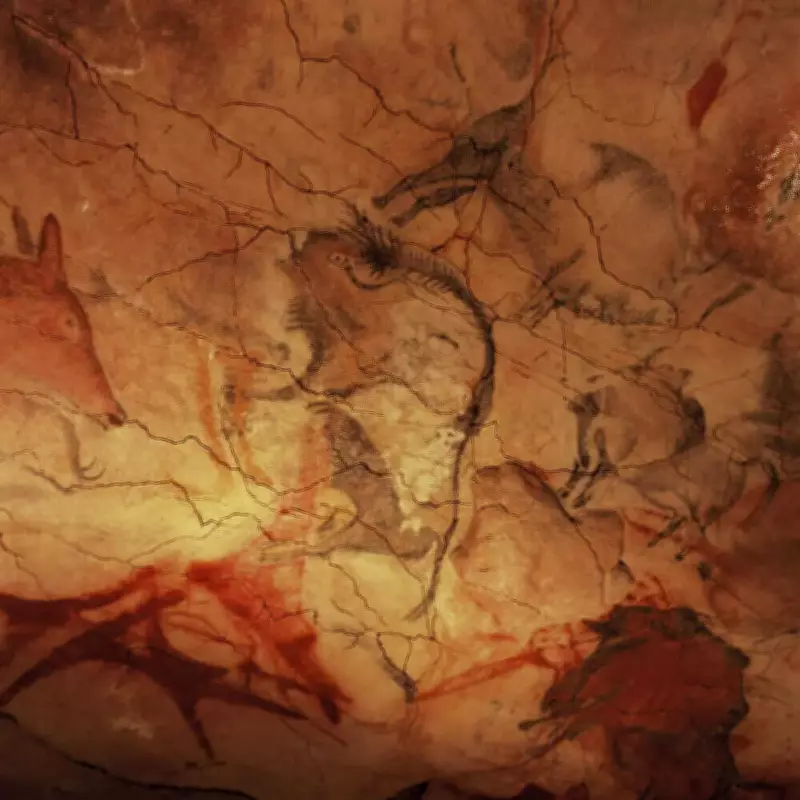
For nearly a decade, the cave remained a local curiosity, known to few as a mysterious hole in the ground. Then, in 1879, the truth behind the cave revealed itself. Marcelino Sanz de Sautuola, an amateur archaeologist, brought his daughter María to investigate the cave. While Sanz de Sautuola searched the cave floor for flints, María lifted her eyes toward the ceiling and noticed a herd of bison galloping across it.
Ceiling Paintings from Prehistoric Times
The images María discovered were not merely primitive drawings; they were highly developed artistic masterpieces featuring shading, proper perspective, and accurate depictions of animal anatomy. UNESCO, which designated the Altamira Cave as a World Heritage site, describes the paintings as the culmination of Upper Palaeolithic artistic creativity. The artist skillfully used the natural contour of the cave ceiling to give life-like dimensionality to the bison images.

Interestingly, for a long time after the discovery, many academics doubted the genuineness of the paintings. They believed it was impossible for hunter-gatherers of 14,000 to 20,000 years ago to possess sufficient artistic skills to create such incredible artwork. However, according to research by the Bradshaw Foundation, evidence of authenticity eventually became unequivocal.
Preservation by Geological Luck
The preservation of the paintings was due to a kind of geological fortune. The cave’s entrance had been sealed long ago by falling rocks, creating an enclosed space with constant humidity and temperature. This natural sealing prevented the painting materials—made of charcoal and ochre—from being washed away. When Cubillas opened the cave in 1868, he effectively unsealed a time capsule that had preserved Ice Age art.
Hunter’s Unexpected Inheritance
A chance day of hunting led to unexpected discoveries, opening humanity’s eyes to itself across the ages. The Cave of Altamira revealed that art was not a product of civilization but something essential to human nature. The bison hunters did not live solely for daily survival; they used painting to communicate and even conduct rituals.
Today, the actual cave is meticulously preserved to protect it from damage caused by visitors’ warm breath. However, a modern reconstruction called the Neocave allows people to experience the awe that María felt in 1879. This site remains an important symbol of humanity, where ancient history is brought to life.
Altamira is a story demonstrating that extraordinary discoveries can spring from mundane actions like taking a closer look. It took an eagle-eyed hunter to discover the cave and an inquisitive child to see the art. Together, they brought to light art that had been buried for twenty thousand years. It is a powerful reminder: history can be right under our noses, hiding in plain view beneath layers of brush and time.