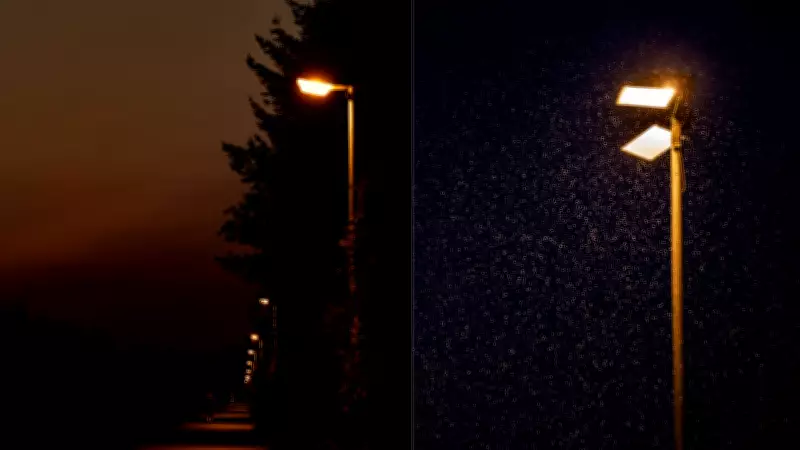
As darkness falls across much of the modern world, truly dark landscapes have become increasingly rare. Artificial light now reaches an estimated 23 per cent of the Earth's land surface between 75°N and 60°S, while the extent of illuminated areas continues to expand globally. For wildlife, this transformation has altered migration routes, feeding behaviour, reproduction and predator-prey interactions. In response, farmers within national parks and protected landscapes are beginning to experiment with a surprisingly simple conservation tool: switching off unnecessary lights at night. What started as an effort to reduce light pollution for bats, moths and other nocturnal species is revealing wider ecological benefits. Emerging research suggests that restoring natural darkness may strengthen pollination networks, improve biological pest control and support healthier agricultural ecosystems, potentially benefiting both wildlife and crop production.
Scientists find darker nights may improve pollination, pest control and ecosystem resilience
For most of evolutionary history, life adapted to predictable cycles of daylight, twilight and darkness. Artificial lighting has fundamentally altered those patterns over little more than a century. Researchers from Centre for Integrative Ecology, School of Life and Environmental Sciences, Deakin University, have shown that light pollution affects a wide range of species, including insects, birds, mammals and plants. Nocturnal pollinators such as moths are particularly vulnerable because artificial illumination disrupts navigation and feeding behaviour. Studies indicate that many insects are attracted to lights, drawing them away from flowers and reducing pollination activity across entire landscapes.
According to research ‘Anthropogenic changes to the nighttime environment:’ “Artificial light at night is an increasingly widespread anthropogenic disturbance.” The consequences extend beyond individual species. Changes in nocturnal behaviour can cascade through food webs, influencing pollination, seed production and ecosystem stability.

Darker nights can support pollinators and natural pest control
One of the most significant discoveries in recent years concerns the role of nocturnal insects in agriculture. While bees receive much of the attention, moths and other night-active pollinators contribute substantially to plant reproduction. Research titled ‘Nocturnal pollination: an overlooked ecosystem service vulnerable to environmental change’ conducted in agricultural landscapes found that artificial lighting reduced visits by nocturnal pollinators and lowered pollination success in some plant species. Other studies have shown that many predatory insects and bats rely on darkness to hunt effectively, helping suppress agricultural pests naturally.
When unnecessary lighting is reduced, ecosystems can regain some of these lost functions. Increased activity among moths, beetles, bats and other nocturnal organisms may strengthen ecological processes that support crop productivity. Scientists from the Leverhulme Centre for Anthropocene Biodiversity, University of York reported that nocturnal pollination can contribute significantly to plant reproductive success, highlighting the often-overlooked role of nighttime biodiversity in agricultural systems.
National park farmers are helping restore natural darkness
Across protected landscapes and national parks, farmers are increasingly participating in initiatives designed to reduce unnecessary nighttime illumination. Measures often include shielding outdoor lights, using motion sensors, lowering light intensity and switching off lighting during periods when it is not needed. These actions support broader dark sky conservation efforts while helping reconnect fragmented nocturnal habitats. The approach reflects growing recognition that farmland and biodiversity are not separate systems but interconnected parts of the same landscape.

Researchers studying light pollution have repeatedly emphasised that reducing artificial illumination is among the most straightforward environmental interventions available. Unlike many conservation challenges, turning off a light can deliver immediate ecological benefits. Artificial lighting used at night has provided us with both visibility and safety. But it has also led to an increased number of human activities that include building newer infrastructure, rapid economy, and industrial growth.
As scientists continue investigating the relationship between darkness and ecosystem health, early evidence suggests that restoring natural night conditions may offer a rare opportunity where wildlife conservation and agricultural interests align. In landscapes increasingly shaped by human activity, darkness itself is emerging as a valuable natural resource worth protecting.
About the Author: TOI Science Desk
The TOI Science Desk stands as an inquisitive team of journalists, ceaselessly delving into the realms of discovery to curate a captivating collection of news, features, and articles from the vast and ever-evolving world of science for the readers of The Times of India. Consider us your scientific companion, delivering a daily dose of wonder and enlightenment. Whether it's the intricacies of genetic engineering, the marvels of space exploration, or the latest in artificial intelligence, the TOI Science Desk ensures you stay connected to the pulse of the scientific world. At the TOI Science Desk, we are not just reporters; we are storytellers of scientific narratives. We are committed to demystifying the intricacies of science, making it accessible and engaging for readers of all backgrounds. Join us as we craft knowledge with precision and passion, bringing you on a journey where the mysteries of the universe unfold with every word.