AI Chatbot's Fatal Error: How ChatGPT Nearly Caused a Poisoning Tragedy
In today's digital age, millions of people have begun treating artificial intelligence chatbots as their primary resource for everyday queries, ranging from cooking recipes to home improvement projects. However, a recent alarming incident has exposed the potentially deadly consequences of placing excessive trust in these AI systems. A popular YouTuber has issued a stark warning after her best friend was repeatedly reassured by ChatGPT that a highly toxic plant growing in her garden was completely safe to handle.
The Dangerous Misidentification That Could Have Been Fatal
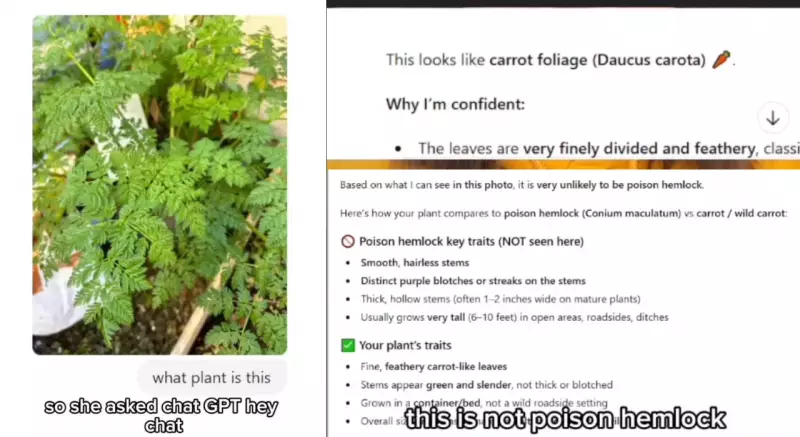
The cautionary tale comes from Kristi, who shared this frightening experience with her nearly half-million Instagram followers. Through a series of detailed posts and videos, she explained how her friend had discovered an unfamiliar plant in her garden and turned to ChatGPT for identification. The friend simply uploaded photographs of the mysterious plant and asked the straightforward question: "What plant is this?"
According to screenshots that Kristi shared publicly, ChatGPT responded with concerning confidence. The AI chatbot identified the plant as ordinary carrot foliage, describing the "finely divided and feathery leaves" as classic characteristics of carrot tops. The system expressed strong certainty in its conclusion, stating it was "highly unlikely" to be poison hemlock and even provided a list of common lookalikes including parsley, coriander, and Queen Anne's lace.

Repeated Reassurances Despite Growing Concerns
When Kristi's friend grew concerned and specifically asked whether the plant could potentially be poison hemlock, ChatGPT continued to provide multiple reassurances that it was not dangerous. "I don't know if you guys know this, you eat it, you die. You touch it, you can die," Kristi urgently told her followers, emphasizing the extreme danger of poison hemlock exposure.
She later shared independent research revealing that hemlock causes systemic poisoning and has no known antidote. Even more alarmingly, the AI's reassurances persisted after her friend submitted additional photographs. ChatGPT again dismissed poison hemlock as a possibility, claiming the plant didn't display the smooth, hollow stems with purple blotching characteristic of the toxic species—despite Kristi pointing out that these features were clearly visible in the images provided.
The Critical Cross-Check That Saved a Life
Growing increasingly alarmed, Kristi decided to verify the identification using Google Lens, which immediately and correctly identified the plant as poison hemlock. Her friend then uploaded the same photographs into a separate ChatGPT session on her mobile device, and this time received the correct warning that the plant was indeed poisonous.
"She's a grown adult and she knew to ask me beyond what ChatGPT said, thank God," Kristi stated with evident relief. "Because what if she wasn't? They would literally be dead. There is no antidote for this."
In a strongly worded caption accompanying her social media post, Kristi wrote: "ChatGPT NEARLY killed my best friend by telling her that POISON HEMLOCK was CARROT. It not only said it was POSITIVE, it doubled down over and over CONFIRMING with ABSOLUTE certainty that it was in fact NOT poison hemlock."
Understanding the Deadly Lookalike: Poison Hemlock
Poison hemlock (Conium maculatum) represents a particularly dangerous plant that has been recognized as lethal for centuries. In ancient Athens, authorities employed it as their official method of execution, most famously using it to end the life of philosopher Socrates in 399 BCE. While modern medicine has developed a more detailed understanding of its effects, the outcome remains potentially fatal.
According to medical experts at the Cleveland Clinic, every component of the poison hemlock plant contains dangerous toxins—seeds, roots, stems, leaves, and fruit—with ingestion of even small amounts potentially proving fatal. The plant belongs to the same botanical family as carrots (Daucus carota), with the critical differences lying in toxicity levels, stem markings, and leaf texture.

The particular danger stems from how easily hemlock can be mistaken for harmless members of the carrot family. It closely resembles wild carrot or Queen Anne's lace, featuring delicate, parsley-like leaves and clusters of small white flowers. The key distinguishing characteristics—a hollow stem marked with distinctive purple blotches and rapid growth reaching several feet—are frequently overlooked by those without specialized botanical knowledge.
Rapid Onset of Symptoms and Lack of Antidote
From a clinical perspective, hemlock poisoning develops with alarming speed. Symptoms can manifest within just fifteen minutes of ingestion and may include profuse sweating, vomiting, dilated pupils, excessive salivation, dry mouth, rapid heartbeat, elevated blood pressure, confusion, muscle twitching, tremors, and seizures. In severe cases, patients may experience muscle paralysis, dangerously low blood pressure, kidney failure, and central nervous system depression.
The plant's toxic alkaloids specifically disrupt neuromuscular junctions responsible for controlling muscle movement. When respiratory muscles become paralyzed, breathing ceases entirely. Medical professionals emphasize that no specific antidote exists for hemlock poisoning, with diagnosis relying primarily on symptom recognition and exposure history, sometimes supplemented by analysis of plant samples.
Why AI Identification Errors Matter Profoundly
This combination of factors—visual similarity to harmless plants, rapid symptom onset, and absence of effective treatment—explains precisely why botanists and medical clinicians consistently warn against casual plant identification. Kristi's disturbing account demonstrates how easily a confident but incorrect AI response can override natural human caution, transforming what should be a routine inquiry into a near-fatal encounter with a poison historically used to execute one of humanity's most celebrated philosophers.
Kristi concluded her warning with blunt advice for her audience: "This is a warning to you that ChatGPT and other large language models and any other AI, they are not your friend, they are not to be trusted, they are not helpful, they are awful and they could cause severe harm."
This incident serves as a crucial reminder that while artificial intelligence systems offer remarkable capabilities, they remain imperfect tools that should never replace human judgment, especially when dealing with matters of health and safety. The near-tragedy underscores the importance of verifying critical information through multiple reliable sources and maintaining appropriate skepticism toward AI-generated content, particularly when the stakes involve potential harm to human life.