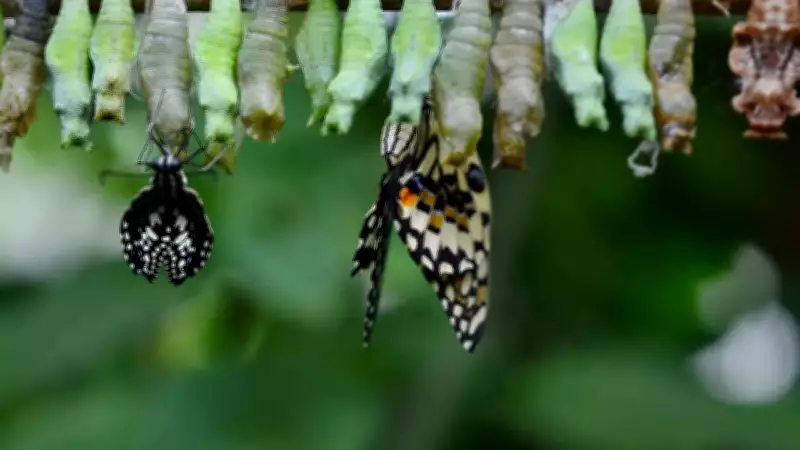
Caterpillar Memories Survive Metamorphosis: Butterflies Recall Lessons Learned
It might sound like something from science fiction, but recent research reveals a biological marvel that challenges our understanding of insect transformation. When a caterpillar undergoes metamorphosis, dissolving into what scientists often describe as "biological soup" within its chrysalis before emerging as a winged butterfly or moth, conventional wisdom suggested complete memory erasure. However, groundbreaking studies now indicate these delicate creatures might retain crucial lessons from their earlier lives.
How Scientists Tested Memory Retention in Caterpillars
Researchers moved beyond theoretical speculation to conduct controlled experiments that yielded surprising results. In a significant study published in the scientific journal PLOS titled "Retention of Memory through Metamorphosis: Can a Moth Remember What It Learned As a Caterpillar?", scientists exposed caterpillars to ethyl acetate, a chemical with a strong odor similar to nail polish remover. Each exposure was paired with a mild electric shock, creating an association between the scent and discomfort.
The caterpillars quickly learned to avoid the unpleasant smell, demonstrating basic associative learning. The true revelation came during their adult phase. After completing metamorphosis, the resulting moths continued to avoid the same chemical scent, proving that the memory persisted through their dramatic physical transformation. This finding suggests neural pathways survive the caterpillar-to-butterfly transition.

Challenging Long-Standing Scientific Assumptions
For decades, entomologists and biologists operated under the assumption that metamorphosis represented a complete biological reset. The prevailing theory described the caterpillar's body, including its brain structures, breaking down entirely before being reconstructed from basic cellular materials. This "caterpillar soup" concept implied no cognitive continuity between life stages.
The new research fundamentally challenges this perspective by identifying specific neurons that remain intact throughout metamorphosis. These preserved neural connections appear to serve as information highways, carrying learned experiences from the crawling caterpillar to the flying adult. The discovery parallels finding original wiring preserved within a completely renovated house—external transformation doesn't necessarily mean internal erasure.
Practical Implications for Butterfly Behavior
This memory retention phenomenon extends beyond laboratory experiments and may explain observable behaviors in natural settings. Female butterflies demonstrate remarkable selectivity when choosing plants for egg-laying, often preferring the same species they consumed as caterpillars. This preference could stem from remembered safety and nutritional value rather than purely instinctual programming.
The research also offers intriguing insights for broader neuroscience. If insect brains can preserve memories through complete bodily reorganization, this demonstrates remarkable neural flexibility that could inform studies on human brain recovery and adaptation. The findings suggest memory systems possess greater resilience than previously recognized across species.
Understanding Insect Brain Reorganization
Insect brains undergo intelligent reorganization rather than simple expansion or contraction during metamorphosis. Despite containing only a fraction of human neurons, these compact neural networks can store experiences for extended periods, influencing behavior across fundamentally different life stages. The transition from leaf-chewing caterpillar to nectar-seeking butterfly represents one of nature's most dramatic lifestyle changes, yet memories bridge this gap.
This cognitive continuity in creatures with brains smaller than rice grains suggests sophisticated biological mechanisms at work. The next time you observe a caterpillar navigating a leaf, consider that it might be acquiring knowledge that will guide its future as a butterfly—a testament to nature's intricate design and the surprising capabilities of even the smallest neural architectures.