We have a perception that being brainy, using cognitive skills, and problem-solving abilities are limited to human beings. However, one of the most amazing experiments, Wolfgang Köhler's famous chimpanzee experiments from more than 100 years ago, changed how we understand animal intelligence, showing that apes could stack boxes to reach bananas hanging out of reach. This helped understand the real cause and effect, not based merely on random guesses. Since then, scientists have found this rare thinking ability in only a few species, such as great apes, elephants, and some birds.
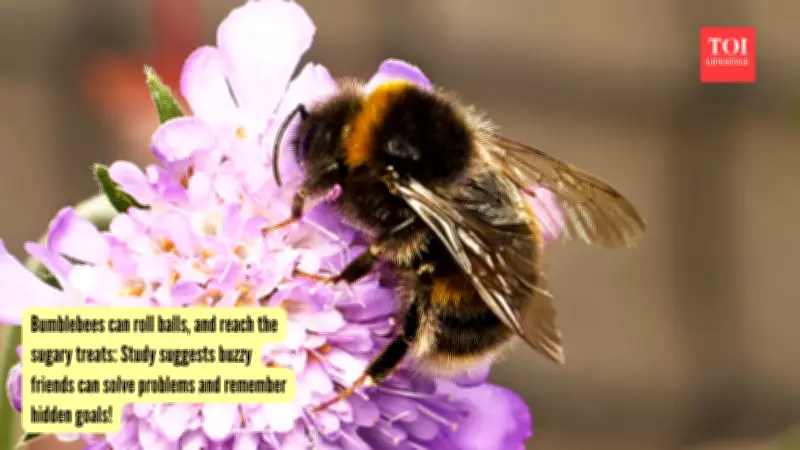
But a study published in the journal Science has changed that assumption, revealing that even bumblebees possess problem-solving abilities spontaneously without training. In the experiment, bumblebees rolled a plastic foam ball underneath an artificial blue flower, climbed over the ball, and used it to reach the flower, obtaining a sugary reward.
Spontaneous Problem-Solving in Bumblebees
"We showed for the first time that bumblebees can solve a completely novel object-manipulation task, spontaneously and without being trained to do so, or without any trial and error," said lead author Akshaye Bhambore, a doctoral researcher at the University of Oulu in Finland. Previous studies showed bumblebees can use socially learned behaviors and logical reasoning to solve puzzles, but in this new experiment, researchers introduced the insects to different task elements without training them on the solution. This indicates they did not copy others or depend on previous knowledge.

Bees Remember the Goal
In another setting, understanding the objective was required. "They knew that if they could not reach the flower on the ceiling, there was a ball they could move to make themselves bigger, so they needed to kind of understand the physics of the task, and they needed to have a goal in mind," explained coauthor Olli Loukola, a behavioral ecologist at the University of Oulu. The researchers repeated the experiment with stricter conditions where the flower was not visible from the ball's starting position, and bees still solved it. Loukola said bumblebees showed "true goal-directed behavior" by using the ball as a ladder. However, he added, this does not mean bumblebees possess humanlike reasoning or consciousness.
Bees' Performance Exceeds Chimps in Some Experiments
The bees' performance is even more impressive than Köhler's chimps, since in some experiments they could not see the target when they started moving the ball, according to Lars Chittka, professor at Queen Mary University of London. "In a sense, it's like you and me entering a room, finding something on the ceiling that needs dealing with, perhaps changing the lightbulb of a lamp, seeing that we need a chair or ladder to get high enough, then going to a different room to fetch the chair or ladder, and coming back with the equipment to the correct destination," Chittka wrote. "All this really requires some understanding of the task at hand, keeping in mind where the target is, and taking appropriate action."
The study challenges long-held assumptions about the cognitive abilities of insects and opens new avenues for understanding animal intelligence.