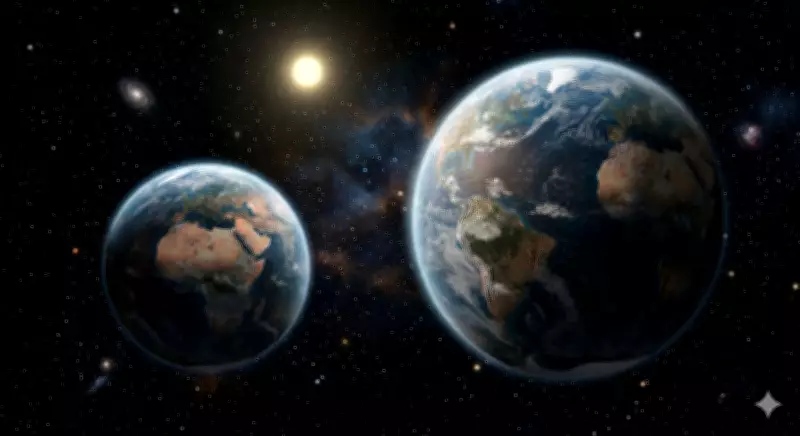
Scientists Discover Bizarre Alien Solar System with Two Earth-Like Planets
In a stunning revelation that has left the scientific community astounded, astronomers have uncovered an alien solar system approximately 120 light-years from Earth that completely defies conventional understanding of planetary systems. This extraordinary discovery features two Earth-like planets arranged in a configuration that turns established formation models on their head.
Two Earth-Like Worlds in One System
The discovery of two Earth-like planets, commonly referred to as super-Earths, within a single solar system represents an exceptionally rare occurrence in astronomical observations. These rocky worlds, slightly larger than our own planet and potentially composed of similar materials, typically appear as solitary entities in their respective systems.
What makes this finding particularly intriguing is the unprecedented opportunity it presents for comparative planetary science. Astronomers have long theorized that examining two similar planets evolving within identical stellar environments could reveal fundamental insights into planetary development processes. This scenario has been compared to studying identical twins raised in the same household who develop distinct personalities and characteristics.

A Planetary Configuration That Breaks All Rules
The true mystery of this alien solar system lies in its unconventional arrangement. According to current scientific understanding, planets form from rotating discs of gas and dust surrounding developing stars. This process typically results in rocky planets forming closer to their parent stars while gas giants emerge in more distant orbits.
However, this newly discovered system presents a complete reversal of this pattern. Observations reveal rocky planets orbiting beyond gas giant planets, a configuration that directly contradicts established planetary formation paradigms. This peculiar arrangement has prompted researchers to classify the formation process as an "inside-out" or unconventional planetary development mechanism.
Revolutionary Implications for Space Science
This groundbreaking discovery was made possible through data collected by advanced space telescopes and exoplanet-hunting spacecraft. NASA's Transiting Exoplanet Survey Satellite (TESS) and the European Space Agency's Characterising ExOPlanets Satellite (CHEOPS) played crucial roles in detecting these distant worlds by monitoring minute variations in starlight as planets transited their host stars.
The research surrounding these Earth-like planets emphasizes that exceptional planetary systems like this one are not mere astronomical curiosities. Instead, they serve as vital laboratories for refining scientific models and testing hypotheses related to:
- Planetary migration patterns
- Gravitational interactions within solar systems
- Environmental influences from parent stars
- Formation timelines and processes
These unconventional systems might ultimately explain why our own Solar System exhibits its particular configuration and whether it represents a common or unique arrangement in the cosmic landscape.
Expanding Our Understanding of the Cosmos
This solar system containing two potentially habitable planets represents more than just another distant world beyond our Solar System. It stands as a powerful testament to how much remains unknown about the universe and planetary formation processes. Each discovery of this magnitude pushes the boundaries of human knowledge and challenges scientists to reconsider long-held assumptions about how solar systems develop and evolve.
As research continues, astronomers anticipate that further study of this bizarre system will yield insights that could reshape our fundamental understanding of planetary science and potentially reveal new pathways for planet formation throughout the galaxy.