The Shocking Truth About Birds With Wings That Never Fly
When most people think of wings, they immediately associate them with flight. Wings are often seen as nature's ultimate symbol of freedom, enabling birds to soar through the skies. However, evolution sometimes produces unexpected outcomes, leading to the development of wings in animals that no longer possess the ability to fly. These creatures may appear ready to take flight at any moment, but they spend their lives running on land, swimming in water, or even climbing walls. They offer valuable insights into how evolution shapes animals according to their environments.
Flightless Cormorants
Not all flightless birds are large. The Flightless Cormorant, native to the Galápagos Islands, has smaller wings compared to other cormorants. Scientists believe that because these birds had abundant food and no significant predators, there was no need to fly. Their small wings became more efficient for diving, making them excellent underwater hunters. This example is often discussed by evolutionary experts as a case of losing complex traits when they are no longer necessary.
Ostrich
Standing nearly nine feet tall, the ostrich is the tallest bird species in the world. Despite having large wings, it cannot fly. Instead, it uses its wings for balance while running, attracting mates, and shading its chicks from the sun. With powerful legs capable of reaching speeds over 70 km per hour, the ostrich evolved to outrun predators rather than take to the air. Evolution favored running ability over flight, making the ostrich a remarkable example of adaptation.

Cassowaries
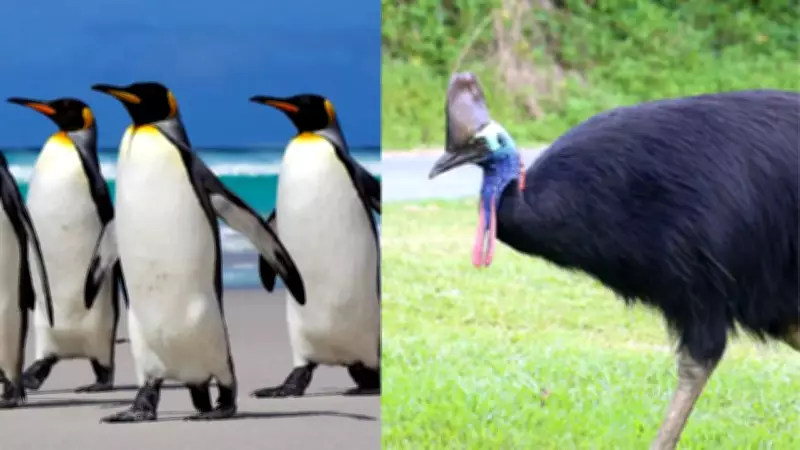
The Southern Cassowary is considered one of the most dangerous birds in the world. Found in the rainforests of Australia and New Guinea, these birds have small wings that cannot lift their heavy bodies. To compensate, they developed strong legs for navigating dense forests and defending themselves. Their wing feathers have even evolved into hard quills, further aiding in protection. The cassowary's evolution highlights how flightlessness can lead to other specialized traits.
Penguins
Penguins are perhaps the most famous flightless birds. Their wings have transformed over millions of years into flippers, allowing them to "fly" underwater. Emperor Penguins, for instance, can achieve high speeds while hunting fish, squid, and crustaceans. Their compact bones and streamlined bodies make them excellent swimmers, but they cannot fly in the air. Evolutionary experts view penguins as a prime example of an evolutionary compromise: trading flight for exceptional diving abilities.
Kiwi Birds
Native to New Zealand, kiwis are among the most unusual-looking birds. They have tiny wings hidden beneath their fluffy feathers, so small that they are nearly invisible. One of the kiwi's most distinctive features is its heightened sense of smell. Since New Zealand had no large land predators, kiwis had no need to fly. Over time, their wings became virtually redundant, reduced to remnants of their flying ancestors. The kiwi is a testament to how evolution can render once-essential features obsolete.