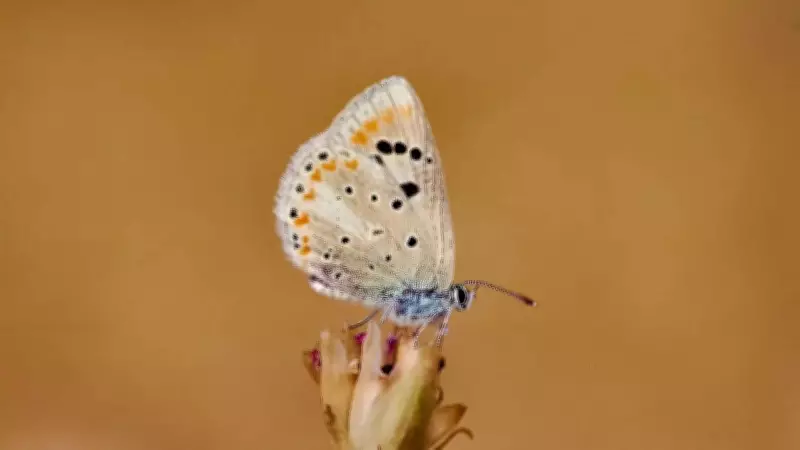
The Atlas blue butterfly is quietly turning into one of the most surprising discoveries in modern biology. It is not famous for bright colours or unusual behaviour. Instead, it is the hidden world inside its cells that has caught scientists off guard.
This small butterfly carries 229 chromosome pairs, the highest number ever recorded in any animal species. At first, the number almost sounds like a mistake. But researchers have confirmed it through full genome sequencing. Most butterflies have far fewer chromosomes, and humans have just 23 pairs. Even its closest relatives look genetically simple in comparison. The Atlas blue butterfly, found in remote mountain regions of North Africa, seems to have followed a completely different evolutionary path.
Atlas Blue Butterfly Genetic Structure Reveals 229 Chromosome Pairs in Rare Species
The Atlas blue butterfly, known scientifically as Polyommatus atlantica, lives in isolated parts of Morocco and north-east Algeria. It is not a species people often encounter. It survives in mountain cedar forests and rugged landscapes that are not easy to access.

For a long time, scientists suspected something unusual about its genetic structure. It did not match the patterns seen in related butterfly species. However, until recently, the full genome had not been properly mapped. Once sequencing was completed, the result was striking. The butterfly has 229 chromosome pairs. This places it far above any known animal species.
What Makes the Atlas Blue Butterfly's Chromosome Count So Unusual
Chromosomes are structures inside cells that carry DNA. They act like storage units for genetic information. Humans have 23 pairs of chromosomes, dogs have 39, and fruit flies have just 4. Some plants even have hundreds.
The Atlas blue butterfly stands out because of how extreme its number is among animals. However, scientists say this does not mean it is more complex or advanced than other species. Instead, the DNA appears to have been split into many smaller sections over time. The total genetic material has not increased much. It has simply been reorganised into more parts. It is a bit like taking a single large document and dividing it into hundreds of smaller files. The information is still the same, just stored differently.
How Chromosome Splitting May Have Occurred Over Millions of Years
Researchers believe this unusual chromosome structure developed relatively quickly in evolutionary terms. The change likely happened over around three million years, which is a short time in natural evolution. The chromosomes appear to have broken apart in areas where DNA is loosely packed. These regions are more likely to split and rearrange over generations. Over time, this process may have been repeated many times.
Most of the chromosomes were affected, except for the sex chromosomes, which stayed more stable. This suggests a highly specific pattern of genetic change rather than random disruption. Scientists describe this as a form of rapid genome restructuring. It does not necessarily mean damage. It may simply be a different evolutionary strategy.
How Environmental Pressure May Shape the Atlas Blue Butterfly's Survival
The Atlas blue butterfly lives in a fragile ecosystem. Its habitat is under pressure from climate change, deforestation, and grazing activity. These changes are slowly affecting the cedar forests where it survives. This raises an important question. Does its unusual genetic structure help it survive, or could it make things more difficult?
Some experts suggest that having many smaller chromosomes might increase genetic flexibility. This could allow the species to adapt more quickly to environmental changes. More genetic recombination might lead to greater variation within the population. However, there is another possibility. Too much genetic complexity might also create instability over long periods. It is not fully clear which effect is stronger. For now, the butterfly continues to survive in a difficult environment.

Why the Atlas Blue Butterfly Continues to Puzzle Scientists
Researchers are still studying how this extreme chromosome structure affects the butterfly's biology. They are trying to understand whether it gives any real advantage or if it is simply a neutral evolutionary outcome. There is also interest in whether similar patterns exist in other species that have not yet been studied in detail. The Atlas blue butterfly might be an exception, or it might be part of a broader but hidden pattern in nature.