The Decade-Long AI Rivalry: How Amodei and Altman's Feud Began
A recent report from The Wall Street Journal has uncovered the deep-seated origins of the ongoing public feud between Dario Amodei, CEO of Anthropic, and Sam Altman, CEO of OpenAI. According to the investigation, the rift between these two prominent artificial intelligence leaders dates back to 2016, but its roots can be traced even further to a group house on Delano Avenue in San Francisco nearly a decade ago.
The San Francisco House Where It All Started
Citing interviews with current and former employees at both companies, as well as individuals close to the executives, the report details how Dario Amodei lived in that house with his sister Daniela. OpenAI co-founder Greg Brockman, a friend of Daniela's, frequently visited the residence. The group engaged in intense discussions about AI technology, with one fundamental disagreement emerging early on.
While Brockman argued that if AI was going to transform everyone's lives, the public deserved to know about developments, Amodei maintained that sensitive technological advancements should be shared with governments first. This philosophical divide would foreshadow the broader conflicts to come.

Escalating Tensions at OpenAI
The report indicates that disagreements multiplied after Dario Amodei joined OpenAI in 2016. He clashed with Brockman over research direction and credit allocation, and reportedly believed that Altman made promises he did not keep. Tensions reached a boiling point in early 2020 when Altman accused both Dario and Daniela Amodei of encouraging colleagues to send negative feedback about him to the OpenAI board.
According to the Wall Street Journal's account, when Daniela summoned the executive Altman cited as his source into the room, that executive denied saying anything of the sort. Altman then denied having made the accusation himself, prompting both Amodeis to begin shouting at him. By the end of 2020, Dario, Daniela, and nearly a dozen colleagues had departed OpenAI to establish their own AI company, Anthropic.
The Public Manifestation of the Rivalry
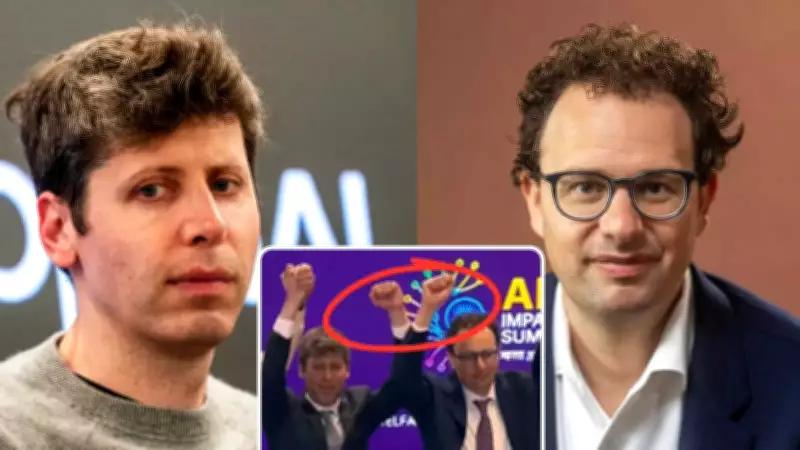
The feud has recently spilled into public view through multiple incidents. When Prime Minister Narendra Modi gathered the world's top AI leaders in New Delhi earlier this year for a closing photograph where executives joined hands and raised them above their heads, Dario Amodei and Sam Altman conspicuously opted out, awkwardly touching elbows instead.
Amodei has also publicly criticized OpenAI's recent contract with the U.S. Defense Department, describing it as a safety threat according to a report by The Information. Altman responded through CNBC, asking the Anthropic CEO to get his facts straight.
Private Communications Reveal Depth of Animosity
The Wall Street Journal report reveals that in private communications with colleagues, Amodei has compared the legal battle between Altman and Elon Musk to a fight between Hitler and Stalin. He called a $25 million OpenAI donation to a pro-Trump political action committee "evil" and likened OpenAI to a tobacco company knowingly selling a harmful product.
The rivalry intensified when Anthropic was barred from Pentagon work and responded by suing the Trump administration. Altman quickly filled the void by announcing a classified Defense Department contract. Amodei fired back on Slack, calling OpenAI "mendacious" and stating that the move reflected "a pattern of behavior that I've seen often from Sam Altman."
Broader Context of AI Industry Tensions
This personal feud occurs against the backdrop of broader friction between Anthropic and the Department of Defense regarding policy restrictions on military AI applications. The conflict highlights the deep philosophical divisions within the AI industry about transparency, government collaboration, and ethical boundaries for artificial intelligence development.
The decade-long animosity between these two influential figures continues to shape the competitive landscape of artificial intelligence, with their companies pursuing fundamentally different approaches to AI safety, transparency, and commercialization.