OpenAI CEO Sam Altman Positions India as Central to Global AI Future
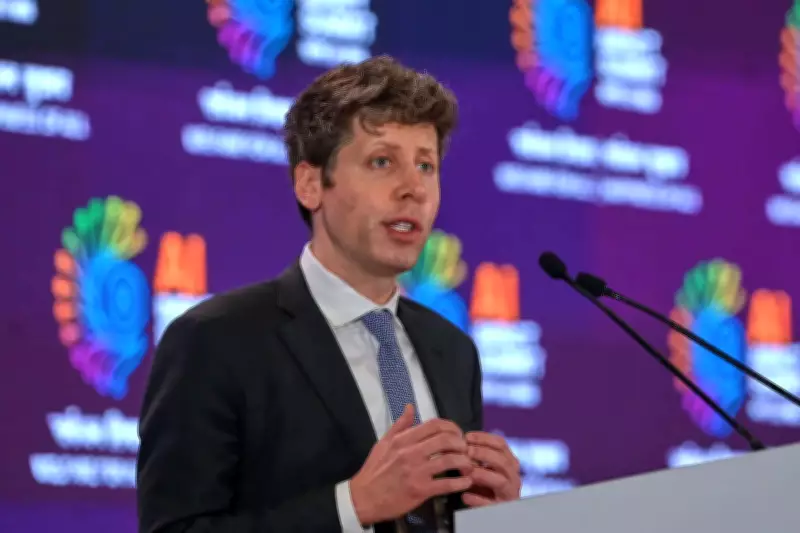
OpenAI CEO Sam Altman has emphatically placed India at the very heart of the global artificial intelligence landscape, asserting that the world's largest democracy is not just adopting AI at scale but actively shaping its fundamental direction. Speaking at the AI Impact Summit on Thursday, Altman revealed staggering adoption metrics that underscore India's pivotal role.
India's Massive AI Adoption and Growth
"More than 100 million people in India use ChatGPT every week," Altman announced, adding a crucial demographic insight: "more than a third of them are students." This massive user base highlights India's profound engagement with cutting-edge AI tools. Furthermore, Altman noted that India has emerged as the fastest-growing market for Codex, OpenAI's sophisticated coding agent designed to assist developers.
Altman elaborated on India's strategic position, stating, "The world's largest democracy is well positioned to lead in AI. Not just to build it, but to shape it and decide what our future is going to look like." This vision positions India not merely as a consumer but as a decisive architect of global AI evolution.

Dramatic Cost Reductions and Accessibility
A significant barrier to AI adoption has been infrastructure costs, which particularly challenge smaller companies and startups seeking quick returns on investment. Altman addressed this directly, highlighting that the cost of OpenAI's models has plummeted by more than 1000 times in just 14 months. He projected that costs would continue to decrease dramatically, making AI increasingly affordable for countries in the Global South and democratizing access to powerful technologies.
The Dawn of Super-Intelligence and New Knowledge Discovery
Altman made several groundbreaking claims about AI's accelerating capabilities. He revealed that AI models in recent months have become so advanced that they are now discovering new knowledge, citing a recent physics result that astonished many physicists. This marks a shift from AI as a tool for analysis to a generator of novel scientific insights.
His most arresting prediction concerned the imminent arrival of super-intelligence. Altman suggested humanity may be only a couple of years away from early versions of true super-intelligent systems. He speculated, "by the end of 2028, more of the world's intellectual capacity could reside inside of data centres than outside of them." While conceding he could be wrong, Altman emphasized this possibility warrants serious global consideration.
Envisioning the potential of such systems, Altman suggested a super-intelligent AI could one day outperform human executives in managing major companies or surpass the best scientists in research endeavors, fundamentally reshaping professional landscapes.
Critical Warnings and the Need for Democratization
Despite his optimism, Altman issued stark warnings about AI's dual-use nature. He cautioned that increasingly capable systems can be dangerously misused, particularly highlighting open-source biological models that could be exploited to create new pathogens. This underscores the urgent need for robust safety frameworks.
Altman also acknowledged widespread concerns about AI power becoming concentrated in the hands of select companies and nations. He argued forcefully for democratization, stating, "All of my study of history suggests that concentrating AI power in the hands of one company or country, even if it was in the name of safety, would be a disastrously bad thing to do." The only viable path forward, he insisted, is to put these powerful tools directly into people's hands, despite potential downsides.

Addressing Media Compensation Concerns
When questioned about fair compensation for traditional news media whose content trains AI models, Altman referenced the US fair use principle to defend OpenAI's practices. He explained, "Our stance is that when we're displaying a quote from a news article or an opinion piece or something like that, we want to do that in a way where we can explore new business models with creators for training." This indicates an ongoing effort to balance innovation with equitable partnerships in the content ecosystem.
Altman's comprehensive address paints a future where India leads global AI democratization, super-intelligence emerges within years, and careful governance prevents catastrophic concentration of technological power.