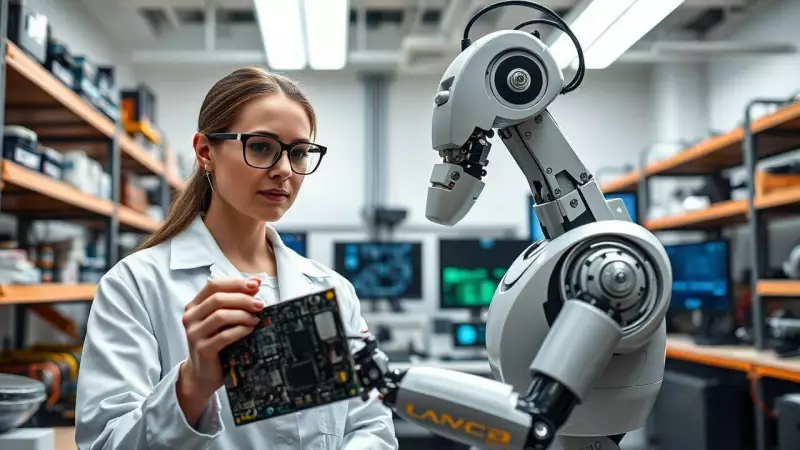
The persistent fear that artificial intelligence and advanced technology will replace human workers has been a constant concern in today's economy. As machines become increasingly capable and systems more intuitive, anxiety about large-scale job losses shadows every technological breakthrough. However, a groundbreaking new report from the McKinsey Global Institute presents a refreshingly optimistic perspective that challenges these widespread concerns.
Human Skills Remain Indispensable in AI Era
Authored by Lareina Yee, Anu Madgavkar, Sven Smit, Alexis Krivkovich, Michael Chui, Maria Jesus Ramirez, and Diego Castresana, the report titled "Agents, robots, and us: Skill partnerships in the age of AI" delivers a powerful message. While current technologies could technically automate 57% of US work hours, this represents only technical possibility, not inevitable reality. The future workforce will be transformed rather than eliminated.
The McKinsey findings highlight a reassuring truth about the durability of human capabilities. More than 70% of the skills demanded by US employers today remain relevant across both automatable and non-automatable tasks. Core human abilities including creativity, judgment, empathy, problem-solving, and communication are not becoming obsolete. Instead, they form the essential foundation upon which AI systems operate effectively.

Even in occupations with high automation potential, human workers remain absolutely essential. Critical functions such as oversight, critical thinking, contextual awareness, and the human touch in customer-facing environments cannot be replicated by even the most sophisticated algorithms.
Redesigning Work for Human-AI Collaboration
McKinsey's central argument presents a clear direction for organizations. The enormous economic value of AI, estimated at $2.9 trillion in the US by 2030, will only materialize if companies fundamentally redesign how work is structured. This transformation isn't about replacing people with machines, but about reconstructing workflows so that humans, AI agents, and robots operate as a coordinated system rather than isolated units.
This comprehensive shift requires rethinking multiple aspects of organizational structure:
- Business processes and workflows
- Job roles and responsibilities
- Team structures and collaboration
- Cultural expectations and norms
- Performance metrics and evaluation
Simply automating individual tasks within existing frameworks is no longer sufficient. Organizations must fundamentally reconsider how work happens, not just who or what performs the tasks.
The Rising Demand for AI Fluency
One of the clearest indicators of this workplace transformation is the explosive growth in demand for AI fluency. McKinsey's research reveals that this crucial skill has grown sevenfold in US job postings within just two years, making it the fastest-rising requirement in the employment market. The message to workers is unmistakable: the future belongs to those who can collaborate effectively with AI, not compete against it.
Importantly, AI fluency doesn't necessarily mean coding expertise. It involves understanding how AI systems function, knowing when to trust them, interpreting their output accurately, and integrating them productively within human workflows.
From Execution to Orchestration
The McKinsey report draws a compelling historical parallel: calculators didn't eliminate mathematicians; they liberated them to focus on higher-level thinking. Similarly, as routine and repetitive tasks are increasingly handled by intelligent systems, human roles are evolving from direct execution to supervision and guidance.
Workers are becoming the orchestrators who guide, supervise, and make sense of the technology operating beneath the surface. This shift transforms the very nature of work, moving away from the feared man-versus-machine confrontation toward a practical partnership where technology handles heavy lifting while human judgment, ethics, and nuanced understanding remain central to how work gets accomplished.

Despite ongoing predictions about job losses, historical patterns suggest that major workforce transformations rarely happen overnight. Changes typically roll out in stages, with AI altering specific tasks, reshaping role definitions, and requiring workers to develop new capabilities gradually rather than eliminating entire workforces in one sweep.
As the report emphasizes, integrating AI successfully requires "a reimagining of work itself." This kind of fundamental shift demands shared responsibility across companies, workers, educators, and policymakers to ensure people can adapt and keep pace with technological advancement.
In this emerging future where technology accelerates decision-making and expands human capabilities, the qualities that stand out most remain distinctly human. Our capacity to adapt, learn continuously, and provide leadership continues to be the defining force in the workplace. The central question is no longer whether technology will replace humans, but how we can redesign work to enable humans and intelligent machines to progress together effectively.