Dubai Business Leader Sounds Alarm on AI's Job Market Impact at Davos Forum
At the prestigious World Economic Forum 2026 in Davos, Dubai's prominent business magnate Hussain Sajwani delivered a sobering assessment about the future of global employment. The founder and chairman of real estate developer Damac Group cautioned that artificial intelligence represents far more than a mere productivity enhancement tool—it heralds a fundamental revolution in job markets worldwide. Sajwani specifically highlighted that economies heavily dependent on outsourced labor could face particularly severe vulnerabilities as this technological transformation accelerates.
India's Outsourcing Sector Faces Existential Challenge
Sajwani's remarks have ignited extensive debate about how AI adoption might reshape international labor dynamics, with special attention focused on India's massive outsourcing industry. The business leader asserted that AI stands poised to change the world "10 or even 100 times more" than the Internet did, warning that nations failing to embrace this technology risk being "left behind" in the global economic race.
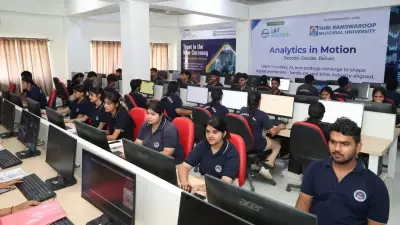
India has long served as the world's premier outsourcing destination, with millions of positions in information technology services, business process outsourcing, call centers, and back-office operations forming crucial components of its economic foundation. A comprehensive 2025 industry analysis suggests that AI-driven automation could fundamentally reshape this very sector. The recent decision by Tata Consultancy Services to reduce its workforce by 12,200 employees has been interpreted by market analysts as potentially signaling the beginning of broader downsizing trends.

Industry experts project that traditional outsourcing roles—including routine programming tasks, manual testing procedures, customer support functions, and administrative work—could see significant displacement as AI systems demonstrate capabilities to perform these activities faster and more cost-effectively. Sajwani reinforced these concerns during his Davos appearance, predicting that "AI is going to take 80 per cent of accountant jobs, nurses and so on and so forth," thereby substantially reducing international demand for outsourced services.
Global AI Adoption Creates Competitive Divides
The Dubai business leader highlighted a widening global disparity in AI adoption rates, noting that countries including China, the United States, the United Arab Emirates, and Saudi Arabia are making substantial investments and accelerating their artificial intelligence capabilities. Meanwhile, regions that exhibit hesitation or implement excessive regulatory constraints risk losing competitive positioning in the emerging technological landscape. Sajwani even drew historical parallels, comparing resistance to AI adoption to the Ottoman Empire's rejection of the typewriter centuries earlier.
Recent data supports the notion that certain labor markets are adapting rapidly to AI realities. A LinkedIn survey revealed that the United Arab Emirates ranks second globally for AI tool usage among professionals, with significant percentages of workers incorporating generative artificial intelligence into their daily tasks and occupational responsibilities. Broader regional surveys indicate that a substantial proportion of recruiters in Gulf nations anticipate job roles being affected by generative AI, with many companies expecting positions to evolve substantially or be replaced entirely.
Beyond Job Loss: The Transformation of Skills and Opportunities
However, economic experts emphasize that AI's impact will extend beyond mere workforce reductions. The Indian Economic Survey 2026 acknowledges that while routine automation may displace certain roles, there exists "good news" in the simultaneous creation of new opportunities and sustained demand for distinctly human capabilities including soft skills, creativity, and adaptability—attributes that artificial intelligence remains unlikely to replicate effectively in the near future.

Market analysts suggest that India's considerable advantages—including its extensive talent base and relatively high AI skill penetration—could potentially enable the nation to transition from primarily serving as a labor exporter to becoming a global innovation and AI services hub. Strategic investments in artificial intelligence training, digital skills development, data center infrastructure, and local computing capabilities might help cushion the employment market against disruptive shocks while simultaneously generating higher-value occupational opportunities.
Global technology commentators similarly observe that across numerous markets including the United Arab Emirates, artificial intelligence is not merely eliminating positions but also creating new roles in specialized areas such as AI development, data science, robotics engineering, and AI integration—even as it substantially reshapes existing occupational categories.
Broader Implications for Global Economic Structures
Sajwani's forecast carries implications extending well beyond employment statistics alone. His warning touches upon critical issues including global inequality in technological access, evolving trade dynamics in services sectors, and the imperative for governments to prepare their educational systems and workforce policies for an AI-dominated future. Nations that fail to adequately upskill their labor forces could witness substantial declines in outsourcing revenues, while technologically advanced economies might attract greater investment inflows and command premium compensation for sophisticated work.
Indian policymakers have already begun emphasizing the necessity for vocational training initiatives, reskilling programs, and AI-focused educational reforms to mitigate potential workforce displacement and position employees for higher-order roles resistant to automation. Concurrently, Gulf nations including the United Arab Emirates and Saudi Arabia continue pursuing aggressive artificial intelligence talent development strategies and digital transformation agendas, aiming to establish themselves as regional technology hubs while diversifying their economies beyond traditional hydrocarbon dependence.
Navigating the AI Transition: Guidance for Workers and Students
For millions of professionals, particularly those employed in sectors closely tied to outsourcing models, the emerging consensus suggests that artificial intelligence cannot be ignored or dismissed. Success in the coming decade will likely depend significantly on proactive reskilling efforts, technological embrace, and strategic shifts toward roles that leverage uniquely human capabilities. These include creative thinking, management expertise, ethical decision-making, and interpersonal communication—domains where artificial intelligence may serve as an assistive tool rather than a replacement.
Simultaneously, the debate sparked by influential figures like Hussain Sajwani underscores how global economic leadership and technology policy are becoming increasingly intertwined, reshaping not only employment landscapes but also geopolitical power structures and international labor market competitiveness. The Dubai magnate's intervention at Davos has effectively positioned artificial intelligence not merely as a technological advancement but as a profound economic disruptor with worldwide implications—particularly for nations historically constructed upon outsourced labor frameworks like India's established model.