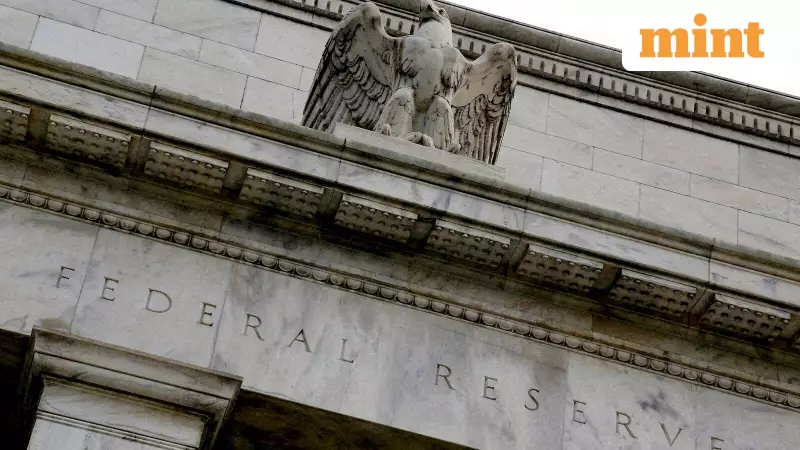
The rapid advancement of Artificial Intelligence (AI) is challenging the very foundations of modern monetary policy in the United States, potentially forcing the Federal Reserve to reconsider its dual mandate and adopt a framework that looks more like India's. This shift comes as the traditional economic relationship between employment and inflation appears to be breaking down.
The Fed's Dilemma: Jobs vs. Inflation in the AI Era
The US Federal Reserve, which is legally required to pursue maximum employment and stable prices, finds itself in a complex situation. Since mid-September 2025, the Fed has reduced its key policy rate by three-quarters of a percentage point to address signs of weakness in the labour market. This action underscores that, for now, its employment objective is taking clear precedence over controlling inflation.
This prioritisation is particularly striking given the broader economic data. In the quarter ending September 2025, the American economy expanded at a robust annualised rate of 4.3%, which was half a percentage point faster than the previous three months. Concurrently, inflation climbed to 2.8% from 2.1%, placing it above the Fed's long-standing 2% target. This combination of strong growth with rising prices and a softening job market presents a new kind of policy puzzle.

Snapping the Phillips Curve: AI's Economic Impact
At the heart of this conundrum is the potential breakdown of the Phillips Curve, a classic economic model that describes an inverse relationship between unemployment and inflation. The theory suggests that low unemployment should drive wages and prices up, and vice-versa. However, widespread AI adoption could be severing this last link. If AI enables companies to boost output (growth) without a proportional increase in human labour, it could lead to a scenario of "jobless growth."
This raises a critical question for policymakers: What if the Fed's task of significantly boosting US employment becomes a near-impossible, Sisyphean endeavour due to AI-driven productivity? Will the central bank be forced to tolerate persistently higher inflation in a futile endless quest for payroll expansion?
Resetting Targets: A Path Toward an India-Like Framework
Faced with this new reality, analysts suggest the Federal Reserve's policy targets may need a fundamental reset. One option—allowing inflation to run higher—is problematic as it would likely undermine confidence and weaken the US dollar. A more plausible alternative, as discussed in financial circles, would be for the Fed to subtly shift its secondary focus from maximising employment to fostering stable output growth.
This recalibration would make the US central bank's approach more similar to the framework long used by the Reserve Bank of India (RBI). The RBI's primary mandate is to maintain price stability, while keeping in mind the objective of growth. This flexible approach, which does not have a strict legal employment maximisation goal, may prove more adaptable in an economy where the job market's behaviour is fundamentally altered by technology.
In essence, whether by tolerating higher inflation or by formally shifting focus toward growth, the outcome points in the same direction: US monetary policy could start to increasingly resemble India's. This potential convergence highlights how global technological shifts, like the AI revolution, are reshaping economic doctrines and forcing the world's most powerful central banks to learn from diverse policy models.