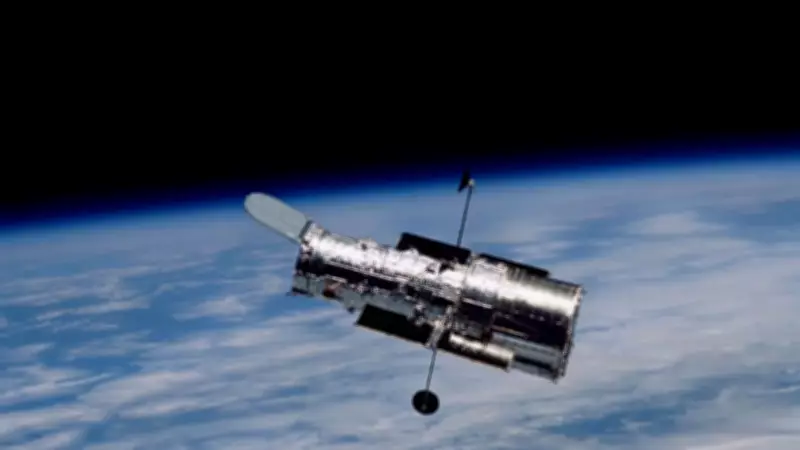
Astronomers have harnessed the power of Artificial Intelligence to unearth approximately 1,400 anomalous objects hidden within the vast data archives of the Hubble Space Telescope. This groundbreaking discovery, achieved by scanning nearly 100 million images, has revealed rare galaxies, gravitational lenses, and mysterious cosmic entities that defy conventional classification.
Revolutionizing Astronomical Research with AI
The research was conducted by astronomers David O’Ryan and Pablo Gómez in collaboration with the European Space Agency (ESA). Faced with the daunting task of manually sifting through Hubble's enormous archive, which spans over 35 years and contains millions of images, the team turned to AI for assistance. They developed a custom-built system named AnomalyMatch to automate the search process.
How AnomalyMatch Works
Instead of programming the AI to look for specific objects, the researchers trained it to identify anything that appeared unusual compared to typical celestial structures like galaxies or stars. This approach allowed the system to act as a sophisticated filter, flagging atypical objects for further human investigation. The AI analyzed nearly 100 million image cutouts from the Hubble Legacy Archive, completing the task in just two and a half days—a feat that would have taken human researchers years, if not decades.

Key Findings from the AI-Assisted Search
The results, published in the journal Astronomy & Astrophysics, were both surprising and enlightening. Among the 1,400 anomalous objects identified, the majority were galaxies undergoing mergers or interactions, processes that significantly alter their shapes. Other notable discoveries included:
- Gravitational lenses: Massive celestial bodies that warp light into arcs or rings, providing insights into dark matter and cosmic expansion.
- Jellyfish galaxies: Galaxies with gas trails resembling tentacles, offering clues about galactic evolution in dense environments.
- Unclassified objects: A group of enigmatic entities that defy existing categorization, potentially representing unknown phenomena in galaxy evolution.
The Role of AI in Modern Astronomy
This study underscores the transformative potential of AI in astronomy. By efficiently processing vast datasets, AI enables researchers to uncover hidden patterns and anomalies that might otherwise be overlooked due to the sheer volume of data. As noted by ESA researchers, even with extensively studied instruments like the Hubble telescope, there are still cosmic surprises waiting to be discovered.
Future Implications and Applications
The success of AnomalyMatch paves the way for applying similar AI-driven approaches to data from newer telescopes, such as the James Webb Space Telescope. This could accelerate discoveries in fields like exoplanet research, dark energy studies, and the search for extraterrestrial life. AI is not replacing astronomers but empowering them with tools to explore the universe more deeply and efficiently.
In summary, the integration of AI into astronomical research is opening new frontiers in our understanding of the cosmos. By revealing the unusual and unexpected, AI is helping scientists decode the mysteries of the universe, one anomaly at a time.