NASA's AI Revolutionizes Astronomy by Discovering Hidden Treasures in Hubble's Vast Archive
For over three and a half decades, the Hubble Space Telescope has been meticulously compiling one of the most extensive visual catalogs of the cosmos ever created. However, the sheer magnitude of this data—nearly 100 million individual image cutouts stored in its archive—has long presented a formidable challenge. No team of astronomers, regardless of size or expertise, could realistically scrutinize every single piece of visual information by human eye alone. Consequently, critical astronomical details were inevitably slipping through the cracks, remaining undetected and unstudied.
AI Steps In to Bridge the Astronomical Data Gap
In a groundbreaking development, NASA has confirmed that artificial intelligence is now effectively bridging this significant gap. Through a post shared by NASA Hubble on the social media platform X, the agency unveiled that an AI-powered system has successfully identified more than 1,300 unusual celestial objects concealed deep within Hubble's existing data repository. Remarkably, many of these discoveries had never been formally cataloged or identified before, highlighting the limitations of traditional manual analysis methods.
How Decades of Data Were Analyzed in Mere Days
What would have taken human researchers years to accomplish was completed in an astonishing two and a half days. Scientists deployed a sophisticated AI system named AnomalyMatch, specifically designed to scan Hubble's entire image archive and flag objects that appeared visually anomalous or out of the ordinary. Instead of painstakingly cataloging stars and galaxies individually, the system concentrated exclusively on detecting irregularities and peculiarities. This innovative research has been formally published under the title "Identifying astrophysical anomalies in 99.6 million source cutouts from the Hubble legacy archive using AnomalyMatch."

This methodology represents a broader paradigm shift within the field of astronomy. As data volumes continue to expand exponentially, it is becoming increasingly impossible for human analysts to detect all significant phenomena manually. According to the X post by NASA Hubble, the AI system effectively narrowed the field of investigation, enabling researchers to focus their attention on the most promising and perplexing findings.
The Astonishing Discoveries Made by Artificial Intelligence
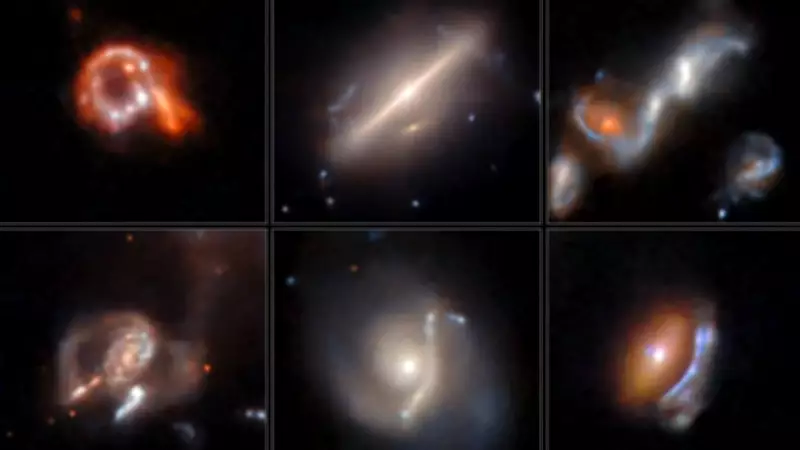
The majority of objects flagged by the AI were galaxies captured during extremely dramatic interactions. Some exhibited elongated tidal streams composed of stars and gas, clear indicators of violent galactic collisions. Others displayed telltale signs of gravitational lensing, where massive foreground galaxies warp and bend light into distinctive arcs and rings.
Additionally, the software identified jellyfish galaxies that are actively shedding gas, irregular star-forming regions, and edge-on planet-forming disks that appear strangely familiar yet previously overlooked. Following meticulous human verification, over 800 of the confirmed anomalies were found to have never appeared in any scientific literature before. This substantial number strongly suggests that, despite decades of continuous observation, astronomers had been missing a significant portion of valuable data.
Why This AI-Driven Approach is Crucial for Future Astronomy
The timing of this technological advancement is particularly significant. Upcoming observatories, such as NASA's Nancy Grace Roman Space Telescope, the European Space Agency's Euclid mission, and the Vera C. Rubin Observatory, are projected to generate data volumes that will far surpass Hubble's already massive output. Without robust automated systems like AnomalyMatch, a vast majority of this invaluable information would likely remain underexplored and underutilized.
AI tools are poised to become standard instruments in astronomical research, assisting scientists in locating rare cosmic events, unexpected structural formations, and potentially phenomena that have not yet been theorized. This shift is less about mere automation and more about ensuring scientific survival and progress in an increasingly data-rich era.