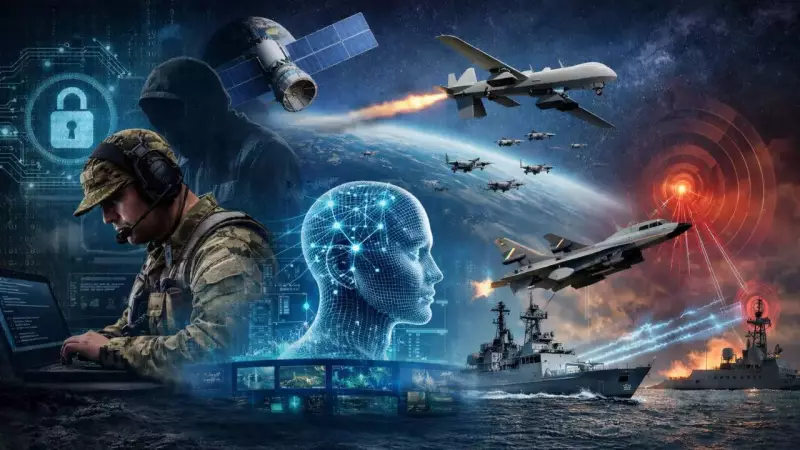
The Invisible Battlefield: How Technology Is Redefining Modern Warfare
Modern conflicts are no longer determined solely by traditional military hardware like tanks crossing borders or fighter jets controlling airspace. Increasingly, the outcomes of wars are shaped long before the first missile is launched—in data centers analyzing satellite imagery, within cyber units probing adversary networks, and through electronic warfare systems that quietly disable sensors and scramble communications.
India's Strategic Imperative in a Complex Security Environment
For India, which faces a multifaceted security landscape ranging from cross-border terrorism to contested continental and maritime boundaries, the integration of artificial intelligence (AI), cyber warfare, and electronic warfare (EW) into its military framework has evolved from a modernization effort to a strategic necessity. Over the past decade, India's armed forces have progressively, though unevenly, adopted a technology-centric doctrine. What distinguishes the current phase is the unprecedented scale and seriousness of this transformation.
AI-enabled surveillance systems now monitor borders that were once guarded by thousands of soldiers. Cyber units prepare for conflicts that may never involve a single shot being fired. Electronic warfare platforms have become increasingly central to air, land, and naval operations. Collectively, these capabilities signify a fundamental rethinking of how India plans to deter, engage in, and prevail in future wars.

From Platforms to Processes: A Doctrinal Evolution
Traditionally, military modernization focused on acquiring platforms such as aircraft, ships, artillery, and armored vehicles. While these remain crucial, the contemporary battlefield rewards those who can process information more rapidly, deny adversaries situational awareness, and shape the battlespace invisibly. India's defense planners have increasingly internalized this lesson, driven by observations of conflicts abroad and lessons learned domestically.
The wars in Ukraine, Nagorno-Karabakh, and West Asia have highlighted the decisive role of drones, electronic warfare, and networked intelligence. Even limited operations against non-state actors now demand precision, real-time intelligence, and information dominance. When facing peer adversaries, the importance of cyber resilience, space-based assets, and electromagnetic spectrum control increases exponentially.
Operation Sindoor: A Case Study in AI-Driven Military Success
Artificial intelligence played a pivotal role in Operation Sindoor, particularly during the intelligence assessment and planning stages that preceded the pre-dawn missile strikes on nine terror targets in Pakistan and Pakistan-Occupied Kashmir. According to senior Army officials, AI-enabled systems were extensively utilized to generate a common operational picture, conduct intelligence analysis, assess threats, and support predictive modeling for long-range strikes.
The Army employed AI tools for real-time multi-sensor and multi-source data fusion, drawing inputs from satellite imagery, aerial surveillance platforms, electronic intercepts, and historical intelligence databases. This enabled planners to identify patterns of militant activity, validate target credibility, and narrow down locations meeting both operational and political thresholds. In total, 23 task-specific AI applications were deployed to process data and inputs during the operation.
AI-driven analytics were also used to prioritize targets, considering factors such as infrastructure significance, occupancy patterns, proximity to civilian areas, and potential collateral damage. Multiple simulations and scenario models assisted planners in shortlisting nine high-value targets with enhanced precision and confidence.
During execution, AI-supported real-time situational awareness allowed commanders to track strike progress, assess outcomes, and maintain coordination across units. Predictive modeling and AI-enabled weather forecasting tools further aided artillery units and long-range vectors, enabling precise timing and targeting under dynamic conditions.

Lieutenant General Rajiv Kumar Sahni, Director General of Electronics and Mechanical Engineers (EME), noted that indigenous AI systems like the Electronic Intelligence Collation and Analysis System (ECAS) were upgraded in real time to identify and prioritize critical threats, helping the Army achieve what he described as strategic dominance. Another system, Trinetra, integrated with Project Sanjay, provided a unified operational picture that improved coordination, situational awareness, and decision superiority.
Operation Sindoor, Sahni emphasized, reflected India's growing technological self-reliance and demonstrated how scientific capability directly strengthens national defense preparedness. The operation illustrated how AI-driven intelligence, surveillance, and reconnaissance can shorten decision cycles while improving accuracy, while also reducing dependence on manual analysis and foreign technology at critical moments.
AI on the Battlefield: Enhancing Human Decision-Making
Artificial intelligence has emerged as the backbone of this transformation. Contrary to popular imagery of fully autonomous killer robots, India's military use of AI is largely focused on augmentation—enhancing human decision-making rather than replacing it.
Across the Army, Navy, and Air Force, AI is being deployed to address the persistent challenge of information overload. Modern sensors generate vast quantities of data from drones, radars, satellites, thermal imagers, and electronic intercepts. Human analysts simply cannot process this deluge in real time. AI systems, trained to detect patterns and anomalies, now act as force multipliers.
AI-enabled surveillance platforms deployed along the Line of Control (LoC) and Line of Actual Control (LAC) can automatically flag suspicious movement, classify objects, and generate alerts, reducing dependence on continuous human monitoring. In counter-terrorism environments, facial recognition and behavioral analysis tools assist forces in tracking suspects across crowded urban spaces, though their use remains tightly controlled due to legal and ethical concerns.
In the Air Force and Navy, AI is increasingly used for predictive maintenance—analyzing vibration, temperature, and performance data to forecast component failures before they occur. This improves fleet availability while reducing costs, a crucial advantage in a force that operates diverse and often aging platforms.
Drones and Swarms: Democratizing Air Power
If AI provides the brain, drones provide the eyes—and increasingly, the sting. India's experience with unmanned systems has expanded rapidly, moving from basic reconnaissance platforms to loitering munitions, armed drones, and swarm concepts.
What makes drones disruptive is not just their capability but their economics. Small, expendable platforms can perform missions once reserved for expensive aircraft or heavily defended ground patrols. In contested environments, numbers matter as much as sophistication.
Swarm drones represent the logical next step. By networking multiple unmanned aerial vehicles through AI-driven coordination algorithms, swarms can saturate defenses, confuse radar systems, and attack targets from multiple vectors. Indian research institutions and military units have conducted trials demonstrating autonomous formation flying, collision avoidance, and coordinated target search.
Unlike traditional air operations, swarms rely on distributed intelligence. There is no single point of failure. Even if several drones are neutralized, the swarm adapts and completes its mission. For defenders, this creates an asymmetry: expensive missiles and air defense systems are forced to engage low-cost targets.
India's drone doctrine increasingly views swarms as complementary to conventional air power rather than substitutes. They are tools for shaping the battlefield—degrading defenses, gathering intelligence, and creating openings—rather than delivering decisive blows on their own.
Cyber and Electronic Warfare: The Invisible Front Lines
Cyber and electronic warfare now form the invisible front lines of modern conflict, operating below the threshold of open war yet shaping outcomes long before kinetic force is applied. Often described as the fifth domain of warfare alongside land, sea, air, and space, cyber operations are among the least visible—and most misunderstood—tools of military power.
For India, the creation of the Defence Cyber Agency marked formal recognition that future conflicts will involve sustained cyber operations targeting military networks, logistics chains, command systems, and, in some cases, civilian infrastructure that supports war efforts. Unlike traditional attacks, cyber operations can be conducted continuously, discreetly, and with plausible deniability, complicating deterrence and response.
Modern military platforms are effectively networked computers. Aircraft, ships, missiles, and radars depend on software-driven navigation, targeting, and communications, creating vulnerabilities that adversaries seek to exploit through malware, supply-chain compromises, and data exfiltration. India's cyber posture therefore emphasizes resilience—network segmentation, encryption, indigenous software development, and regular red-team exercises aimed at limiting systemic failure. Simultaneously, offensive cyber capability is viewed as essential for disrupting adversary command and control during crises.
Electronic warfare operates in parallel, contesting the electromagnetic spectrum on which modern militaries rely. EW involves jamming, deception, interception, and protection of electronic signals, from radar emissions to communication links. In high-intensity conflict, control of the spectrum often determines the tempo of battle. Platforms without effective EW suites remain vulnerable, regardless of their technological sophistication.
Indian forces have accelerated the induction of indigenous EW systems, including radar warning receivers, jammers, and decoy dispensers across air, land, and naval platforms. Warships deploy EW suites capable of detecting and classifying emissions across wide maritime areas, while ground-based EW units support formations by disrupting adversary sensors and communications.
The growing integration of AI into cyber and EW systems marks a critical leap. Machine-learning algorithms can rapidly classify unfamiliar signals, adapt jamming techniques, and separate genuine threats from background noise in real time. In contested environments where milliseconds matter, this speed increasingly determines survivability and operational success.
Indigenous Push and Technological Self-Reliance
Operation Sindoor marked a decisive moment in India's long-running push for defense indigenization, offering rare battlefield validation of systems developed under the Aatmanirbhar Bharat framework. Defense Minister Rajnath Singh, addressing DRDO scientists and technical personnel after the operation, stated that the mission demonstrated that indigenous systems are now strengthening India's operational readiness, rather than merely supplementing imported capabilities.
Self-reliance has become a national mindset, Singh said, crediting DRDO's technologies for being effectively used on the battlefield during Operation Sindoor. His remarks, made at a Defence Research and Development Organisation (DRDO) function following the 77th Republic Day Parade, underscored a shift in how indigenization is being measured—not by prototypes or trials alone, but by deployment under live operational conditions.
Senior defense officials involved in the operation noted that AI-enabled, home-grown analytical and decision-support systems played a critical role in intelligence fusion, threat prioritization, and mission planning. This, Singh highlighted, reflected a broader transformation of the defense sector driven by indigenous research, accelerated induction cycles, and closer integration between the armed forces, DRDO, and industry.
The defense minister framed the technological race in stark terms. In today's times, especially on the battlefield, we must move forward with the theory of 'survival of the fastest' and not just 'survival of the fittest', he said, warning that technologies considered cutting-edge today can become obsolete within a few years. The emphasis, he argued, must be on speed—in research, decision-making, and deployment.
A key structural weakness Singh highlighted was the time lag between research and induction. Calling for urgent reforms, he said the biggest performance metric for defense R&D should be reducing the time between research to prototype, prototype to testing, and testing to deployment, adding that timely induction into the armed forces must outweigh purely laboratory-based achievements. To bridge this gap, the government has pushed for co-development models in which industry partners are involved from the design stage itself, rather than brought in only at the production phase.
The Defence Acquisition Procedure (DAP) 2020 prioritizes the Buy (Indigenously Designed, Developed and Manufactured) category for capital procurement, while government-funded innovation schemes such as the Technology Development Fund (TDF) and iDEX have expanded sharply. Funding caps under TDF have been raised to Rs 50 crore per project, while iDEX Prime now allows grants of up to Rs 10 crore, signaling the state's willingness to underwrite technological risk.
Singh was explicit that DRDO must move beyond a monopolistic R&D model. Government support will only be meaningful when DRDO cooperates with the public sector, private industries, MSMEs, start-ups and academia, he said, pointing to programmes such as the Light Combat Aircraft Tejas as evidence of what collaborative development can achieve. Similar models, he suggested, are now essential in emerging domains such as drones, electronic warfare systems, radars, and AI-enabled platforms.
The results are beginning to show in export figures. Defence exports, which stood at under Rs 1,000 crore in 2014, have climbed to around Rs 24,000 crore, with the government targeting Rs 50,000 crore by 2029–30. Singh urged DRDO to factor in export potential at the design stage itself, arguing that global markets not only recover costs but also enhance strategic credibility and partnerships.
Operation Sindoor thus sits at the intersection of policy intent and operational outcome. It illustrated how indigenous technologies—once criticized for delays and limited scope—are now being absorbed into core military functions such as intelligence analysis, targeting, and battlefield decision-making. More importantly, it reinforced the government's argument that technological self-reliance is no longer just about reducing imports, but about preserving strategic autonomy and operational freedom in high-stakes conflicts.
Space and the Extended Battlefield
No discussion of future warfare is complete without space. Satellites underpin navigation, communication, surveillance, and missile warning systems. Their vulnerability has made space a contested domain.
India's demonstration of anti-satellite capability in 2019 was a strategic signal, but officials have repeatedly emphasized that deterrence, not weaponization, is the objective. The real focus lies in resilience: deploying redundant satellite constellations, enhancing space situational awareness, and ensuring rapid replacement capability.
AI plays a role here too—in analyzing satellite imagery, detecting changes on the ground, and managing increasingly crowded orbital environments. As space assets become more numerous and essential, protecting them without escalating conflict remains a delicate balancing act.
The Road Ahead: Integration Over Innovation
The future of India's military transformation will depend less on acquiring cutting-edge gadgets and more on integrating existing capabilities effectively. AI, cyber, and EW are only as powerful as the doctrines, training, and organizational cultures that employ them.
Jointness—coordination among the Army, Navy, and Air Force—is essential in multi-domain operations. Data-sharing protocols, common communication standards, and integrated command structures will determine success more than individual platforms.
India's push for AI, cyber, and electronic warfare dominance reflects a sober assessment of the future battlefield. Wars will increasingly be decided in invisible domains—through algorithms, signals, and data—long before they are visible on television screens.
Operations like Sindoor suggest that India is learning to fuse technology with doctrine, leveraging indigenous capabilities to achieve precision and restraint. The challenge ahead lies in scaling these successes, safeguarding ethical norms, and staying ahead in a rapidly evolving technological contest.
The next war India prepares for may never be declared formally. It may unfold quietly, in networks and spectra, before erupting—or being deterred altogether. In that reality, dominance will belong not just to those with the strongest weapons, but to those who master the invisible battles that shape modern warfare.