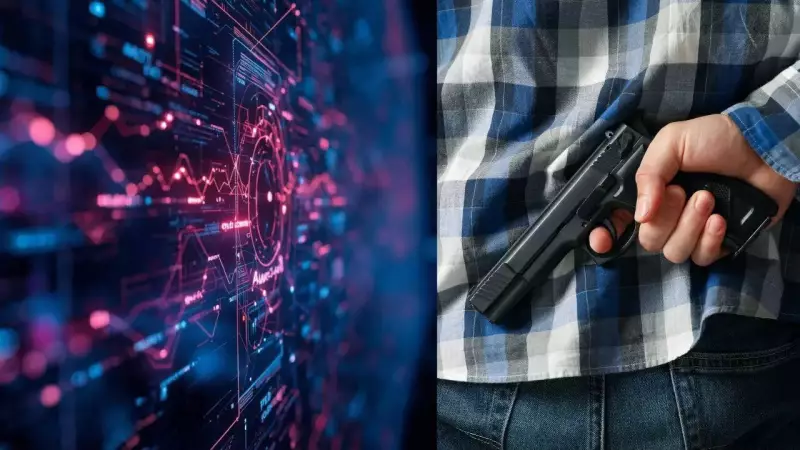
While criminal activity often seems to strike without notice, it rarely does. Patterns exist, but they can be difficult to spot from street level. A common perception in urban India and globally is that police attention is not distributed equally across neighbourhoods when trouble flares up. Now, groundbreaking research led by scientists at the University of Chicago has moved this feeling from anecdotal evidence to data-driven reality, using artificial intelligence to both forecast crime and uncover a quiet imbalance in law enforcement response.
How the AI Model Works: Beyond Simple Hotspots
The innovative computer model developed by the researchers takes a novel approach. Instead of relying on traditional labels like neighbourhood names or district borders, it divides a city into small tiles, each roughly a thousand feet wide. Every reported crime is treated as a point in time and space. By analysing how these points cluster and repeat, the AI learns local, hyper-specific patterns.
The system does not assume crime spreads like a disease. Instead, it detects subtler signals, such as how one event can increase the probability of a similar event nearby days later. This method allowed the model to predict reported violent and property crimes about one week in advance with an impressive accuracy of close to 90% in several large US cities, including Chicago, Los Angeles, and Philadelphia.

The Stark Finding: A Tale of Two Neighbourhoods
Perhaps the more significant revelation came when the team examined what happened after crimes were reported. They compared arrest rates across areas with different socioeconomic profiles. The findings were clear and concerning.
When crime occurred in wealthier areas, police arrests increased. However, in less advantaged neighbourhoods experiencing similar levels of criminal activity, there was no corresponding rise in arrests. In some instances, arrest rates even declined. This indicates that during periods of high demand, police resources are disproportionately directed toward more affluent localities, a pattern that risks deepening existing social inequalities.
One researcher pointed out that when the policing system is under pressure, it appears to prioritise areas that are already receiving more attention, leaving others under-served.
Data, Design, and the Future of Policing
The study was careful in its data selection to minimise bias. It focused on crimes more consistently reported to police, such as homicides, assaults, burglaries, thefts, and motor vehicle thefts. Offences like drug possession, which are heavily tied to discretionary enforcement, were excluded to prevent distorting the patterns.
The researchers caution against using the high-accuracy model for pre-emptive police surges in predicted areas, warning this could exacerbate bias. Instead, they propose it as a powerful simulation tool for policymakers. City officials can use it to test scenarios—like what happens if crime spikes in one zone or enforcement is boosted in another—allowing them to see the ripple effects of decisions before implementing them on the ground.
The model's success across multiple cities suggests the underlying social dynamics it captures are universal, making it a potentially valuable tool for urban safety planning worldwide, including in India's major metros. Ultimately, the research does not create fairness but makes visible the hidden imbalances already present in the system, data that is now harder to ignore.