Prominent industrialist Gautam Adani issued a stark warning on Sunday, stating that the advancement of artificial intelligence (AI) has evolved beyond a mere technological race into a high-stakes contest for global supremacy. He emphasized that India must urgently develop its own sovereign capabilities in this critical field to safeguard its national interests.
A Sovereign Imperative for India
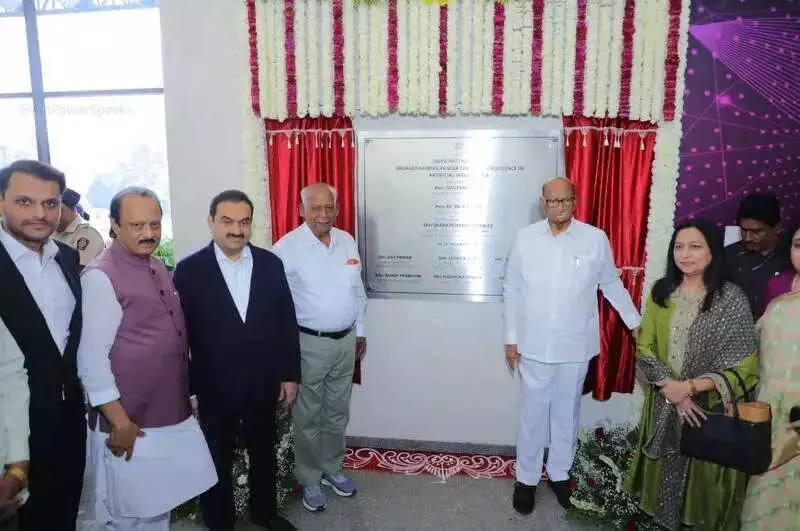
Speaking at the inauguration of the Vidya Pratishthan's Sharadchandra Pawar Artificial Intelligence Centre of Excellence in Baramati, Adani laid out a compelling case for national self-reliance in AI. "If Bharat does not build its own AI models and its own compute infrastructure and its own intelligence ecosystem, then our behaviours, preferences, markets and decisions will be extracted, trained upon and monetised by other nations," he cautioned.
The event was attended by a host of political dignitaries, including NCP (SP) chief Sharad Pawar, Baramati MP Supriya Sule, deputy chief minister Ajit Pawar, and his wife, Rajya Sabha MP Sunetra Pawar. Adani stressed that the country's approach must be strategic, not just convenient. "Bharat must approach AI not as a convenience, but as a strategic national capability built in Bharat, governed in Bharat, and aligned with Bharat's national interest," he asserted.

The Fourth Industrial Revolution and Its Dual Forces
Adani framed the current era as the fourth industrial revolution, defined by the transformative power of artificial intelligence. He explained that human progress advances in leaps, each driven by a technology revolution that initially disrupts society before rebuilding it at a higher level of capability.
He acknowledged the profound anxieties accompanying such shifts, including fears of job displacement, irrelevance, and ceding control to poorly understood systems. "Fear of displacement, fear of irrelevance and fear of giving up control to systems we do not yet fully understand are not signs of weakness, they are deeply human," he said. However, he offered a historical perspective for optimism, noting that technology ultimately expands possibilities. "History is remarkably consistent on the fact that technology does not destroy work, it first disrupts roles and then expands possibilities," Adani stated.
He cited the cellphone revolution as a prime example, which, contrary to fears, created millions of jobs. Between 1991 and 2024, India added over 230 million non-farm jobs, with the majority generated after the proliferation of digital infrastructure.
From Access to Capability: The AI Leap
Adani expressed confidence that AI represents the next, even more powerful, leap forward. "If cellphones gave Bharat greater access, AI will give it greater capability," he predicted. Yet, he also highlighted the double-edged nature of this advancement, warning against growth without sovereignty.
"A nation of 1.4 billion people cannot afford to place its jobs, data, culture, and collective intelligence at the mercy of foreign algorithms and foreign balance sheets," Adani warned, underscoring the strategic risk of dependence.
He pointed to the stage where AI's true value would be realized: its integration into physical infrastructure and industries. "Real transformation begins when AI models step into the real world, into airports, ports, power grids, and factories. This is where the value of AI truly explodes. I call this the industrialization of AI," Adani concluded, outlining the practical frontier where India must compete and win.