Imagine deploying an advanced video recorder to the bottom of a completely dark and ice-cold ocean, expecting footage of nothing but empty space and mud. That is precisely what occurred during a landmark oceanographic expedition in 1977. Geologists and oceanographers from various nations sailed aboard ships across the Pacific Ocean to the Galapagos Rift. As they lowered heavy, remote-controlled imaging equipment through more than a mile and a half of water, their sole objective was to locate geological signs of volcanic hot springs.
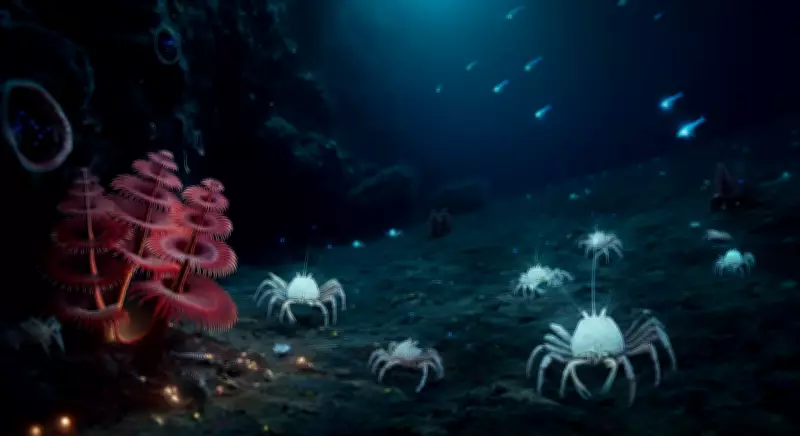
When the cameras finally reached the ocean floor, they revealed an astonishing scene that left everyone breathless. What should have been a barren landscape of stone was teeming with life: large white clams, peculiar crabs, and red-tipped tube worms swaying with the currents. In these deep-sea oases, creatures thrived in pitch-black conditions under immense pressure that would seem inhospitable to all known life forms.
Rethinking the Textbook Rules of Biology
The discovery of this deep-sea oasis caused a seismic shift in scientific thought because it contradicted one of the most fundamental laws of natural science. In the paper Submarine Thermal Springs on the Galapagos Rift, published in the journal Science, the initial goal was to find hot springs, but what they actually found was a biologically self-sustaining ecosystem. Before this revelation, the prevailing scientific consensus held that all complex life on Earth was unconditionally dependent on sunlight and photosynthesis.

These colorful creatures around hydrothermal vents proved that entire ecosystems could exist without sunlight. According to the Woods Hole Oceanographic Institution's article The Discovery of Hydrothermal Vents, their survival relies on a phenomenon called chemosynthesis. Unlike photosynthesis, which harnesses sunlight, specialized bacteria use the chemical energy from mineral-rich, poisonous waters venting from Earth's magma. This demonstrated that complex ecosystems can exist without photosynthesis, and these findings now guide the search for alien life on other planets and moons. This expedition proved that groundbreaking progress often emerges from unexpected places.
Expanding Imagination About Life Beyond Earth
The stunning truth that creatures could survive on volcanic chemicals revolutionized scientists' ideas about possible forms of biological existence on our planet. Hydrothermal vents revealed that our underwater world is not a biological wasteland but a dynamic set of islands heated by Earth's internal energy. Beyond providing insights into unknown ocean species, this unique phenomenon reshaped discussions about how Earth's first life forms emerged.
Today, astrobiologists use data from these Pacific volcanic springs to redesign their search for extraterrestrial life on distant worlds. The existence of chemosynthetic vent communities suggests that living organisms could survive inside the dark, ice-covered oceans of alien moons like Jupiter's Europa or Saturn's Enceladus. The enduring legacy of the 1977 expedition proves that groundbreaking progress often requires looking beyond familiar assumptions. It shows that our greatest scientific breakthroughs frequently occur when we dare to peer into absolute darkness, only to discover that nature has built a beautiful, thriving world where we least expected it.
It was mind-blowing to learn that after years of gazing into space and imagining bizarre alien worlds on far-flung celestial bodies, an entirely new code of living organisms existed right under our noses in the depths of our own ocean.