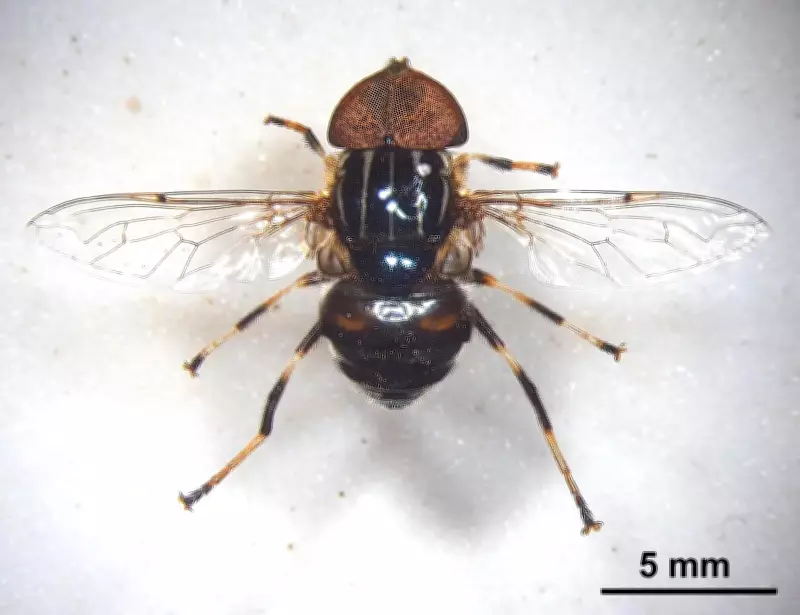
In a significant breakthrough for Indian entomology, researchers at the Zoological Survey of India (ZSI) have discovered two new species of hoverflies in the Gangetic Plains of West Bengal. Named Eristalinus sapphirinus and Eristalinus brunettii, these findings mark the first additions to India’s known Eristalinus fauna in more than a century. The last major contribution to this genus was recorded in 1923.
Landmark Study Published in European Journal of Taxonomy
The landmark study, published in the prestigious European Journal of Taxonomy, was spearheaded by researchers Bristi Roy, Oishik Kar, and Jayita Sengupta. The team operated under the mentorship of Dhriti Banerjee, Director of ZSI, and Atanu Naskar, Officer-in-Charge of the Diptera Section at ZSI Kolkata.
Ecological Importance of Hoverflies
Hoverflies (family: Syrphidae) are vital ecological contributors, serving as crucial pollinators for both wild crops and natural ecosystems. Despite their environmental importance, the genus escaped new scientific classification in the region for 103 years.

Integrative Taxonomic Approach
Between 2022 and 2025, the research team examined specimens collected across multiple districts of West Bengal. Because many hoverfly species look remarkably identical, the team deployed an integrative taxonomic approach — combining traditional physical examinations with modern mitochondrial COI DNA barcoding — to confirm the flies as entirely new to science.
“The discovery reminds us that biodiversity does not survive only in remote forests,” said Dhriti Banerjee, Director of ZSI. “Even highly human-modified landscapes like the Gangetic Plains continue to harbour unknown life forms. Nature still has countless stories waiting to be discovered.”
“Many hoverfly species are remarkably similar in appearance, making accurate identification challenging,” explained Atanu Naskar. “By integrating traditional morphological taxonomy with DNA barcoding and modern species-delimitation approaches, we were able to confidently establish the distinct identity of these two new species.”
Bristi Roy, lead researcher, emphasised the broader stakes of the discovery: “Pollinating insects form the foundation of healthy ecosystems, and hoverflies are among their significant yet least recognised members. The discovery of these two new species after a century highlights how much of our insect biodiversity remains undocumented, even in landscapes we encounter every day.”
Implications for Biodiversity Conservation
This discovery underscores the importance of continued exploration in agricultural and urban areas, which may host undiscovered species. The findings also highlight the effectiveness of modern molecular techniques in revealing cryptic biodiversity.