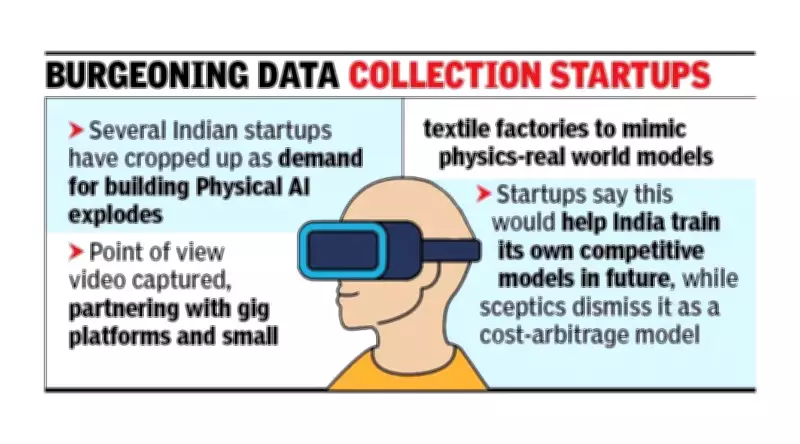
Chennai-based home services startup Pronto's recent admission that it is piloting in-home video recordings to train physical AI systems has brought attention to a rapidly expanding and loosely regulated industry of AI data capture and labelling for the global robotics supply chain. Pronto is not alone in this endeavor. Other startups, including Human Archive, Humyn Labs, Egolab AI, and Neocambrian, are collecting what is known as egocentric data or first-person video captured through wearables or head-mounted cameras. These companies partner with cloud kitchens, hotels, home services platforms, small textile and garment factories, and warehouse operators to record everyday tasks such as cooking meals, washing dishes, stitching garments, assembling components, and sorting inventory. In some cases, startups have built dedicated 'data factories' equipped with motion-tracking rigs.
Client Base and Applications
According to Abhinav Kukreja, founder of Neocambrian AI, which has raised funds from angels including the Dalmia Family Office Trust, typical clients are robotics companies, vision-language-action model developers, and world model firms. He noted that there is no equivalent repository of physical behavior on the internet, and robots need to learn from messy homes, crowded factories, small shops, and repair stations—environments that India offers in abundance. When done correctly, this can become an additional source of paid work for many workers and households, and the company compensates both environment owners and data collectors.
Training Physical AI Systems
This data is used to train world models and physical AI systems, teaching robots to navigate and act in messy, unstructured environments, and enabling smart glasses for object recognition. An industry insider revealed significant demand from the defense industry, particularly for autonomous drone applications. However, the practice also raises questions about privacy, legality, and compensation, as in some cases videos are recorded without pay or consent from workers. TOI learned that some factories have paused such pilots after recent backlash.

Global Demand and Expansion
Manish Agarwal, co-founder of Humyn Labs, which works with leading frontier labs, said demand is growing from robotics OEMs, software makers, and enterprises. The company collects and converts data into episodic strings for robot memory, which helps build low to mid-level agentic capabilities including physical action, voice, sight, and mobility. He emphasized that they use verified networks of workers across 16 countries, as robots cannot be trained only in Indian environments. For European domestic robotics to navigate better, training data similar to that environment is necessary.
India's Role in AI Value Chain
Startups argue that this is India's entry into the global AI value chain, and that working with frontier labs could help the country train competitive models of its own in the future. However, skeptics view it as a familiar cost-arbitrage play. Madhukar Yarra, CEO of Bengaluru BPO NextWealth, which annotates these videos, called it a flash in the pan, noting that much of the data is collected through unorganized gig work.
Industry Perspective and Safeguards
Sangeeta Gupta, SVP at Nasscom, stated that physical AI data could diversify India's AI services beyond traditional data labeling. However, she stressed that issues around informed consent, anonymization, worker awareness, and ethical use will require continued industry responsibility and evolving safeguards.