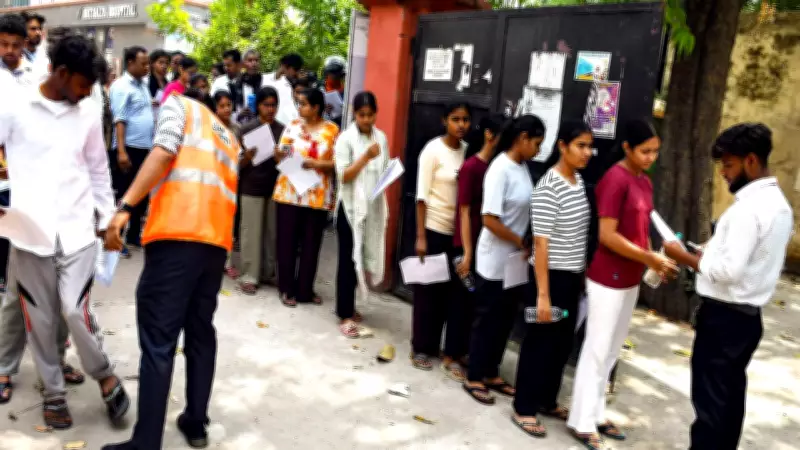
Cabinet secretary T V Somanathan, while reviewing preparedness for the June 21 NEET-UG retest, stated, “The full might and weight of the law will fall on any person trying in any manner to distort, disrupt or tamper with the integrity or smooth conduct of the re-examination.” This underscores the deployment of an unprecedented security apparatus by the Centre on Friday.
Security Measures for NEET-UG Retest
From military aircraft in the skies to lockdown facilities on the ground, round-the-clock cyber monitoring and a secret lockdown facility for question paper setters, the June 21 NEET-UG retest indicates the challenge confronting the National Testing Agency (NTA) and the government after the cancellation of the May 3 test triggered a CBI probe and widespread concern among more than 22 lakh candidates.
As the Centre battles to restore confidence in India’s largest entrance examination after last month’s paper leak controversy, officials said confidential question papers will travel through a tightly controlled network involving Air Force aircraft, helicopters, designated landing points, armed escorts and multi-agency surveillance before reaching examination centres. Security personnel have been placed on standby across the chain to respond to any contingency.

Isolation of Paper Setters
At the other end of the process, the experts responsible for preparing the examination paper have effectively been cut off from the outside world. Housed at a secure undisclosed location, paper setters, moderators and translators remain under strict isolation with access to phones, laptops, internet services and other communication channels heavily restricted.
Senior government officials also sought to reassure candidates over concerns regarding cyber vulnerabilities. They said question papers are protected through one of the country’s most secure digital architectures and are not susceptible to cyber breaches. The arrangements reflect the government’s determination to plug every vulnerability identified after the paper leak controversy that led to the cancellation of the original examination.
Review Meetings and Coordination
Somanathan reviewed preparedness with NTA director general Abhishek Singh where he stressed on close coordination between the Centre, states and district administrations, and said the government is working collectively to ensure a smooth, transparent and secure conduct of the medical entrance. The review followed earlier meetings with central government secretaries and state chief secretaries on June 1 and June 4 to assess preparedness and strengthen coordination mechanisms.
The operation, officials described, as one of the most extensive security exercises ever mounted for a public examination. Education ministry sources said confidential question paper packets will be airlifted by the Indian Air Force to 18 locations across the country before being moved under security cover to examination centres, with defence establishments, civil authorities and security agencies maintaining close coordination throughout the exercise.
Multi-Tier Security Framework
Authorities have simultaneously tightened controls over the question paper preparation process. All experts involved in setting, moderating and translating the examination paper have been moved to a secure undisclosed location and placed under strict isolation until the examination concludes on June 21. Mobile phones, laptops, smartwatches and personal communication devices have been barred.
The lockdown of paper setters forms the first layer of a multi-tier security framework put in place by the Centre, the education ministry and NTA. Officials said every stage of the examination cycle — from question paper development and translation to moderation, printing, packaging, storage, transportation and distribution — is now under enhanced oversight. The process has been compartmentalised to ensure that no single individual or group has access to the complete chain of operations.
Digital Safeguards and Cyber Monitoring
While declining to disclose technical details, officials said multiple layers of digital safeguards have been built into the system and described the protection framework as being comparable to standards used for securing high-value digital financial infrastructure.

The security push extends to the online space. Authorities are carrying out round-the-clock monitoring of social media platforms, messaging applications and online forums to identify fake question papers, misinformation campaigns and suspicious activity. Technology companies including Meta, Google and Telegram have been asked to assist in rapid detection and takedown of misleading content linked to the examination.