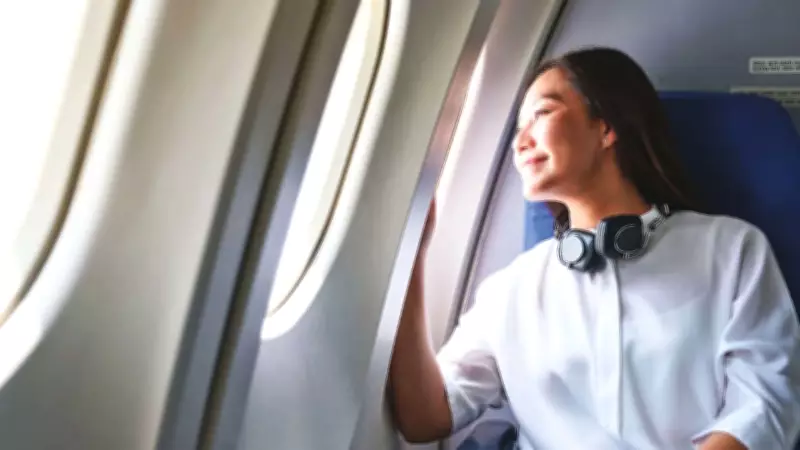
Can anything soothe a hassled air traveller, trapped somewhere between turbulence, delays and the purgatory of a long-haul flight? Dark chocolate? A cup of hot tea? What about music, perhaps?
In 1978, Brian Eno thought so. The English musician was sitting at a newly built airport near Cologne, Germany. Everything about it, he would later recall, was dazzlingly beautiful. But over the PA system was this really loud 'terrible German disco music'. Nobody, he realised, had thought about what kind of music belonged to an airport.
That irritation produced one of the most influential ambient albums of the 20th century: Ambient 1: Music for Airports. While creating it, Eno ensured that the music 'mustn't interfere with communication'. In the album's sleeve notes, he also wrote that ambient music 'must be as ignorable as it is interesting.'

Music is the first thing guests hear when they board
To mask disturbing and stressful sounds, such as those from aircraft fuelling, luggage being stowed in overhead bins or passengers taking their places noisily, airlines are increasingly considering music as part of the experience.
'We always describe an aircraft as a tin box in the sky before you fill it with all the sensory elements,' says Max De Lucia, co-founder of sonic branding agency DLMDD.
'Airport music helps you to be more zen, less stressed when there is the sound of the engine blaring into your ears. You can shut your eyes, not your ears,' says Laurent Cochini, managing director of Sixième Son, a French sonic branding agency that has worked with the Etihad Airways and Cathay Pacific.
That explains why airlines have begun commissioning their own soundtracks for boarding, in-flight moments and arrivals. Academy Award-winning composer Hans Zimmer has created an original score for Qatar Airways. Shankar Mahadevan, along with Prasoon Joshi and percussionist-composer Taufiq Qureshi, gave Air India its signature track, India Takes Flight. Akasa Air introduced SkyBeats from day one. Emirates, meanwhile, has been at this for over a decade: its boarding music, composed with Christian Saglie in 2012 and known internally as the Emirates Sonic, was designed to do more than announce a flight. 'Our easily distinguishable boarding music was designed to evoke feelings of comfort and trust, in addition to reinforcing the positive sentiment towards the brand that our customers have grown to love,' says an Emirates spokesperson.
The genre now has a cult following: Cathay Pacific's tracks have half a million listens on Spotify; Singapore Airlines' have 3.3 million; Eno's Ambient 1 has more than 70 million.
'Airport music helps you to be more zen, less stressed when there is the sound of the engine blaring into your ears. You can shut your eyes, not your ears,' says Laurent Cochini, managing director of Sixième Son.
Naarayan T V, Chief Marketing Officer of Akasa Air, understands the stakes. 'It is often the first thing guests hear when they board and the last thing they hear before they leave, making it a subtle but powerful touchpoint in the journey.' Akasa's original soundscape, SkyBeats, created with independent Indian musicians, is calibrated to the time of day: softer on early and late flights, slightly more energetic through the afternoon.
Calming music creates a feeling that you are in a safe environment
Air travel is no less than a paranoia drill: a thorough security procedure, an immigration officer's stare, a departure gate that is always farther than it looks. Santosh Ghatpande, certified music therapist, says, 'Calming, soothing music can create a feeling in your brain that you are in a safe environment.' The pace matters as much as the melody: 'If you play faster paced music, people are already in a hurry, so that music can either enhance their speed or jumble them up.'
Airlines have started to take the science as seriously as the branding. Emirates says it caters to every genre, but one category gets particular attention: 'Wellness and restful sleep sounds are also a significant focus to ensure passengers have a relaxing experience onboard,' says an Emirates spokesperson.
UK-based composer Rohan De Livera, who created the sound of Singapore Airlines, cuts to it: 'You aren't creating music for people to listen to -- you are creating music for people to feel.'

The first movement he wrote, called Boarding, is heard at the gate and as passengers enter the aircraft. 'The music is slow, graceful and mostly sticks to a tempo of around 80bpm, about the same as an average human heartbeat, so the music guides you into a more relaxed state.' The landing music carries 'a sense of longing and excitement for seeing home, and family or for arriving at your destination.'
A cabin is not a concert hall
The challenge is that airline music has to work in a peculiar environment. It cannot behave like a film song, a jingle or a playlist. It must be present without being pushy, soothing without being sleepy, and memorable without being irritating.
Hans Zimmer, who composed an original score for a leading carrier, said the music 'reflects the beauty of travel'.
Sageesh Bhandari, who composed IndiGo's All I Want is Touchdown, describes the balance as a 'fine line between an earworm and annoying'. For IndiGo, the goal was not to create a traditional corporate airline jingle but a genuine travel anthem. 'The core motif is catchy, but the instruments and textures around it are allowed to breathe.'
Singer Srishti Bhitrikothiy, who performed the track, received a message from a passenger who was terrified while flying with his newborn baby for the first time. The music, he told her, had helped them both. 'I think that is the magic of music,' she says.
A brand you can hear
Flight music has quietly become a serious investment in airline branding. 'Music is a universal language. You're in New Delhi, I'm in Paris. I work for brands in Hong Kong, Brazil, Abu Dhabi, the US, and I never have to translate anything,' says Cochini. For Etihad, Sixième Son built the score the way Emirati craftswomen build the Al-Sadu carpet, start local, before opening slowly to the world. For Cathay Pacific, the agency composed the track, but the National Youth Orchestra of Hong Kong performed it.
Max De Lucia, co-founder of sonic branding agency DLMDD, puts it more visually: 'We always describe an aircraft as a tin box in the sky before you fill it with all the sensory elements.' For airlines, he says, the brief is often about 'capturing the intersection of brand experience, brand memorability and timelessness, a sound that will work as well 10 years from now as it will today.'
Cochini agrees on what the music must never do: call attention to itself. 'It's not a 10-second loop. It's 'okay, let's take a moment. Let's breathe, and then we will enjoy the ride.''
Which brings it back to where it all began. Eno didn't set out to build a commercial category. He set out to answer a simpler, stranger question: 'What if you could make a kind of music that made you less worried about the idea of dying? What if you could make a piece of music that made your life seem less the center of your attention?' Forty-seven years on, airlines from Delhi to Doha are still trying to answer it.