

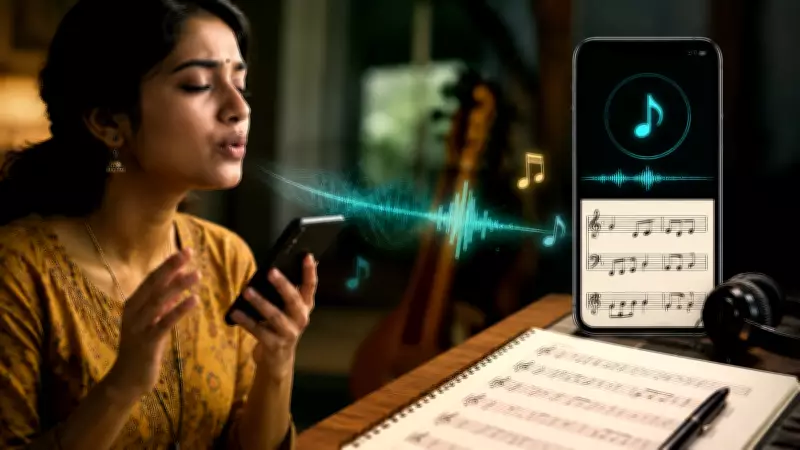
A California startup designed to make music education more accessible is having an impact that its founders did not fully anticipate. Andrew Carlins, an MBA classmate of mine, shared the story of his company, Songscription, which describes itself as an AI lab for music learning. Its main product allows users to upload an audio recording and convert it into sheet music, MIDI, tabs, and piano roll. Users can also tailor the output, such as sheet music, to their skill level. Upload a file, get notation back—that is the whole product, and it turns out to be enough.
Personal Motivation Behind Songscription
Carlins grew up with a stutter and discovered that when he sang, his stutter disappeared. 'Music is quite literally how I found my voice,' Carlins explains. He built Songscription because he believed that a world with more access to music learning and live performance is a better world, as he had personally experienced music's unique ability to empower individuals and unite people from different backgrounds.
Real-World User Stories
Songscription's users tell the story better than Carlins or the product description can. A music teacher in Brazil uses Songscription with elementary students as a teaching supplement. A violin teacher in the United States used it to produce notation for a student who learns better from the page than by ear. A visually impaired pianist used it to get his own compositions written down for the first time. One user wrote to the Songscription team: 'I never thought this would be notated. Thanks for fulfilling a dream.' None of these people needed a machine to create music for them; they needed one that could help them learn and perform music live.

The Story of Sushma, a Carnatic Music Teacher
The India story is worth telling in detail. Sushma is a Carnatic music teacher whose students, like many in India today, listen to as much film music as classical. They come to her lessons with requests for Tamil and Hindi film songs—melodies they already know by heart and want to read on the page. The problem is that Carnatic music and Western staff notation are two distinct systems, and Sushma, trained in one, had no grounding in the other. She found Songscription, uploaded a film song her students had been asking about, and got readable sheet music back. She wrote to the Songscription team afterward, not as a formal review but as a note. She mentioned the output was clean, the process easier than expected, and the website messages while processing made her laugh. She closed with regards to the whole team. It was a small note, but it shows whether a product is landing and having the impact it was built to have.
Addressing a Gap in Music Technology
Sushma's experience highlights a gap in how music technology has been built. India has a large and serious music education culture, a tradition of both classical training and mass popular music, and a growing number of learners who move between those worlds. Most transcription tools were designed with Western music pedagogy as the default. A Carnatic teacher navigating film music notation is not a use case those tools were built for. Songscription, which gives users access to Western notation regardless of their musical background, fits that gap reasonably well. Carlins says the company eventually wants to support non-Western notation systems as well, though that work has not shipped yet.
What Songscription Is Not
It is worth clarifying what Songscription is not, because the AI music conversation is mostly about generation. Products that compose new music, write lyrics, or produce tracks from a text prompt get most of the attention. Songscription does none of that. It takes music that already exists and makes it readable and accessible. That distinction matters for evaluating its effects on musicians. Songscription is not trying to do the creative work for anyone; it is trying to remove the technical barrier between a musician who has an idea and a page that can hold it.

Accessibility as a Core Theme
The accessibility theme runs through the user base consistently. The visually impaired pianist who could not use conventional notation software. The Carnatic teacher whose training did not include Western staff notation. The elementary school students in Brazil whose teacher needed a faster way to produce arrangements. Each is a person who, for a specific and legitimate reason, could not get what they needed from existing tools. Songscription is not solving every version of that problem, but it is solving enough that the pattern is noticeable.
Current Limitations and Availability
The product currently works best with single-instrument recordings, with piano as its strongest use case and other instruments available in beta. Full band transcription is not yet supported. Songscription is publicly available with a free tier at songscription.ai.





