The Blank Canvas: Djokovic's Exhaustion After Epic Victory
The face revealed nothing, appearing as a blank canvas devoid of expression. There was no upward lift at the corners of his mouth, no distinctive sparkle in his eyes. His body seemed completely spent, resembling an engine that had run entirely dry. Perched on a highchair during his post-match press conference, Novak Djokovic, the celebrated five-time champion, looked noticeably slighter than he had appeared on court just moments earlier.
The Wimbledon Crucible: Battling Federer and 15,000 Voices
The Serbian superstar had miraculously saved two match points during an epic five-set contest en route to claiming the title against his arch-rival Roger Federer in the dramatic 2019 Wimbledon final. Djokovic wasn't merely competing against the most beloved figure in tennis history; he was simultaneously confronting the overwhelming support of approximately 15,000 fervent fans on Centre Court, who were rambunctiously cheering for the Swiss maestro throughout the nearly five-hour marathon.
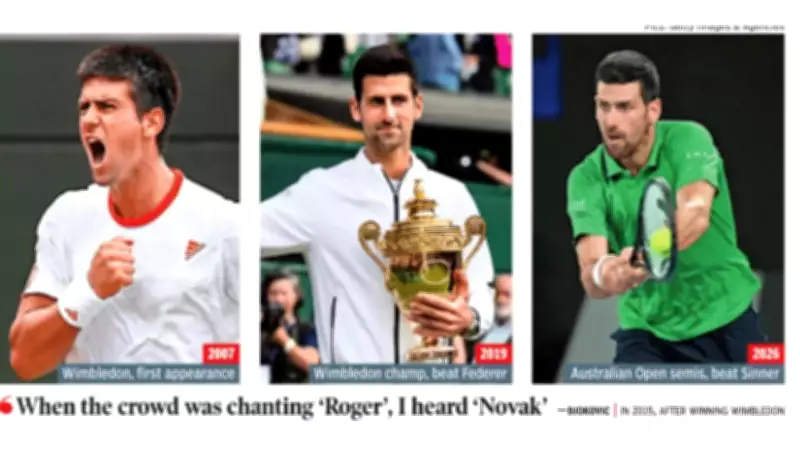
When later questioned about the crowd's overwhelming support for his opponent during those intense four hours and fifty-seven minutes, Djokovic offered a revealing response. "When the crowd was chanting 'Roger', I heard 'Novak'," he stated, managing a smile that never quite reached his eyes. "I try to convince myself that it's like that," he added, accompanied by a faint, almost forced laugh. "It's similar, Roger and Novak."

The Cliff's Edge: Djokovic's Match Point Philosophy
Seven months following that historic encounter, at the Dubai Duty Free Tennis Championships, Djokovic was asked about the psychological resilience that makes him so remarkably unyielding when facing match points. "It's like being on the edge of a cliff. There is no going back. This is it. I accept the situation and try to make the most out of it," explained Djokovic, who has essentially written the modern playbook on fighting from seemingly hopeless positions. "It's a matter of life or death at that point," he emphasized.
As he delivered this answer, he glanced across the room and nodded thoughtfully. "I don't know if I gave you a great analogy. That's the feelings you have, it's all or nothing," he concluded.
The Elusive Quest: Seeking Affection Beyond Championships
Despite his legendary fighting spirit, Djokovic—who fluently speaks five languages but expresses himself most eloquently through his tennis—has long pursued something more intangible than trophies: the genuine affection of crowds and the warmth of the sport's storytellers. Beyond his obvious athletic achievements, he remains remarkably difficult to decipher, resembling a complex puzzle comprising approximately 50,000 intricate pieces. Tennis's ultimate mental strategist simultaneously stands as its most inscrutable champion.
Breaking the FeDal Hegemony: Djokovic's Ascent
Djokovic first announced his arrival at tennis's highest echelons during the summer of 2007. At just twenty years old, he had already climbed to world No. 3, positioned directly behind the formidable duo of Roger Federer and Rafael Nadal. That September, he reached the US Open final; merely four months later, he captured his maiden Grand Slam title. However, it wasn't until the conclusion of 2010—after becoming leaner, lighter, and fully committed to a strict vegan, gluten-free diet—that Djokovic genuinely began threatening the established FeDal (Federer and Nadal) hegemony.
During this era, Federer was dominating with artistic brilliance, while Rafael Nadal, the powerful left-hander with a bruising forehand, represented his natural opposite. Their rivalry felt complete and compelling. Did tennis truly require another contender? A potential third wheel? The sport appeared to have everything: a Swiss genius and a Spaniard who worshipped at the altar of meticulous routine. Only Djokovic, fueled by green juices and unshakable conviction, wasn't seeking permission to join their exclusive club.

Media Relations: Chocolate Gestures and Press Conference Dramas
In his early years at the sport's summit, Djokovic developed a unique tradition of concluding the season by wandering through the interview room at the ATP Finals (then held in London) while carrying boxes of chocolates—gluten-free, naturally—for the journalists. This small sweet gesture provided a pleasant conclusion to their long season. Reports indicate the Serb replicated this practice at the beginning of the year during the Australian Open, distributing dates and locally procured coconut chocolate balls to media members.
Djokovic, who trained in various makeshift facilities during his childhood—including an unused swimming pool amid the Yugoslav wars of the late 1990s—has never been an easy interview subject for the media, particularly for the hundreds of journalists who travel globally to cover Grand Slams. He could become especially challenging following losses, and over recent years, his press conferences have frequently concluded after just three or four questions as he prefers to keep interactions brief.
A memorable incident occurred during the 2018 French Open quarter-finals, where Djokovic suffered a surprising defeat to world No. 72 Marco Cecchinato, a result that reverberated throughout the tournament grounds. Following the three-hour, twenty-six-minute match, Djokovic emerged from the lift on the upper tier of Court Philippe Chatrier and unexpectedly opened the door to the secondary (much smaller) interview room, even as announcements directed him to the main press conference area. The Serb slouched into an empty chair and refused to move. Transcribers scrambled to relocate their equipment across the space but ultimately ran out of time, forcing the press conference to be transcribed from a recording later.
The only question Djokovic answered comprehensively that day concerned his post-match embrace with Cecchinato at the net. "It's never been hard for me to congratulate and hug an opponent after we've shared a great moment on the court," he stated.
Unconventional Approaches: From Philosophy to Pandemic Controversy
Djokovic, whose game heavily incorporates scientific advancements ranging from specialized diets to cutting-edge fitness regimens, has also embraced more unconventional methodologies. For nearly two years, he included Pepe Imaz on his team—a former Spanish tennis player whose coaching philosophy promotes 'Love and Peace' as fundamental tennis principles.
Approximately four Australian summers ago, Djokovic faced deportation from the country after refusing COVID-19 vaccination ahead of the Australian Open. Upon arriving in Melbourne, the Serbian superstar's visa was initially cancelled for failing to meet Australia's stringent pandemic entry requirements, despite having received a medical exemption. Following a brief legal confrontation, Djokovic was detained in an immigration detention center before ultimately being sent home, missing the opportunity to compete in a tournament he had already won nine times.
Respected in the Locker Room: A Champion's Legacy
Regardless of how Djokovic's popularity has fluctuated among tennis fans globally, he remains profoundly respected and genuinely liked within the professional locker room. Over the years, numerous prominent players—including Andy Murray (who even coached him briefly last year), Daniil Medvedev, Alexander Zverev, and four-time major winner Jannik Sinner—have publicly praised the Serbian icon. Many credit Djokovic for assisting them during their formative careers, whether through valuable practice sessions or insightful advice.
This week at the Australian Open, eighteen-year-old Iva Jovic articulated a clear distinction regarding Djokovic's character. "A lot of times when you meet your hero, it is, Oh wow, that's definitely not how it looks on TV!" she observed. "But with Novak, he's almost even kinder and more attentive than what is captured on camera."
For countless members of the tennis community, Djokovic represents not merely a champion documented in record books, but a genuine role model whose very presence elevates the entire sport. His complex journey—balancing unparalleled competitive intensity with a heartfelt desire for connection—continues to define one of tennis's most fascinating narratives.