India's journey from a nation with a modest shooting culture to a burgeoning global powerhouse is a story of policy changes, pioneering champions, and a remarkable grassroots explosion. The catalyst for this transformation can be traced to a pivotal policy shift in 2012, often called Indian shooting's '1991 moment', mirroring the country's economic liberalisation. This change unshackled the sport's potential, leading to a participation boom, especially among young women from non-traditional sporting regions.
The Data Behind the Boom: A 100% Surge in Six Years
The numbers tell a compelling story of explosive growth. In 2019, a total of 8,011 shooters participated in the national championships. By 2024, that figure had ballooned to a staggering 13,522. The ongoing national championships this year have witnessed an even more dramatic rise, with entries soaring to 16,951—marking an increase of over 100% in just six years.
This surge is most pronounced in the air rifle and air pistol events, disciplines favoured for their relatively lower cost and easier accessibility. The growth is being driven significantly by women. While men still outnumber women in cumulative participation (43,785 men vs. 23,365 women over six years), the rate of increase among women is phenomenal. Their participation is growing by over 100% year-on-year, rapidly closing the gender gap.
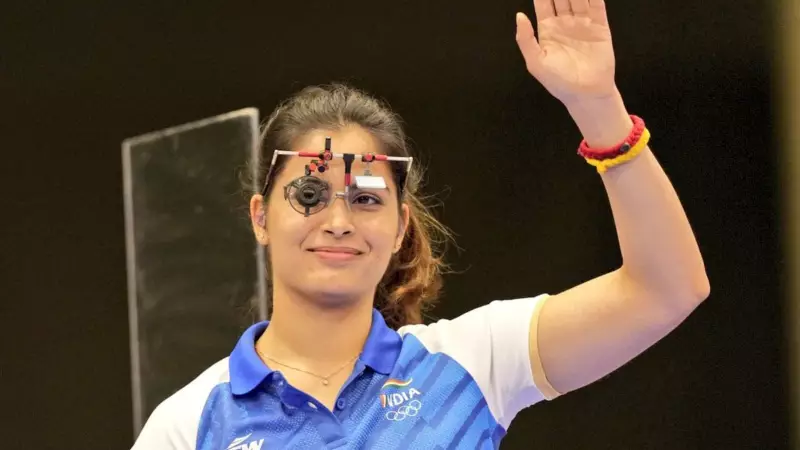
A prime example is the air pistol event, where Manu Bhaker clinched an Olympic medal in Paris. Participation in this category skyrocketed by nearly 111%, jumping from 1,033 shooters in 2019 to 2,860 last year. Similarly, air rifle saw numbers rise from 1,075 to 2,038 in roughly the same period.
From Small Towns to the Shooting Range: The New Indian Shooter
The profile of the Indian shooter is changing. Take the story of 15-year-old Aditi Rajeshwari from Ankleshwar, Gujarat—a city known more for its chemical industry than sports. Inspired by Abhinav Bindra's historic gold at the 2008 Beijing Olympics, she began travelling to nearby Bharuch to train. Today, she is honing her skills at the prestigious Army Marksmanship Unit in Mhow, Madhya Pradesh.
Her journey, shared with her elder brother and top shooter Agam Aditya, from a city with little sporting culture to the national stage is no accident. It reflects shooting's deep penetration into India's hinterlands, reaching places where the sport was never part of the public consciousness. This widespread reach is a direct result of three key amendments to gun laws over 18 years.
The Policy Triggers: Liberalisation and Legacy
According to NRAI secretary Rajiv Bhatia, the evolution of firearm regulations has been fundamental. The liberalisation of air weapon imports in 2007 set the stage. However, the game-changer came in 2012 with the simplification of import permits for firearms. Before this, the process was a bureaucratic labyrinth that could take up to a year. A single clerical error could force a shooter to restart the entire process and pay a penalty equal to the weapon's cost.
"After 2012, it has become so easy," says Bhatia. "Shooters apply directly to the NRAI, we issue an import permit in 10-15 days and you can import the weapon. What took one year, now takes one month." For air weapons, no import permit is needed for rifle club members. A further amendment in 2016 lowered the age limit for handling weapons from 16 to 12, opening doors for teenage prodigies.
This policy ease was supercharged by a golden generation of champions. The initial wave was created by a hat-trick of Olympic medals from 2004 to 2012: Rajyavardhan Singh Rathore's silver, Abhinav Bindra's gold, and the bronzes and silvers of Gagan Narang and Vijay Kumar. "Suddenly, you had schools and colleges giving extra marks to state-level competitors," notes NRAI secretary-general Pawan Singh. "So, parents were more willing to send their children for shooting."
Today, the legacy continues. Role models like Apurvi Chandela and Manu Bhaker inspire the next wave. The sport is also marketed for its cognitive benefits. "Parents come to us not because they want to make their children Olympic champions, but so that their focus improves," adds Singh. With quality coaching now available even in remote areas, as the Aditya siblings found in their coach Mittal Gohil, India's aim to become a dominant global shooting force is firmly on target.