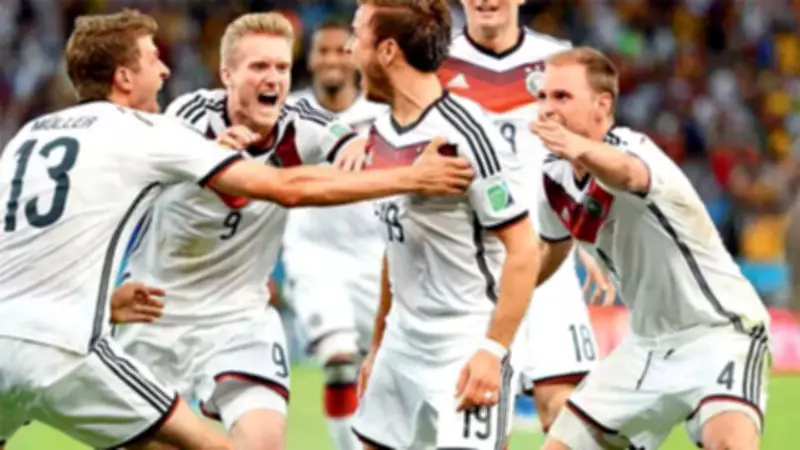
In a span of four years, Bild, the rambunctious and hugely popular tabloid newspaper in Germany, splashed two banner headlines across its front page with the same two words — 'Ohne Worte', meaning no words or speechless in German. The first one, published on July 9, 2014, ran across a boisterous Toni Kroos being lifted aloft by Sami Khedira against the backdrop of a 7-1 scoreline as Germany moved closer to lifting the World Cup for the fourth time. Four years later, on June 28, 2018, the tabloid served up the same headline spreading again across the frame of Kroos, but this time, the German veteran was standing on his own, hands on hip and looking downcast. The '0-2' scoreline seen in the background was self-explanatory: Germany, the defending world champions, exited at the group stage with a stunning loss to South Korea.
Football and Its 'Peripeteia' Moments
From suffering to salvation, the game constantly creates itself. This sudden and swift reversal of fortune is what Aristotle described as 'peripeteia'. In modern football, we call it a 'winner's curse'. In the long history of the World Cup, only twice have the champions defended their crown. When Italy did it in 1938, the third World Cup was a straight four-game knockout tournament. In 1962, Brazil offset an early injury to Pele with the genius of Garrincha. In 15 editions since, seven teams have come to lay their hands on the trophy but none could manage to retain it. Argentina (1990), Brazil (1998), and France (2022) came closest to bucking the trend but it stayed as a so-near-yet-so-far tale for them.
A Nuanced Phenomenon
Why do the defending champions falter so spectacularly four years after scaling the summit? Taking teams' historical performance and ranking data into account, a model published by Goldman Sachs has significantly reduced Argentina's chances of defending the title thanks to a 'winner's slump' effect. Four years is a long time, and the 'been-there-done-that' factor often has a shelf life of its own. In an information age, a winning team immediately becomes a subject of dissection by its opponents. Spain's tiki-taka under Vicente del Bosque in 2014 or Joachim Loew's high-line swift combination style in 2018 lacked the earlier mystique, partly because the core of the team had aged and partly because rivals had studied them more markedly.

There's also a paradox called the innovator's dilemma at play here as coaches tend to refuse to stray from what has brought success. Italy, Spain, and Germany returned to defend the World Cup with the same managers, and instead of putting a wager on the unproven, they came to exploit almost the same tried and trusted formula. Zinedine Zidane was a shadow of his past for France in 2002 after missing the first two games through injury. A much slower Xavi and Iniesta failed to recreate the magic of 2010 against fast-paced teams. Loew's decision to bank on world-beaters while ignoring hungry youngsters who had won the Confederations Cup a year ago backfired in Russia.
Add to this the impact of psychological burnout. As Juergen Klinsmann once said: 'For any team that won the World Cup, they go through so much stress, so much work, tension and exhaustion that to repeat it is almost impossible.' This brings focus back on two Lionels in Argentina's camp. Can manager Scaloni, who has decided to include 17 of the 26 players from his world-conquering side of 2022, go where the likes of Marcello Lippi, Del Bosque, and Loew failed to reach? Can Messi, at 38 and with his body now showing signs of wear, reproduce a sense of deja vu in the US? The world will be watching them with hope and a not-so-kinder history standing in their way.