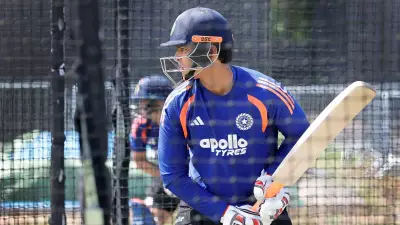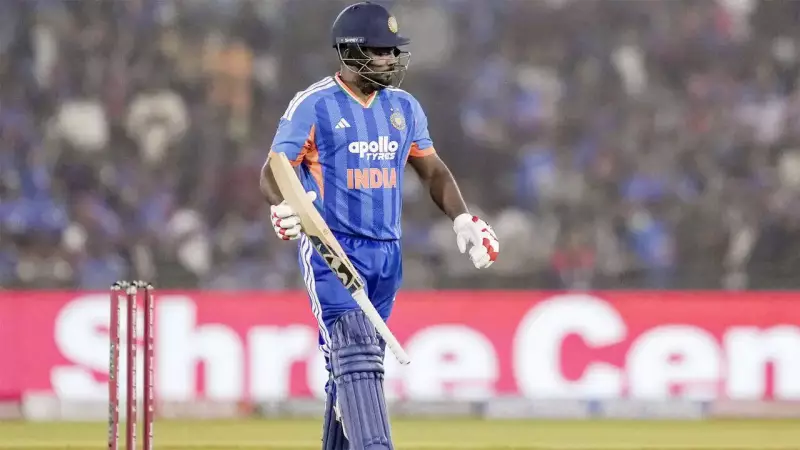
Sanju Samson's T20I Career: A Tale of Unfulfilled Promise and Persistent Challenges
For over a decade, Sanju Samson has represented one of Indian cricket's most fascinating paradoxes. A batter endowed with exceptional elegance and undeniable natural talent, his T20 International career has nevertheless been characterized by perplexing inconsistency that has left fans and analysts equally bewildered.
Recent Struggles Amplify Longstanding Concerns
His recent disappointing performances against New Zealand — scores of just 10, 6, and 0 in the first three matches — have only served to highlight these ongoing concerns. The contrast becomes particularly stark when compared with competitor Ishan Kishan, whose current golden touch has earned widespread admiration from both supporters and cricket experts.
Examining Samson's career statistics reveals a complex picture. Across 55 T20 International matches spanning 11 years, he has accumulated 1,048 runs with a strike-rate exceeding 147, complemented by three half-centuries and three centuries. Notably, two of those centuries were achieved during India's tour of South Africa in late 2024.

Technical Vulnerabilities Against Specific Bowling Attacks
However, deeper analysis uncovers significant vulnerabilities against particular bowling attacks. His strike-rate drops noticeably to 131 against Australia, further declines to 118 versus England, and reaches its lowest point at 113 when facing New Zealand.
Since assuming opening responsibilities from 2025, distinct patterns have emerged in how opposition teams approach bowling to him. England developed an effective strategy early last year, consistently delivering fast, short-pitched balls directed at his body across five consecutive matches. This tactic forced hurried pull shots that lacked both power and precise timing.
In 2026, New Zealand's Matt Henry (on two occasions) and Kyle Jamieson, both operating in the mid-130s kph range, have predominantly bowled straight deliveries or targeted leg-middle lines. This approach has successfully restricted his ability to free his arms and execute shots through the off-side.
Expert Analysis: Technical and Psychological Dimensions
To better understand the multifaceted issues affecting Samson's batting, insights were gathered from two respected figures in Indian cricket. Former India opener WV Raman, widely regarded as one of the country's foremost authorities on batting technique, and Rajasthan Royals High Performance Director Zubin Bharucha, who has worked extensively with Samson, offered their perspectives.
WV Raman identified a dual challenge encompassing both technical and psychological elements. "Sanju faces difficulties on both technical and mindset fronts. His bat-speed during the downswing remains consistent regardless of variations in bowling speeds. This approach brings him success against bowlers operating around the 130 kmph mark," Raman explained.
"However, when facing deliveries either above or below this speed threshold, or encountering variations in pace, problems arise. The solution lies in adjusting his bat-speed during the downswing according to the ball's pace. Once he masters this adjustment, he should find his rhythm," Raman added regarding the technical dimension.
On the psychological aspect, Raman noted: "Mentally, he is acutely aware of the intense competition for the wicketkeeper-batter position in white-ball cricket. This awareness likely contributes to the pressure he experiences, despite possessing ample talent to overcome these challenges. He remains a capable player who can deliver significant performances for India."
Raman dismissed suggestions that moving Samson through the batting order has disrupted his rhythm, emphasizing that contemporary players value adaptability. "In T20 Internationals, he is best suited for positions within the top three, where he can perform optimally. Modern cricketers emphasize adaptation and versatility across batting positions. This shouldn't pose problems unless he is placed extremely low in the order."

The Mental Game: Confidence and Clarity
Samson has long been recognized as a confidence-dependent player. Several years ago, he revealed in a podcast how, following a low score in a match, he discreetly left the stadium and spent time reflecting alone along Marine Drive.
Zubin Bharucha, who has mentored numerous Rajasthan Royals talents including Samson, Yashasvi Jaiswal, and Dhruv Jurel, believes the primary issues reside in the psychological domain. "There are no technical deficiencies whatsoever. For him, it's entirely a matter of mindset. He fluctuates between extraordinary and average performances due to occasional lack of clarity, though this experience is universal among cricketers," Bharucha observed.
"Every player encounters these phases — Suryakumar Yadav recently experienced similar challenges. It ultimately revolves around developing better management strategies for these mental fluctuations," added Bharucha, who has conducted comprehensive research into batting mechanics.
Strategic Countermeasures and Practice Solutions
Ravichandran Ashwin recently highlighted how New Zealand employed straighter lines against Samson, while England utilized short, rapid bowling. Bharucha elaborated on strategic adjustments: "In such scenarios, it involves practicing additional shots in perceived weaker areas. He has been deliberately scoring more runs on the off-side than the on-side."
"This is standard practice among batters — encouraging bowlers to target off-stump lines while positioning themselves to score from those deliveries. This naturally prompts bowlers to adjust by moving toward middle and leg lines, creating easier, lower-risk opportunities to hit toward the on-side," Bharucha explained.
"Occasionally, when excessively preparing to exploit the off-side, batters can become slightly mispositioned for leg-side shots. This simply requires heightened awareness, especially since Samson already possesses competent on-side strokes."
Regarding practical solutions, Bharucha recommended: "Practice additional deliveries targeting that specific area. Ideally, have throwdown specialists consistently vary their lines from off-stump to leg-stump during training sessions."