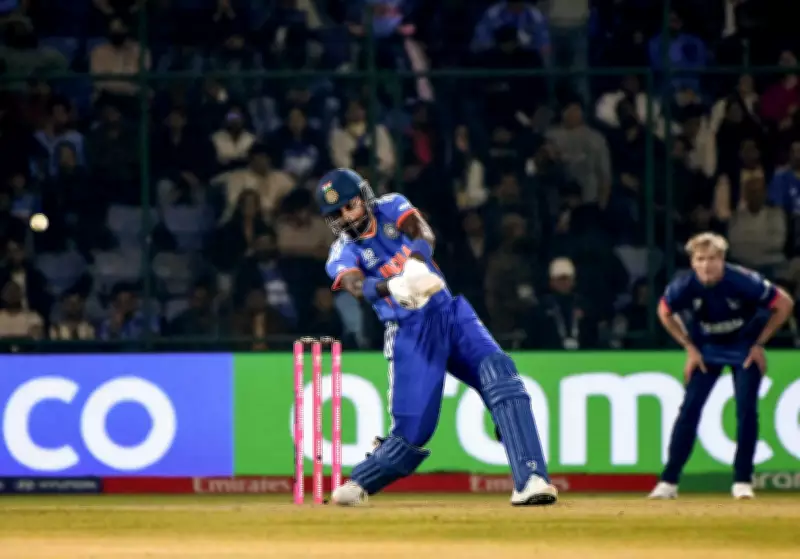
Hardik Pandya: The Self-Made Cricketer Who Rose from Chaos Like Atum
In Egyptian mythology, Atum is the primordial creator deity who emerged from chaotic waters, bringing himself into existence before shaping the rest of the world. In simpler terms, Atum created himself. This ancient tale finds a modern parallel in the rise, grind, and survival of India's premier all-rounder, the MVP of white-ball cricket: Hardik Pandya.
Chaos and Resilience: The Pandya Story
Chaos and Hardik Pandya go hand-in-hand, yet the cricketer has consistently fought the odds, shutting out external noise and battling continuous perceptions. With his quirky hairdos, numerous tattoos, unique dressing style, flashy cars, and an impressive collection of exotic watches, Pandya is a figure who commands attention. Fans love him for his cricket, question his choices, and troll him for his personal life, but one glance leaves a lasting impression of warmth that instantly makes you feel at home. Hate him, troll him, but you can't ignore him. Pandya is the heartbeat of India's white-ball set-up and the crucial piece that has kept the scales in balance since 2016.
The Early Glimpse: John Wright's Discovery
However, 2016 is not the key year in the Pandya story. It was the 2013-14 season of the Syed Mushtaq Ali Trophy when John Wright, then Mumbai Indians head coach, was scouting local talent from the stands. Watching one of Baroda's games, Wright's first glance of Pandya left a lasting impression on the New Zealander. Over a decade later, the 71-year-old recalls the details as if they occurred yesterday.

"I watched him for a week in various games at BKC. He didn't get a lot of runs, but he had an attitude. He kept trying to hit it over the boundary and attack," Wright tells TimesofIndia.com from New Zealand. "We tried to sign him that year only as we had a gap in our squad. I think Jalaj Saxena got injured and we could have replaced him, but Hardik picked up a back injury, so we couldn't. He came to nets at Wankhede and bowled and batted. And then he got injured, so we couldn't get hold of him that year."
Wright adds, "We got him the next year. I was lucky because I played against Kiran More, and Kiran and I have been mates for years. He knew a bit about him, but I loved his attitude. I'll never forget that clip of his hip - like Virender Sehwag, which is just a shot that you see. That was 2014, he played for us from 2015 and started winning titles with us."
Mentorship and Bonding: The Pollard Connection
Pandya's entry into the Mumbai Indians setup meant sharing the dressing room with legends of the game. In that dugout, he found mentors and coaches, forming bonds that remain strong. Kieron Pollard's entry into his life remains a defining moment of Pandya's career. In the West Indian all-rounder, Pandya found someone he could relate to, speak with, and learn from. While those lessons extended beyond cricket, the early confidence was something that stayed with Pollard for many years.
"My first thought of him was someone who's excited, someone who had that youthful sort of exuberance coming into the unknown world, but still just being himself," says Pollard in an exclusive chat. "And again, I think that is what took me aback because normally when guys come into a setup like MI, they're normally shy. But he wasn't shy. He was confident. And I think that was what took me."
While the first impression was positive, Pollard took it easy with the young all-rounder. He wasn't looking too far ahead, but when he saw Pandya navigate through the lows of his career, he made a decision. The West Indian was convinced that Pandya has the "true mettle" to excel at the big stage and is "made for the big times."

"I think it took a couple of years for me to actually make that determination in terms of 'he's cut out for it' because he had highs and then he had some lows," explains Pollard. "And that's where you can actually see the true mettle of an individual because it tends to happen. You have one good season and then that's it for some guys. But the manner in which he went through his highs and lows is sort of proof to myself that he has what it takes. And again, for us, we spent a lot of time together. He spent a lot of time chatting about cricket, about life, brains and stuff like that. And so all of these things, after being taken in, and then you see the expressiveness on the field, that's when you really realize, okay, this guy, he's made for the big times."
Learning from Teammates: The Power of Peer Coaching
During his early days in the MI set-up, Wright noticed the growing closeness between Pandya and Pollard, seeing their friendship blossom into a special bond. It rubbed off on the cricket too, as the veteran coach still feels that the "best coaching comes from your co-players."
"I think one of the things that stands out is that they were great mates. They seemed to get on really well," says Wright. "And obviously, playing together, that relationship helped. The best coaching comes quite often from your co-players. From the mates in the team. You can be a coach, but the best coaching comes from your teammates. It's an old-fashioned way of learning, but it's probably the best and strongest. For instance, when in the Indian team, Anil Kumble's influence on our spin bowlers was huge. Rahul Dravid, Sourav Ganguly, Sachin Tendulkar, and VVS Laxman's influence on other batters was massive. I think as a coach, you need to create that environment so that the players are learning off each other. And I think that has happened with Polly. But I think they love each other's company. They're great mates. He learned an awful lot from Kieron Pollard."
Caribbean Outlook and Mental Strength
In his numerous interactions, Pandya has always called Pollard the brother from another mother. The bond between the two remains special, and Pandya maintains that his Caribbean outlook on life continually draws him to Pollard. When Hardik's brother Krunal entered the MI set-up, the trio instantly clicked and together became the franchise's heartbeat for many years, helping them win titles and dominate the IPL. In Pollard's words, they were the "real engine room" of the setup. Regarding the Caribbean outlook, Pollard doesn't restrict it to music and style.
"We tend to associate that with Caribbean and West Indian music and style. But we also have that pride and that passion as well for performance," says Pollard. "As soon as you don't perform, people look at what you're doing. That's exactly from a Hardik perspective. That's exactly what has happened to him. He dresses nicely, he's there, he likes himself, he likes to look nice. He has that flair. People tend to try to use that against him because they don't have that confidence. That's what happened. So that is certain things that can resonate with myself."
Pollard and Pandya spent numerous late nights and early mornings in hotel corridors, and it wasn't just fun and games. It was about life, cricket, and everything in between. During his active playing days, Pollard was always known to shut out outside noise and speak his mind. It's an art that takes years to master, but with Pollard's words of wisdom, Pandya had an early bootcamp that prepared him for the numerous battles life, and cricket, had in store.
"I think it was just one of the conversations and one of understanding who can have an impact on you and who you allow to have an impact on you," Pollard reveals. "If you know that you're doing everything that you need to perform on a cricket field, and it's not happening, it's ok because it's a game, it's a sport, you feel a lot, right? But if you allow people who can't even pick up a bat or a ball or who only have an opinion because they're watching data to affect you, that's where the problem is. My cricket will speak for me. And if my cricket doesn't speak for me today, it's over. I'll get it to speak for me tomorrow. And that is the mentality I've had and that is the mentality that we sort of drill the conversations. Because people tend to say things, but we can control what we can control. We don't live it. But when you start to live it mentally, you get stronger."
Overcoming Injuries and Criticism
Over the years, Pandya has been labeled as fragile and injury-prone, with little appreciation for the relentless grind of a premier all-rounder. He isn't just a bits-and-pieces cricketer; he's a freak who can break into any XI purely on the basis of his batting or bowling. After career-threatening injuries and surgeries, Pandya continues to go strong, having already played 131 T20Is and 94 ODIs for the country. And he is not done yet!
"He would have been told a lot of things. He wouldn't be able to bowl again. His body's not strong. Who are you to say something like that? If you're not the expert," says Pollard. "So when you realize that those are just words and people are using words to maybe create an agenda, just channel your energy to say, okay. If you tell me I can't, I will show you I can. That's exactly what he did over the years. As I said, it has not been easy for him. And a person like that, living in India, the media is going to use that as a target. So that's the consequence that comes with the overall of that lifestyle. But you have to be able to be strong enough to overcome it. I believe he has been strong enough to overcome it. Who says they're not going to have more? Because life is like, life is a life thing. But he has now the template to overcome it. That's it."
Legacy and Hope for the Future
Flashy wraps on the car, expensive watches, and an envious lifestyle. While Pollard wouldn't buy most of the things—exuberantly priced watches in particular—that Pandya does, he is an incredibly proud "brother from another mother" to see the story unfold from close quarters. Pollard understands the feeling of winning a World Cup for the country, giving more than 100% in matches and during preparations, but hopes Pandya is remembered for "what he has done on the field."
"I just hope and pray one day that we continue to remember Hardik Pandya for what he has actually done on the cricket field," says Pollard. "Rather than the expensive watches and the cars and all that, because that tends to come first. As cricket tends to come second in the media world. For what he has done from a cricketing perspective and white-ball cricket, doing what he did especially after where he came from, the support he had from family—we must not forget that. The journey has been phenomenal and long it may continue."
Before disconnecting the call, Pollard remembered to laud Pandya's red-ball outings for India too. The current perception is that Pandya doesn't want to play Test cricket for India anymore, but just like Atum, he is determined to rise from chaotic waters.