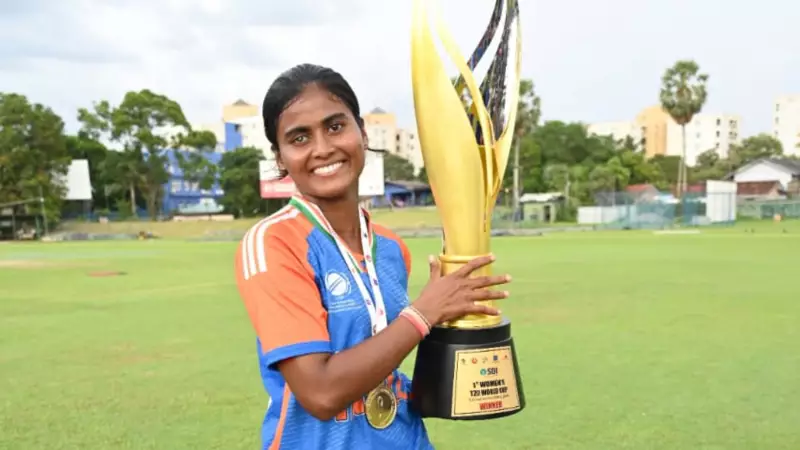
The story of T.C. Deepika is a remarkable saga of triumph over adversity. From scavenging for fallen fruit to stave off hunger in her childhood to leading India to victory in the inaugural Women's T20 World Cup for the Blind, her journey has been extraordinary. Now, the 23-year-old captain hopes her success on the cricket field in Sri Lanka becomes a powerful catalyst for change in her native village of Tambalahatti in Andhra Pradesh, a place still grappling with deep-seated regressive practices and a lack of basic infrastructure.
A Champion's Plea Brings a Road to Her Village
Following the historic World Cup win in November 2025, Deepika and her team were celebrated across the nation, visiting the Prime Minister's residence, Rashtrapati Bhavan, and the BCCI headquarters in Mumbai. However, for Deepika, one interaction stood out. While meeting Andhra Pradesh Deputy Chief Minister Pawan Kalyan, she seized the moment to highlight a critical issue plaguing her remote village located near the Karnataka border.
"I told him that there are no roads to our village because of which we are facing trouble," Deepika revealed. Her direct appeal had an immediate impact. Kalyan promptly allocated Rs 6.2 crore for a road construction project, a move that promises to transform connectivity for Tambalahatti's 45 families, most of whom belong to the Yadav community and work as farmers.

Beyond Roads: Challenging Regressive Traditions
While the new road will address a tangible problem, Deepika's vision for change runs deeper. She points out that the village's isolation has perpetuated harmful customs, particularly those targeting women. "Women are still asked to sleep outside their homes, either in farms or under a tree, during their menstrual cycle. Pregnant women, too, are not allowed to stay at home. It is also quite common to see girls getting married at a young age," she explained, attributing these practices to a severe "lack of education."
Her brother Girish confirmed that formal education for most children in Tambalahatti ends at Class 4. This educational deficit forms the backdrop of Deepika's own early life, marked by poverty and personal tragedy.
A Childhood Forged in Hardship
Deepika's challenges began in infancy. At just five months old, she accidentally poked her finger into her right eye. With no medical facilities nearby, her parents, daily wage labourers Chakthamappa and Chithamma, took her to hospitals 30 km and 68 km away. The treatment, which cost Rs 3,000—a fortune for the family—could not save the vision in that eye.
The family's financial struggles were acute. Chakthamappa and Chithamma together earned Rs 800 on days they found work. On days without work, which sometimes stretched consecutively, the family went to bed hungry. "Many times when I was young, my brothers and I used to roam around the village searching for fruits fallen on the streets. If we found anything, we picked it up and ate it," Deepika recalled. The situation was so dire that their grandfather died of starvation, and their father often survived on just one meal a day in his youth.
Cricket: The Path to a New Life
Deepika's life took a turn when she moved away for her education, first to the School of the Blind in Kunigal, Karnataka, and later to the Ranga Rao Memorial School for the Disabled in Mysuru, where she discovered cricket. The distance meant her father had to borrow money to visit her, a sacrifice that weighed heavily on her. "Whenever he visited, I used to check his pockets to see if he had money to go back home," she said.
After Class 10, she returned home but continued her studies. In 2019, a call from Shikha Shetty, now the national team manager, invited her to selection trials. Seeing cricket as a way out of poverty, Deepika attended with help from a well-wisher. Once selected, the Samarthanam Trust for the Disabled took her under its wing. "My life changed after that," she stated.

Her talent flourished, culminating in her stellar performance at the World Cup where she scored 246 runs in five games, including a brilliant 91 off 58 balls against Australia in the semi-final. Leading India to a seven-wicket win over Nepal in the Colombo final, she made the nation proud.
Today, TC Deepika stands not just as a World Cup-winning captain, but as a beacon of hope. She embodies the potential for sport to be a transformative force, aiming to use her hard-earned platform to drive social change, empower women, and inspire the children of Tambalahatti and beyond to dream bigger.