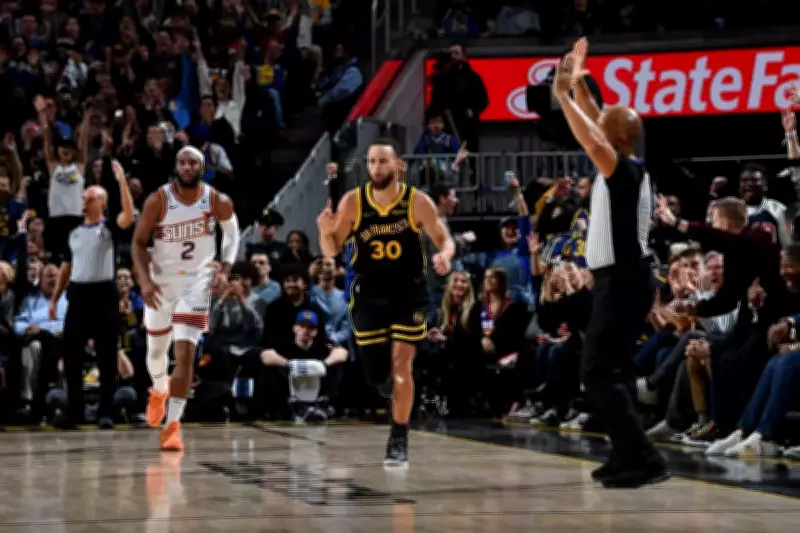
Warriors vs Suns: A Battle of Depth Over Star Power
The highly anticipated NBA clash between the Golden State Warriors and Phoenix Suns on February 5 unfolded under unusual circumstances, with several marquee players sidelined due to injuries. Instead of a duel between elite guards, the contest evolved into a strategic test of roster depth and lineup adaptability for both franchises.
Critical Standings Implications
The game carried significant weight in the Western Conference playoff picture. Phoenix entered the night leading the Pacific Division, while Golden State was fighting to maintain position and avoid slipping into the play-in tournament range. With both teams missing key contributors, the outcome promised to reveal which organization possessed superior bench strength and coaching flexibility.
Extensive Injury Reports Reshape Rotations
Golden State Warriors Absences:

- Stephen Curry: Right patellofemoral pain syndrome
- Jimmy Butler III: Right ACL tear (season-ending)
- Seth Curry: Back/left sciatic nerve irritation
- LJ Cryer: Left hamstring injury management
- Kristaps Porziņģis: Illness following recent trade arrival
Phoenix Suns Absences:
- Devin Booker: Right ankle sprain (seventh consecutive game missed since January 23 injury)
- Jalen Green: Right hamstring injury management and left hip contusion (initially questionable)
The absence of Curry and Booker particularly altered the game's expected dynamics, shifting emphasis away from individual offensive brilliance toward collective execution.
Projected Rotations and Responsibility Shifts
Golden State's Adjusted Approach: With their primary playmakers unavailable, the Warriors leaned heavily on veteran leadership. Draymond Green assumed expanded playmaking duties while directing the defensive scheme. Brandin Podziemski took on increased ball-handling responsibilities, building on his season averages of 11.5 points, 4.6 rebounds, 4.0 assists, and 1.2 steals per game. Al Horford moved into a larger frontcourt role, while Moses Moody and De'Anthony Melton provided crucial perimeter support.
Phoenix's Strategic Pivot: The Suns compensated for missing shot creators by emphasizing wing scoring and perimeter shooting. Dillon Brooks led this approach with averages of 20.4 points and 2.5 made three-pointers per game. Collin Gillespie contributed 13.6 points and 3.3 threes while running pick-and-roll actions. Grayson Allen added 14.1 points with 2.7 threes per contest. Mark Williams anchored the interior defense with 10.5 points, 7.6 rebounds, and 1.1 blocks per game.
Head-to-Head Context and Standings Impact
The rivalry between these franchises has remained fiercely competitive over recent seasons. While Golden State dominated during their championship runs, Phoenix has significantly closed the gap in recent years. The teams split their first two meetings this season, with Phoenix winning a narrow 99-98 decision on December 18 via late free throws.
Entering February 5, the Suns held a 31-20 record and first place in the Pacific Division. The Warriors stood at 27-24, occupying third position in the division. Statistical similarities between the teams were striking, with Golden State averaging 116.2 points per game compared to Phoenix's 114.1, and rebounding numbers showing minimal separation at 42.7 versus 43.1 respectively.
Team Statistics Snapshot
Comparative Team Metrics:

- Record: Warriors 27-24 (3rd Pacific), Suns 31-20 (1st Pacific)
- Points Per Game: Warriors 116.2, Suns 114.1
- Rebounds Per Game: Warriors 42.7, Suns 43.1
- Assists Per Game: Warriors 28.9, Suns 24.9
- Steals Per Game: Warriors 9.9, Suns 10.3
- Blocks Per Game: Warriors 4.5, Suns 4.1
- Turnovers Per Game: Warriors 15.6, Suns 15.1
- Team Field Goal Percentage: Both 46.1%
- Team Three-Point Percentage: Both 36.5%
These remarkably similar statistical profiles indicate closely matched playing styles, with both teams demonstrating efficient scoring capabilities while occasionally struggling with ball security.
Injury-Driven Matchup Factors
The absence of primary shot creators Curry, Booker, and Green fundamentally altered offensive approaches for both sides. Additionally, Butler's season-ending injury deprived Golden State of one of their premier perimeter defenders. The Warriors' size disadvantage without Porziņģis created rebounding opportunities for Phoenix's Mark Williams to exploit.
Outside shooting emerged as a potential deciding factor, with Phoenix's Allen, Gillespie, and Brooks providing crucial spacing, while Golden State relied on Podziemski and their guard rotation to generate perimeter offense. The game ultimately served as a comprehensive evaluation of organizational depth, with Phoenix seeking to solidify their division lead and Golden State fighting to remain clear of play-in tournament positioning.