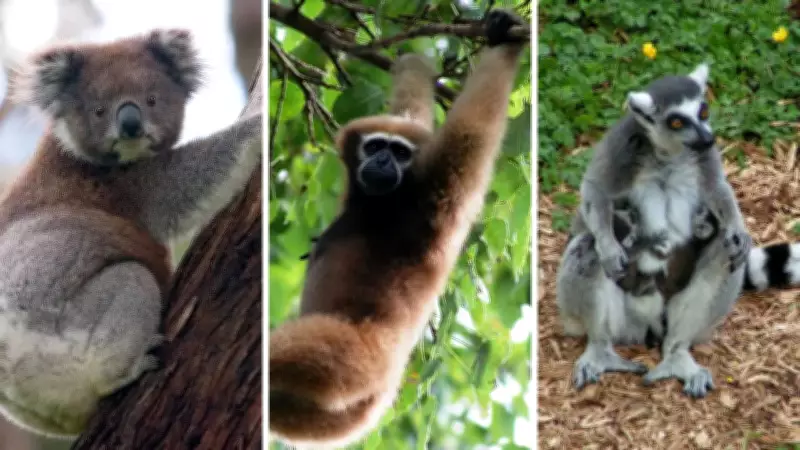
While opposable thumbs are often associated with human dexterity and tool-making, evolution has produced this trait in several other species beyond primates. From marsupials in Australia to amphibians in South America, various animals have developed specialized grasping mechanisms to climb trees, hold food, and create tools. These adaptations are crucial for survival in diverse habitats. Here are ten unexpected animals that can grab, grip, and climb like humans.
1. Baboons
Baboons, found across Africa and the Arabian Peninsula, possess an excellent opposable thumb system similar to humans. This allows them to manipulate small objects, use tools for food extraction, and even engage in aggressive interactions. Their grasping ability conserves energy while performing these activities.
2. Gibbons
Gibbons, known as lesser apes, have two opposable thumbs and two opposable big toes. This unique arrangement enables them to hold objects securely using both hands and feet simultaneously, aiding their arboreal lifestyle.

3. Lemurs
Lemurs feature opposable thumbs on both hands and opposable big toes on both feet. Their long fingers provide a secure grip while moving through trees. Some lemur species can lift up to ten times their body weight, showcasing their strength.
4. Koalas
Koalas have two opposable thumbs on each hand, allowing them to cling tightly to eucalyptus branches. This adaptation is essential for their tree-dwelling lifestyle. Interestingly, koalas, like humans, have unique individual fingerprints.
5. Opossums
Opossums lack opposable thumbs on their front feet but possess an opposable hallux (big toe) on their hind feet. This helps them grasp branches and groom themselves while climbing. Their back feet have evenly spaced toes, while front feet have five fingers.
6. Chameleons
Chameleons have specialized feet with toes grouped into opposing bundles (two or three toes per bundle), providing a precise and steady grip on branches. Sharp claws further enhance their climbing ability.
7. Slow Lorises
The Slow Loris, the only venomous primate, has opposable thumbs and large hands and feet. It is an excellent climber, spending most of its time in the canopy and rarely descending to the ground except to defecate.
8. Waxy Monkey Tree Frogs
This rare South American amphibian possesses opposable thumbs, enabling it to climb branches rather than hop like typical frogs. Its name reflects its monkey-like climbing abilities, demonstrating convergent evolution.
9. Macaques
Macaques, found across Asia and North Africa, have fully opposable thumbs that grant fine motor skills for precise object manipulation. They are the only primate genus besides humans with such widespread adaptability.
10. Other Notable Species
Beyond these examples, many other animals exhibit grasping adaptations. For instance, some birds and insects have evolved specialized feet or appendages for gripping. Understanding these mechanisms highlights the diverse evolutionary paths to survival.