Science pointed the way. Legs carried it through. A routine VO2 max test — a measure of how efficiently the body uses oxygen under increasing workload — redirected Army runner Sawan Barwal from track to marathon. Two years later, it delivered a national record, erasing a 48-year-old mark.
The Record-Breaking Debut
Barwal, 28, a havildar, clocked 2:11:58 on his marathon debut at Rotterdam earlier this month, shaving 2 seconds off Shivnath Singh's 2:12:00 from 1978 — one of Indian athletics' longest-standing benchmarks. He finished 20th, but history tilted. His next target is consistency at the global level, with the Asian Games on the horizon.
The Science Behind the Shift
The turnaround began in 2024 at the Army Sports Institute (ASI). Coaches assessed his VO2 max — the ceiling of aerobic capacity, indicating how much oxygen muscles can use during sustained effort. High scores often signal endurance potential, and Barwal's numbers were exceptional. "Combined with his running economy and discipline, it was clear he had the physiological profile of a high-performance marathoner," an ASI official said Wednesday.

Barwal had built his career over 5,000m and 10,000m, consistent domestically but short of a global breakthrough. ASI's call was to shift him up — from track to 42.195km — where aerobic efficiency outweighs raw speed. "Finishing was the goal. Breaking a record wasn't," Barwal said.
A Test of Will
Rotterdam turned into a test of both science and will. The start temperature hovered near 12°C and dropped to about 7°C by the finish. In the final 400m, Barwal's body gave way. "I was freezing and completely drained. No energy left. I collapsed a few metres before the finish," he said. He got up, crossed the line — and likely lost minutes in that stumble. The clock still stopped at a national milestone.
From Hills to History
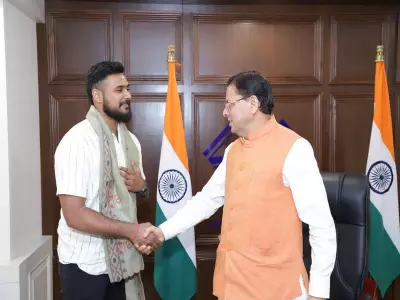
Barwal's endurance roots run deeper than lab readings. He grew up in an Uttarakhand village, walking nearly 6km daily to school across hilly terrain — conditioning long before structured training. Local race wins led to an Army sports quota entry in the Bengal Engineer Group, Roorkee, in 2019.
Plateaus are common in elite sport, according to ASI. Rather than lose athletes, systems now reroute them. "At a certain point, some stagnate. We transition them to disciplines that better suit their abilities," the official said, citing similar cross-discipline shifts elsewhere.
For Barwal, science rewired a career. Numbers spotted what instinct hadn't. A higher ceiling, a longer road — and a finish line that arrived with a fall, a rise, and a record.