India secured the strategic Saltoro Ridge in 1984, leading to a fierce battle for Quaid Post. Operation Rajiv saw Indian soldiers, led by Naib Subedar Bana Singh, bravely capture the post in 1987 after intense fighting. Renamed Bana Post, its capture marked a significant Indian victory, thwarting Pakistani attempts to regain dominance.
The NJ9842 line, drawn under the Karachi Agreement after the first Indo-Pak war, was meant to mark an end. Instead, it pointed “thence north to the glaciers” — and straight into the next conflict.
In 1984, 35 years later, India moved first, securing the strategic Saltoro Ridge overlooking the Siachen Glacier, pre-empting Pakistan. Islamabad responded in 1986, when its elite Special Services Group captured the left shoulder of Bilafond La. At 21,500 feet—the highest feature in the area—the position gave Pakistan a commanding advantage. Such was the importance of the post that the Pakistanis named it Quaid Post, after Muhammad Ali Jinnah.

In 1987, the 8th Battalion of the Jammu and Kashmir Light Infantry (JAK LI) was tasked with capturing this post. The unit held two positions — Sonam and Amar — on either side of Quaid Post, with Sonam being the lower of the two. Both Indian posts were dominated by the solitary Pakistani position perched above them. At such extreme altitudes, Indian positions were accessible only by helicopter, and sustained Pakistani fire made even routine movement hazardous, inflicting casualties on the outgoing 5th Battalion of the Bihar Regiment. It soon became clear: if 8 JAK LI was to hold its ground, the Pakistanis would have to be dislodged.
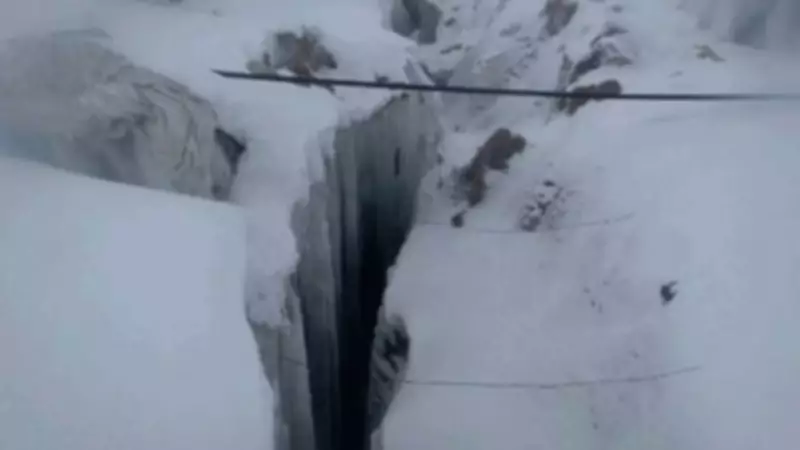
The terrain of the Siachen Glacier is among the harshest battlefields on earth. The geography is unforgiving—near-vertical walls of ice rising up to 500 metres stood between the Indian Army and its objective. The glacier itself is a frozen expanse where temperatures drop from around -35°C in summer to -60°C in winter. Deep, hidden crevasses lie beneath layers of snow, while avalanches and gale-force winds pose constant threats to both men and material. All of this unfolds at altitudes above 20,000 feet, where even seasoned climbers struggle with minimal equipment and supplemental oxygen.
Finding a Way to the Top
On the 29th of May 1987, a small team of Indian soldiers, led by Second Lieutenant Rajiv Pande, and a dozen men moved out to find the best route to the post on a dominating height. The patrol had advanced undetected till the very last stretch. Lance Havildar Mulk Raj Sharma, armed with nothing more than an ice axe, carved footholds into the sheer wall, anchoring the rope that would guide the rest. Inch by inch, the men climbed towards the objective. Then, in a moment, a Pakistani Machine gun broke the silence, the 13 men finding their way to the top of the mountain were cut short of the objective.
"As the patrol moved ahead, placing a rope to the top, Havildar Mulk Raj was establishing a path for others to follow. They were fired upon when they were 30 meters away from the Pakistani post, resulting in many casualties. Of the 13 men who went to make way to the highest post on the planet, only 2 survived," said Brigadier Rajiv Williams (retd), who was then a Major serving with 8 JAK LI. For his sacrifice, 2/Lt Rajiv Pande was awarded India's third-highest wartime gallantry award.
Operation Rajiv: 8 JAK LI Hits Back
The battalion, now resolved to take the dominating feature, named their next move Operation Rajiv, as a mark of respect for the young officer and his team. "The task was entrusted to a force of 55 officers and soldiers. The team consisted of 2 officers, 3 JCOs and 50 other ranks. This team was led by Major Varinder Singh. The newly formed Army Aviation Corps undertook a massive effort to assemble the men and equipment, in their Cheetah helicopters that could take only one man at a time," said Brigadier Rajiv Williams.

On 23 June 1987, the force moved out, taking hours to cover barely a kilometre as weather and terrain resisted every step. It took time to locate the rope fixed by Pande’s patrol, delaying the assault. By the evening of 24 June, the rope was found and the climb began once more. "A base was established below the objective, which was manned by the Pakistani Special Services Group, the best that the Pakistanis had to offer. The first assault was launched under Subedar Harnam Singh. As they advanced, they passed the frozen bodies of Lt Rajiv's patrol. At 03:30 AM on 25 June, they were detected and came under fire. The weapons of the assault element jammed in the extreme cold, leading to the assault to be called off," Brig Williams recalled.
Time was now an enemy as much as the sub-zero temperatures, the howling winds and the Pakistanis. Supplies dwindled. For over 48 hours, the men endured the cold, surviving on the small amount of rations the troops carried, the assault element was forced to suck ice to quench their thirst. On the intervening night of June 25–26, a second attempt was made under Subedar Sansar Chand. Once again, the defenders held their ground. The altitude, the paralysingly thin, oxygen-deprived air, the cold, and the firepower combined to repel the attackers.
Three nights at over 21,000 feet, out in the open and exposed to the elements, had pushed the men to their limits. Weapons malfunctioned in the freezing darkness. The decision was then taken by Major Varinder Singh to launch the assault in broad daylight, supported by fire from 130 mm artillery guns. Brigadier Williams added that "At 1:30 PM on 26 June 1987, Naib Subedar Bana Singh led a small assault group of five men closed in on the post and stormed the position. The small team of five men took a difficult route that required climbing a vertical wall several hundred feet tall. What followed was brutal, hand-to-hand combat in the rarefied air. In the confined space of the post, bullets gave way to bayonets and the troops who were out in the open for the last three days persevered and won through sheer determination. Six remains of Pakistani soldiers were recovered in the fierce engagement".
Quaid-e-Azam Jinnah Gives Way to Bana Singh
The capture of the post broke the tactical dominance Pakistan had enjoyed over the area. In honour of the man who led the final charge, Quaid Post was renamed Bana Post. Naib Subedar Bana Singh was awarded the Param Vir Chakra, India’s highest gallantry award for valour.
Musharraf's First Defeat
An embarrassed Pakistani army, reeling from the loss of a post of immense tactical importance, sought to regain the initiative. Then commander of the SSG Brigade, Pervez Musharraf launched an audacious attempt to recapture the position, along with the neighbouring posts of Sonam and Amar at the Bilafond La complex, under Operation Qiadat. The operation was launched on September 23, 1987.
Indian troops, positioned on the dominating ridgelines, detected the Pakistani build-up and responded with Operation Vajra Shakti to counter the offensive. Repeated Pakistani assaults on the Bilafond La complex were beaten back, with heavy casualties. These operations consolidated India’s tactical advantage in the Siachen Glacier region. "The credit for this victory goes to the junior leadership men such as 2nd/Lt Sharma of the 3/4 Gurkha Rifles, who was awarded the Vir Chakra for his role in the battle and Subedar Lekh Raj of 8 JAK LI, who fought till his very last," Brig Williams said.
Years later, as Pakistan army chief, Pervez Musharraf would return to the mountains with the Kargil War — an attempt to rewrite the balance on the heights. It failed. But long before Kargil, on a wind-lashed ridge at 21,500 feet, the first verdict had already been delivered. In the thin air of Siachen Glacier, where survival itself is a battle, Indian soldiers had settled the score — one icy step at a time.