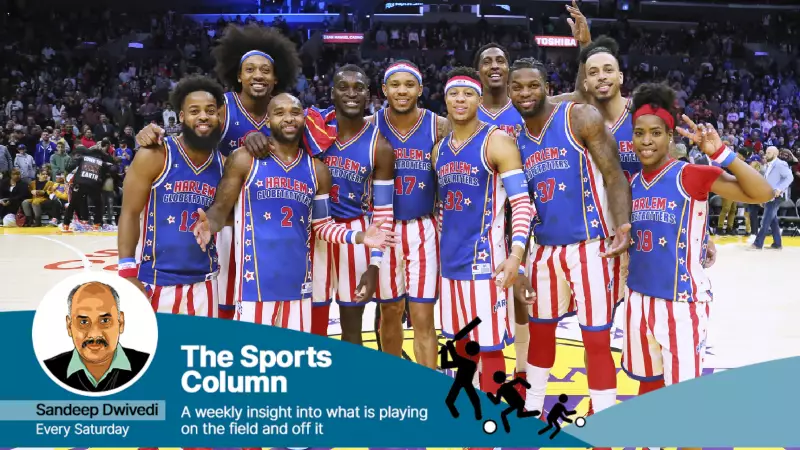
In a tale that transcends sports, the Harlem Globetrotters are not just celebrating a century of basketball wizardry but a hundred years of breaking barriers and uniting people. From being denied hotel rooms in a racist America to sharing tea with Soviet Premier Nikita Khrushchev, their journey is a testament to resilience, talent, and the power of joy. As they kick off their ‘100 Year Tour’, their legacy is not measured in championship trophies but in the millions of hearts they conquered worldwide.
More Than a Game: Breaking Racial Barriers
The early 20th century in America was a time of deep-seated racism. The story of the Globetrotters begins in this era, where a travelling chimpanzee trained to bowl would be given a hotel suite, but a supremely talented team of Black basketballers was denied a room. Sports were segregated, with Black athletes confined to the ‘Negro Major League’. The Globetrotters, initially seen as less worthy than an animal, emerged from this ghettoisation to change perceptions forever.
They were pioneers of what is now called ‘show basketball’ – incredible ball-handlers, dazzling dribblers, and master tricksters. Their games were not just about winning; they were a form of artistic expression and subtle protest. Playing mostly against white teams, their breathtaking skills were a powerful rebuttal to racist stereotypes, proving Black athletes were not just ‘good enough’ but often spectacularly superior. This laid the groundwork for the slow integration of races in professional sports.

Ambassadors of Joy: America's Unlikely Soft Power
At the height of the Cold War, the Harlem Globetrotters became one of America's most effective tools of soft power. They were unofficial ambassadors who could open doors diplomacy alone could not. Their universal language of laughter and jaw-dropping athleticism disarmed hostility and built bridges.
Their impact was staggering. They have performed in an estimated 127 countries, entertaining nearly 148 million fans. On a South American tour, two warring nations declared a temporary truce just to watch them play. In the 1950s, when the US sought to reach out to Argentina under Juan Perón, the Globetrotters went to Buenos Aires and were showered with gifts by First Lady Eva Perón. They even received the Athletic Order of Lenin medal after a tour in the Soviet Union.
They took basketball to places with no hoops culture, playing on drained-out pools and skating rinks. In Brazil, they drew 120,000 fans to a football ground. Chinese basketball legend Yao Ming credits the Trotters' tour for inspiring him to take up the sport.
The Art of the "No Way!" Move
The core of the Globetrotters' appeal was their revolutionary style of play. They transformed basketball from a rough, cage-fight-like sport into a symphony of speed, fluid motion, and inspired comedy.
Their repertoire was endless:
- Blind hook shots from the foul line.
- No-look tries from half-court that ended with the perfect ‘swoosh’.
- Passing the ball magically without looking, perfectly timed for a teammate in stride.
- Spinning the ball on a finger, bouncing it off their head, or hiding it in their jersey as part of a hilarious gag.
Every night featured new improvisation. They mocked their opponents with such skill and charm that the crowd was left in splits. As author Ben Green noted in his book Spinning the Globe, they orchestrated “dazzling skills and inspired comedy,” making the ball an extension of their personality.
Inspiring a Future President: The Obama Connection
Perhaps one of their most profound impacts was on a young boy living in Hawaii, where there were few Black people. That boy was Barack Obama. Watching the Harlem Globetrotters play was a formative experience for the future US President.

Reflecting on their influence, Obama said the players represented the Black men of that generation – individuals of enormous talent who endured indignities to survive. Their strength and determination, he noted, “did the groundwork for people like myself to serve in the US Senate.” From being denied a hotel room to inspiring a man who would occupy the White House, the Globetrotters’ journey symbolizes the arc of a more inclusive American dream.
As they embark on their second century, the Harlem Globetrotters’ legacy is secure. They are more than a basketball team; they are cultural icons who used sport as a vehicle for social change, global diplomacy, and pure, unadulterated joy. For 100 years, they haven't just shot hoops; they have made the impossible seem possible, one ‘no way’ move at a time.