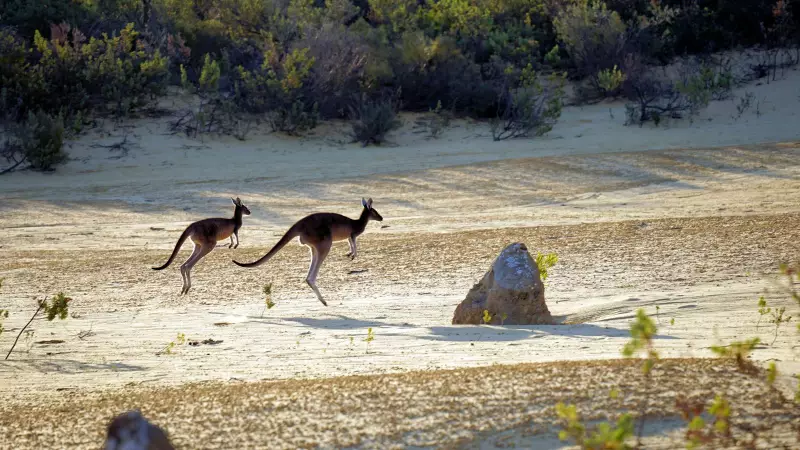
For decades, paleontologists have operated under the assumption that Australia's extinct mega kangaroos were simply too colossal to hop. These prehistoric marsupials, some weighing as much as 250 kilograms, were thought to have joints and tendons incapable of withstanding the immense stresses associated with the iconic kangaroo bounce. A groundbreaking new study published in the journal Scientific Reports is now overturning these long-standing beliefs, offering a fresh perspective on the locomotion of these ancient giants.
Revisiting Mobility Through Bone Analysis
Led by researcher Jones and her team, the study embarked on a meticulous investigation into how these enormous creatures might have moved across the ancient Australian landscape. Rather than relying solely on assumptions based on their formidable size, the scientists conducted a detailed comparative analysis. They examined the hindlimbs of 94 living kangaroo and wallaby specimens alongside 40 fossil samples representing 63 different species, including members of the giant kangaroo genus Protemnodon. These animals thrived during the Pleistocene era, a period spanning from approximately 2.6 million to nearly 12,000 years ago.
The Crucial Fourth Metatarsal
A central element of this research was the focused examination of the fourth metatarsal, a long bone in the foot that plays a vital role in hopping for modern kangaroos. This bone is essential for absorbing and distributing force upon each landing. By meticulously measuring the length and width of this bone and correlating these dimensions with estimated body weights, the research team assessed whether the skeletal structures of giant kangaroos could endure the pressures generated by hopping.

Surprisingly, the findings indicated that the metatarsals of even the largest extinct species possessed sufficient strength to support hopping motions. This discovery directly challenges previous hypotheses that suggested their sheer mass would have made such locomotion biomechanically impossible.
Assessing Tendon Support Structures
The researchers extended their inquiry by estimating the size of the heel bones in these ancient animals to deduce the type of Achilles' tendons required for effective hopping. This aspect was crucial, considering the energy-conserving function of these tendons in modern hoppers. Through comparative analysis of heel bones between extinct and contemporary kangaroo species, the team concluded that the heel bones of giant kangaroos were remarkably large, adequately structured to support the robust tendons necessary for hopping.
Hopping: A Supplementary Survival Strategy
While these anatomical findings strongly suggest that giant kangaroos possessed the physical capability to hop, the researchers propose that it was likely not their primary mode of transportation over long distances. They explain that the substantial size and extra weight of these creatures would have made sustained hopping inefficient and excessively energy-draining. However, the study posits that brief, intermittent periods of hopping could have played a significant role in their survival strategies.
Observations of modern small animals, such as mice and certain marsupials, show that they occasionally employ hopping bursts even when their primary locomotion is walking or running. Similarly, for giant kangaroos, these short hopping episodes might have been instrumental in evading predators, like the extinct Marsupial Lion (Thylacoleo), by enabling rapid directional changes.
This comprehensive study fundamentally contradicts traditional views on the mobility of large prehistoric animals, adding considerable depth to our understanding of Australia's ancient fauna. It reveals that the giant kangaroos that once roamed the continent may have been more agile and acrobatic than previously imagined, demonstrating that even massive creatures could incorporate dynamic movements into their behavioral repertoire.