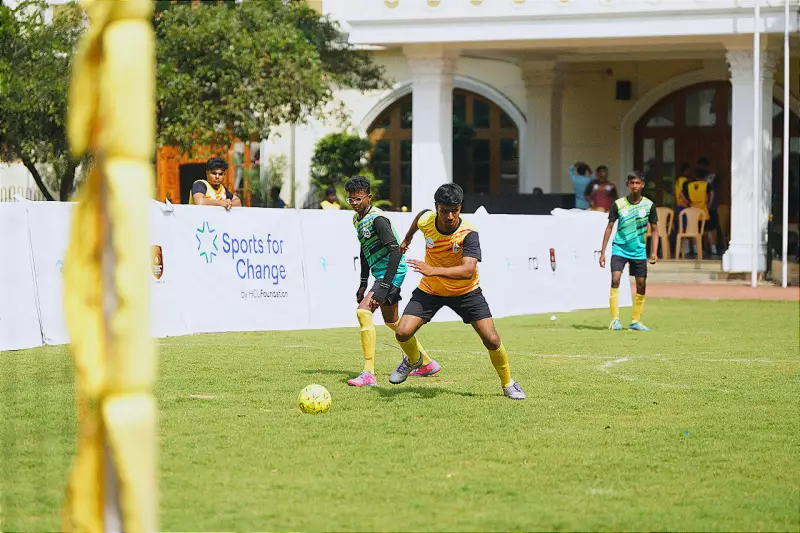
On a school ground in Chennai, the swift movements of 14-year-old T Manivasagam defy expectations. Born with congenital blindness, he chases a football guided solely by its sound and the voice of his coach shouting "voy"—the safety cue in blind football. A student of Poonamallee Government School, Manivasagam represents a new wave of athletic talent emerging from Tamil Nadu's initiatives for the visually impaired.
Overcoming Fear, Chasing Dreams
For Manivasagam, the most difficult part of training was learning to run without fear. "I was constantly worried of bumping into someone or something," he admits, recalling his coach's assurances that the path ahead was clear. After six dedicated months of training, his fear has transformed into ambition, and he now dreams of representing India in blind football.
His teammate, 22-year-old B Sheik Irfan, shares a similar story of rediscovery. A football lover since childhood, Irfan stopped playing after losing vision in one eye, followed gradually by the other. Blind football brought him back to the field. "I restarted recently. Ever since I lost my vision, I've learnt how important trusting your own team is," says Irfan, who now aims to pursue the sport professionally.

The 'Acham Thavir' Initiative: Scouting Talent and Building Confidence
Both athletes are participants in the Tamil Nadu Blind Football Association's (TNBFA) pioneering 'Acham Thavir' (Fearless) programme. This initiative actively travels to schools across Chennai to scout and coach visually impaired and partially sighted students. Its core mission is to dismantle misconceptions and build confidence through sport.
"There is a misconception that visually impaired and partially sighted people cannot participate in sports," states Francis Sebastian, General Secretary of TNBFA. "That's why we created 'Acham Thavir' to scout for talent, teach movement, coordination, and build confidence."
Francis identifies building initial confidence as the biggest challenge, as students fear collisions and falls. "The first session is about making them understand what running is," he explains. Coaches employ touch-based demonstrations to teach skills like dribbling, while players learn to track the ball by sound and follow precise verbal cues from guides.
Building a Sporting Ecosystem for the Visually Impaired
Blind football began gaining traction in Tamil Nadu around 2015, with the TNBFA being formally established in 2019. From a small volunteer network, the association has grown steadily. Key milestones include:
- Hosting the first women's national championships alongside the fifth men's nationals in Chennai in 2021.
- Organizing Tamil Nadu's first state championship for partially sighted players in 2024, featuring 100 participants from schools and clubs.
- Launching a pro-league this year to spotlight emerging talent.
The ultimate goal of 'Acham Thavir', according to Francis, is to build an Olympic culture of excellence, respect, and friendship among visually impaired students and widen access to sports. However, a gap remains in women's participation. "We are still waiting for a partially sighted women's team to emerge," says T Bhuvaneswari, captain and coordinator of the women's blind football team.
Bhuvaneswari believes programmes like 'Acham Thavir' are crucial for change. "For most girls, the biggest hurdle is the fear of getting hurt. Once they overcome that, everything else falls into place. We will soon see more girls stepping onto the field."
From the school grounds of Poonamallee to state championships, the journey of Manivasagam, Irfan, and countless others is rewriting the narrative for visually impaired athletes in India. Through the sound of a rolling ball and shouts of "voy," a new, inclusive sporting legacy is being forged in Chennai.