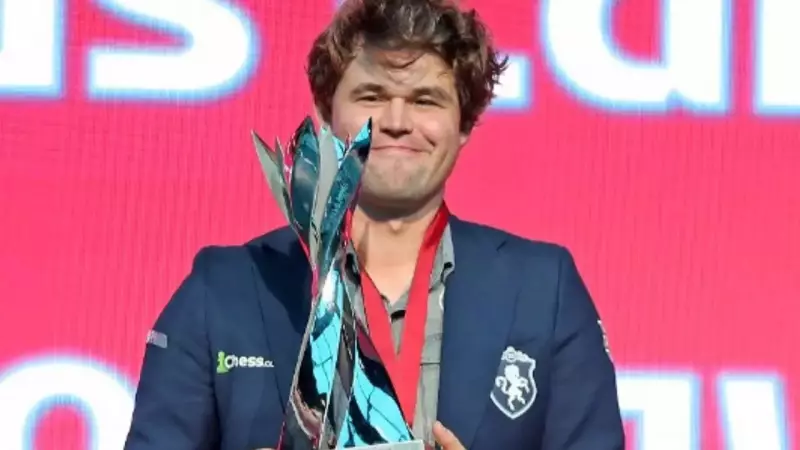
If fellow chess elites were to petition scientists to declare Magnus Carlsen a separate species, unqualified to compete with mere mortals, their plea might be understandable. The Norwegian grandmaster, at 35, has once again left the chess world in awe, securing his fifth career double by winning both the World Rapid and World Blitz titles in Doha, Qatar. This monumental victory marks his staggering 20th overall world championship title, reinforcing his dominance in a way that makes even his fiercest rivals seem like novices.
The Unfinished Business of Doha
Carlsen revealed that returning to Doha was driven by a desire to settle old scores. He referred to his 2016 performance in the same city—a silver in blitz and bronze in rapid—as "unfinished business," admitting that not clinching the blitz title back then still bothered him. "It was not a straightforward decision at all to play here," Carlsen confessed in a press conference streamed by FIDE. "But once I decided to play, I thought I should give my very best. I have probably over-performed a little bit. Winning both (titles together) should not be a norm. But sometimes, the numbers don’t lie."
His path to glory, however, was not smooth. The blitz tournament presented significant hurdles, forcing Carlsen to secure 4.5 points in the final five rounds just to qualify for the semi-finals. He candidly analysed his early struggles: "I was not doing many things right till the 14th round. My pace was too slow and I could not keep my cool in time trouble, which is a pretty bad combination when you are playing slowly." The turning point came with the knockout stages. "Once we got to the knockouts, I thought I should really try and enjoy this. I did not necessarily expect to be there. It was a tough event but I am super happy because, at some point, I defied the odds."

The Psychological Edge of a Champion
When a journalist hinted at his "waning powers," Carlsen responded with characteristic confidence: "I don’t think I am getting worse compared to my opponents!" He further elaborated on the unique mindset that sets him apart from the competition. "I’m playing for the first place when I am playing here," he stated. "A lot of players, a majority of the top boards, want a good prize and maybe a medal and maybe a win. For them, getting one of the top prizes is the most important thing. But for me, it’s different. That’s certainly a huge psychological advantage that I have."
This mental fortitude was on full display, even as he showed his human side. The pressure manifested in visible nerves—banging the table, spilling pieces, and even nudging a cameraman's equipment during critical endgames in both tournaments. Yet, his sheer quality prevailed. "When I am on my game, I am usually very good in any format that you put in front of me," he boasted, a statement his record undeniably supports.
Respect from Rivals and Strategic Insights
The chess community continues to grapple with how to approach the Carlsen phenomenon. World No. 2 Hikaru Nakamura offered strategic advice after watching the final, commenting on his streaming platform about opponent Nodirbek Abdusattorov's approach. "Though at some level, it’s good to treat Carlsen like any other player, in certain situations—especially endgames—you have to be mindful about whom you are playing," Nakamura advised. "It’s better to simplify the position rather than getting into positional battles with Magnus."
Younger stars also hold him in high esteem. The eccentric Alireza Firouzja recently expressed his respect in Mumbai, saying, "Magnus says whatever he believes in and does whatever he believes in." This sentiment echoes the broader acknowledgment of Carlsen's impact, having dominated this fast-evolving cerebral sport for 15 years and uplifting it through online initiatives during the Covid-19 pandemic.
As a new generation of players, whom Garry Kasparov once called "Vishy Anand’s children," rise with younger minds and AI-backed preparation, Magnus Carlsen has delivered a powerful reminder. With his 20th world title secured in Doha, he continues to cement his position as an absolute great, defying odds and redefining excellence in modern chess.