Pune's Vimannagar One-Way Traffic System Descends into Chaos After Official Changes
Residents of Pune's Vimannagar neighborhood declared on Tuesday that the highly promoted one-way traffic system has effectively collapsed. This breakdown is attributed to the transfer of key officials and a significant relaxation in enforcement, resulting in widespread disorder on the area's roads.
Initial Success Followed by Rapid Deterioration
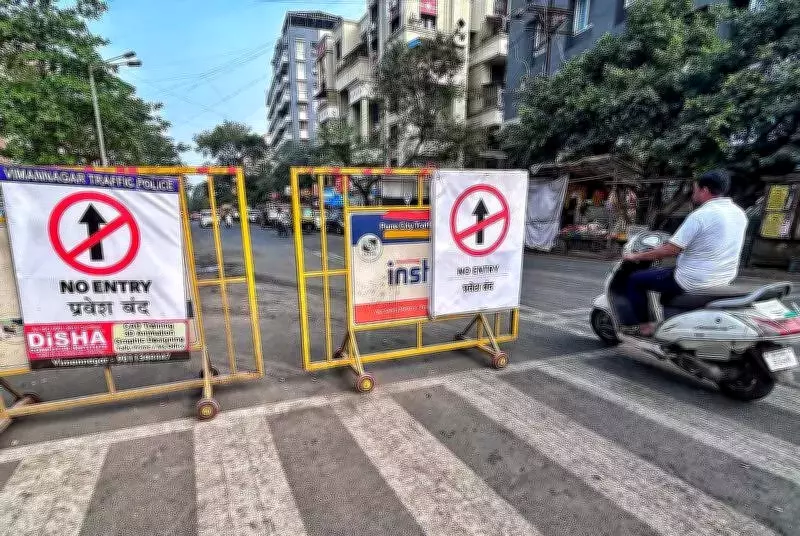
The one-way system was implemented in mid-November last year as a strategic measure to alleviate congestion on Vimannagar's narrow internal roads. In its early stages, the initiative showed promising results. Traffic police data indicated that peak-hour travel times were reduced by nearly eight minutes, a notable improvement for daily commuters.
Key components of the plan included designating the stretch from Ganga Puram Chowk towards Ganpati Mandir as one-way, alongside the road from Shree Krishna Hotel toward Café Coffee Day. However, local residents now assert that these initial gains have been completely erased.

Residents Voice Frustration Over Enforcement Failures
"The Vimanagar one-way worked initially due to a combination of citizen support and strict enforcement," explained Anita Hanumante, a long-time resident. "But lax monitoring, selective policing, and poor compliance from commuters have severely weakened the system."
Hanumante confirmed that the issue has been formally raised with senior officials, including the additional commissioner and the Deputy Commissioner of Police (traffic), who originally oversaw the plan's execution. Despite the current chaos, residents remain cautiously optimistic that corrective actions will be implemented promptly.
Motorists Revert to Old Habits, Violations Escalate
Another concerned resident, Rajesh Nambiar, observed a gradual return to previous driving behaviors. "People complied with the rules for a while, but over time, they returned to their old ways. This has led to frequent wrong-side driving, particularly by two-wheelers," he stated.
Nambiar emphasized that the problem is no longer confined to motorcycles. "While wrong-side driving is a common menace among two-wheelers in Pune, even luxury car drivers in Vimannagar are now doing the same. It has become a habitual pattern," he added.
He further highlighted a critical enforcement gap: whereas police were previously stationed at all exit points, their presence is now largely concentrated at Dattamandir Chowk, leaving other stretches completely unmanned.
Proposed Solutions and Official Response
To address the escalating issue, Nambiar proposed the installation of e-challan cameras at both ends of the one-way stretches. He argued that automated enforcement would serve as a constant deterrent, ensuring discipline even in the absence of physical police personnel.
In response to mounting complaints, Assistant Police Inspector Raja Rajkumar Barde of the Vimannagar traffic division maintained that personnel are actively deployed and violators are being penalized. "Traffic police are active on the ground. Vehicles violating the one-way rules are being stopped and issued challans," Barde asserted, noting that enforcement efforts continue into the evening hours.
He stressed that the department is adopting a zero-tolerance approach to wrong-side driving. "Our teams are stationed on both one-way routes, and any vehicle entering from the wrong side is fined without exception."
The situation in Vimannagar underscores a broader challenge in urban traffic management, where initial successes can quickly unravel without sustained enforcement and administrative continuity. Residents await concrete measures to restore order to their neighborhood's roads.