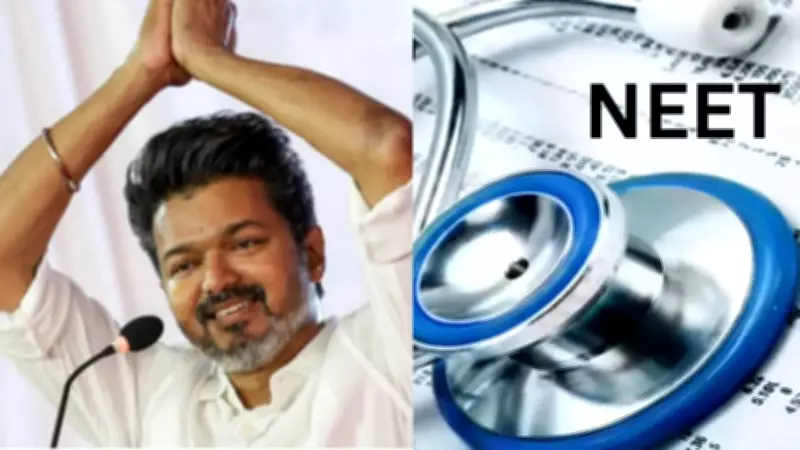
When Vijay stepped into politics with Tamilaga Vettri Kazhagam (TVK), he positioned himself as a fresh alternative, powered by youth support and digital mobilization. His campaign spoke of dignity, clean governance, and empowerment, which has now translated into victory for him at the Tamil Nadu Assembly Elections.
However, what Vijay’s entry did not change was Tamil Nadu’s position on the National Eligibility cum Entrance Test (NEET). From his early speeches in 2024, Vijay made his stance clear. “People have lost faith in NEET. The nation doesn’t need NEET. Exemption is the only solution,” he said, backing Tamil Nadu’s long-standing demand to opt out of the exam. He has also argued that NEET is unfair to economically weaker students and has called for education to be moved to the State List.
The ruling establishment, led by Chief Minister M K Stalin, has consistently opposed NEET through legislative and political means. The state government passed anti-NEET Bills in 2021 and 2024, proposing admission based on Class 12 marks, but these were rejected at the central level. Stalin had called the rejection a “dark chapter in federalism” and even convened all-party meetings to build consensus.

This reflects a rare point of agreement across political lines in the state. Parties that otherwise compete fiercely have taken a similar position on NEET, arguing that the exam disadvantages rural and state board students, favors those who can afford coaching, and reduces representation from less privileged backgrounds.
Data and committee findings in the past have pointed to a drop in rural representation in medical admissions. Tamil Nadu's A K Rajan Committee (2021) shows rural students' share fell from 61.45% (pre-NEET average) to 50.81% (post-NEET), while urban rose from 38.55% to 50.09%.
The Bharatiya Janata Party (BJP) has defended the exam as a measure to ensure merit-based admissions and bring uniformity across states. They argue that NEET helps reduce capitation fees and irregularities linked to private medical college admissions. The Centre has also pointed out that students from Tamil Nadu have continued to perform well in the exam in recent years, with several securing top ranks. “NEET is only against those private medical colleges that demand hefty capitation from the students and it is not discriminatory. Nor is it against social justice,” BJP leader K Annamalai had said in a statement. NEET was introduced in 2013 and fully from 2017, replacing fragmented exams like AIPMT, state CETs, AIIMS, and JIPMER with a single national test for all MBBS, BDS, and AYUSH seats.
NEET undermined states by centralizing medical admissions, overriding their autonomy to set criteria, syllabi, and reservations. States lost control over 85% of seats, forcing a uniform NCERT syllabus that disadvantages state boards.
Whether this political consensus in the state can lead to any structural change in NEET remains uncertain. For now, the exam continues to be mandatory for medical admissions across the country.