What truly defines a "strong" government? By conventional metrics, the administration led by Chief Minister Yogi Adityanath in Uttar Pradesh appears formidable. It commands a robust electoral mandate and has cultivated an image of being uncompromising on crime. This political capital has been used to advance a distinct ideological agenda, enacting laws on issues like "love jihad" and cow protection, while often backing police actions described as "encounters." The Bharatiya Janata Party's dominance in the state's previously fragmented political arena seems absolute.
The Ghaziabad Incident: Swords, Threats, and Viral Notoriety
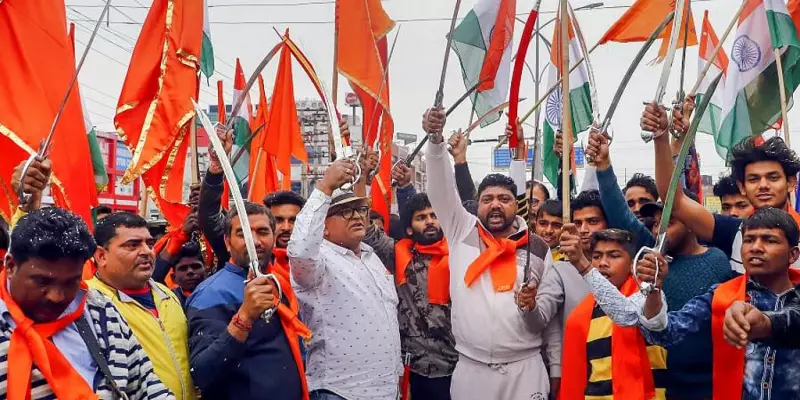
However, a critical test of this strength lies in the state's willingness to uphold its most fundamental duty: maintaining the monopoly on lawful force. This core principle was challenged starkly at the close of December 2025. Members of the Hindu Raksha Dal (HRD) became the subjects of a widely circulated video from Ghaziabad. In the footage, they were seen distributing swords (talwars) and openly calling for violence against minority communities, thereby cultivating an atmosphere of intimidation and fear.
The HRD is not a banned organization, though its members reportedly face numerous criminal charges. In the video, the activists addressed the camera with evident assurance, seemingly confident in their political backing. Following public outrage, police made several arrests in connection with the incident. Notably, the national president of the HRD, Pinky Chaudhary, remained at large as of early January 2026.

Selective Application of Law and Political Silence
On the surface, the arrests might suggest the system is working. But this view overlooks a troubling pattern of differential treatment based on politics and identity. Contrast the response to the sword distribution with an event from just three months prior. The UP police arrested individuals for wearing t-shirts bearing the phrase "I Love Muhammad," even slapping charges under the stringent Unlawful Activities (Prevention) Act. Chief Minister Adityanath himself commented that habitual offenders needed "denting and painting."
While a simple display of faith is a constitutional right and poses no threat to state authority, it triggered a severe crackdown. Conversely, when a group with a record of flouting the law openly incites violence and arms citizens, the political condemnation from the state's leadership is conspicuously muted. There is no strong reassurance to citizens that they are protected from extremist groups claiming to represent the majority.
For a government that brands itself as tough on crime, true strength would be demonstrated by impartially prosecuting and punishing anyone, irrespective of their community or political links, who incites violence and distributes weapons. Strength is not demonstrated by power used only against the vulnerable or by retreating from a challenge perceived to come from within one's own ideological sphere. That is not strength; it is bullying.
The Cost of Strategic Silence and Mixed Signals
A cynical argument might defend this silence as political realpolitik—avoiding alienation of the core voter base. However, this short-sighted approach can backfire, as seen in recent events. Prime Minister Narendra Modi's attendance at a Christmas Mass in Delhi, a gesture potentially aimed at showcasing harmony, was largely overshadowed and its sincerity questioned.
This was because it coincided with a series of attacks on Christmas celebrations, an alleged assault on a Christian woman by a BJP leader in Jabalpur, and an official silence from top leadership on these incidents. The mixed messaging rendered the PM's outreach vulnerable to accusations of hypocrisy, seen by many as a cynical signal to international observers or voters in Kerala.

A genuinely strong government would have publicly condemned such attacks and made it unequivocally clear that vigilante groups—including those wearing saffron—cannot be allowed to usurp the state's authority. As the ruling dispensation urges citizens to shed a "colonial mindset," it must also dismantle a modern-day zamindari system in law and order, where lumpen elements operate their own fiefdoms with implied consent. Continued silence in the face of their actions is dangerously close to endorsement.